.png)

.png)
Artificial Intelligence has already delivered significant value across industries. Traditional AI models have helped organizations improve forecasting, detect fraud, automate repetitive tasks, personalize customer experiences, and generate insights from large volumes of data.
However, as customer expectations grow, organizations are looking to shift beyond purely rule-based approaches. They increasingly need AI that can help complete work across real operational environments, where tasks span multiple systems, teams, business rules, and approvals.
That is where the next phase of AI adoption begins. Enterprises are moving toward systems that combine intelligence with orchestration, contextual decision-making, automation, and human collaboration. Rather than replacing existing AI investments, this approach builds on them to create more connected and outcome-driven operations.
In this blog, let’s understand what Agentic AI is and how it works in Pega.
Agentic AI understands task context, suggests the next best action, and makes automated decisions, adapting to changing situations with minimal human intervention. It interacts with the required tools and data to achieve the pre-determined goal independently. Since Agentic AI represents an advanced level of intelligence, it offers numerous benefits, some of which are listed below.
Faster Process Completion: By reducing delays between decisions and actions, agentic AI can accelerate workflows such as customer service, onboarding, and complex case resolution.
Less Manual Effort: Routine coordination tasks, repetitive follow-ups, routing, and data gathering can be automated, allowing employees to focus on higher-value work.
Better Decision Consistency: Since Agentic AI learns continuously from experience and leverages business rules to standardize decisions across large volumes of cases or requests.
Improved Customer Experience: Faster resolutions, proactive communication, and smoother journeys can lead to stronger customer satisfaction and loyalty.
Measurable ROI From AI Initiatives: Because agentic AI can be applied directly to operational workflows, organizations can track outcomes such as reduced resolution times, lower service costs, and higher customer retention.
Similar to how advanced cybersecurity systems learn from attack patterns rather than relying solely on predefined rules, agentic AI continuously evolves and adapts to changing conditions.
Agentic AI in Pega is not a standalone chatbot or isolated AI, unlike standard chatbots that only respond to queries. Pega's agentic AI uses reasoning and planning to complete multi-step tasks, such as resolving customer claims or managing fraud detection.
At its core, agentic AI in Pega is tightly integrated with case context, business rules, and enterprise data. It continuously evaluates the state of a case, identifies the desired outcome, and determines the sequence of actions required to achieve it.
For example, in a fraud detection scenario, instead of simply flagging a suspicious transaction, the agent can initiate a full investigation workflow, retrieving transaction history, validating anomalies, triggering risk assessments, and escalating the case if needed.
AI Embedded Inside Operational Workflows
Pega combines agentic intelligence with its existing strengths in workflow automation, case management, real-time decisioning, and low-code application architecture. Real-time decisioning allows the system to evaluate live context and recommend the best next action instantly.
Case-Centric Agentic Execution
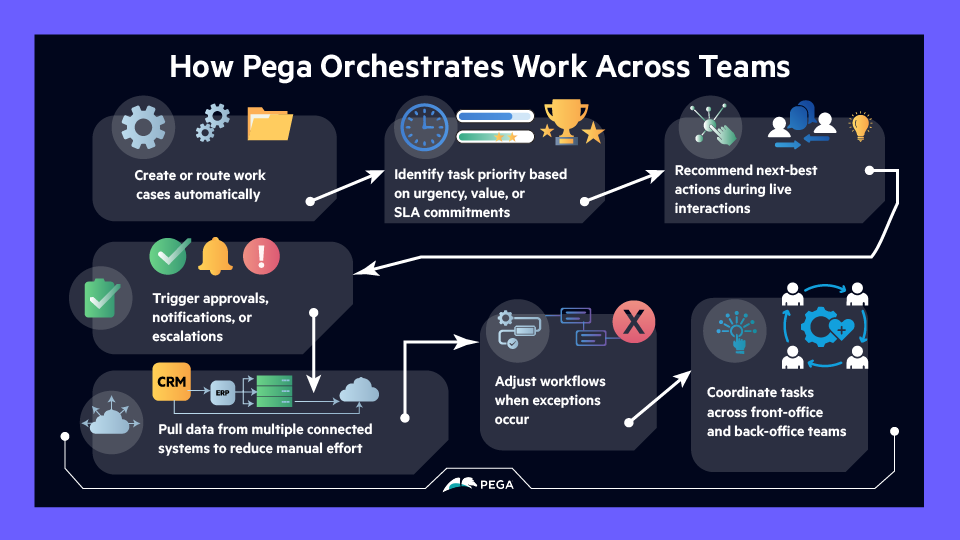
A major advantage of Pega is its case management foundation. Enterprise work often revolves around resolving cases rather than isolated tasks. Agentic AI becomes more valuable when it can manage an end-to-end case lifecycle. For example, in a payment investigation, AI can gather transaction data, classify the issue, assign ownership, trigger outreach, monitor deadlines, and recommend resolution steps. In customer service, it can analyze intent, open the right case type, guide the agent, and coordinate fulfillment actions behind the scenes. This case-centric model is what turns AI from an assistant into an operational participant.
Workflow Design
Pega uses AI agents to accelerate the creation and improvement of workflows. By applying proven design patterns and operational best practices, organizations can build new processes faster, simplify existing journeys, and reduce time spent on manual process modeling.
AI-Powered Decisioning
Agentic AI in Pega combines real-time data, case context, and business rules to help determine the most effective next action. This enables intelligent routing, automated approvals, prioritization, and straight-through processing where appropriate.
Task Optimization
Pega applies Agentic AI to monitor and improve how workflows are managed throughout the business. It can identify friction points, reduce bottlenecks, and streamline multi-step processes to improve overall performance.
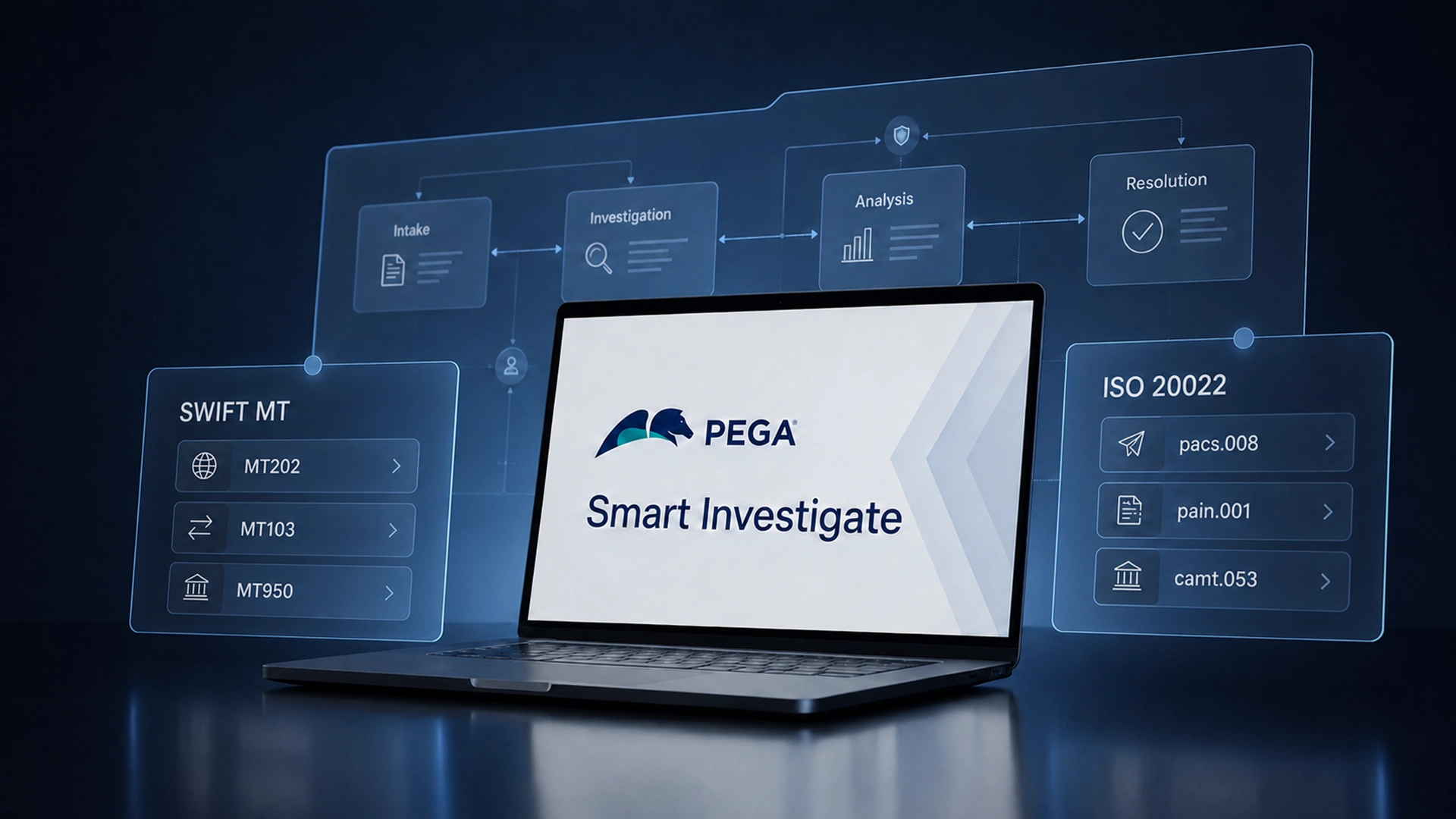
Banks and payment providers handle delayed transfers, failed payments, missing funds, reconciliation issues, and cross-border payment exceptions. These investigations are often time-sensitive and involve multiple internal and external parties.
With Pega, agentic AI can:
AI is entering a new phase where business value comes from action, not just insight. As enterprises look to simplify complex operations, improve service experiences, and scale more efficiently, agentic AI offers a more practical path forward.
EvonSys enables organizations to scale Pega’s AI capabilities across operations, driving measurable results from initial deployments to full enterprise transformation.
Explore how Pega can work for your business.

.png)


.png)