

.png)

.png)
Technology no longer sits on the horizon. It is already shaping how businesses operate, compete, and grow.
From agentic AI to extended reality, each advancement aims to automate manual tasks. What was once a complete manual workflow is gradually evolving into fully automated processes. In a recent study, McKinsey reported that 76% of the organizations have started using AI in some capacity.
But now the real question is: are you keeping up with recent advancements in AI, such as hyperautomation, agentic AI, and more? Are you limited to AI alone, or are you exploring advancements in other areas like cloud, cybersecurity, and more?
In this blog, we explore a few digital transformation trends that are streamlining workflows in every possible way.
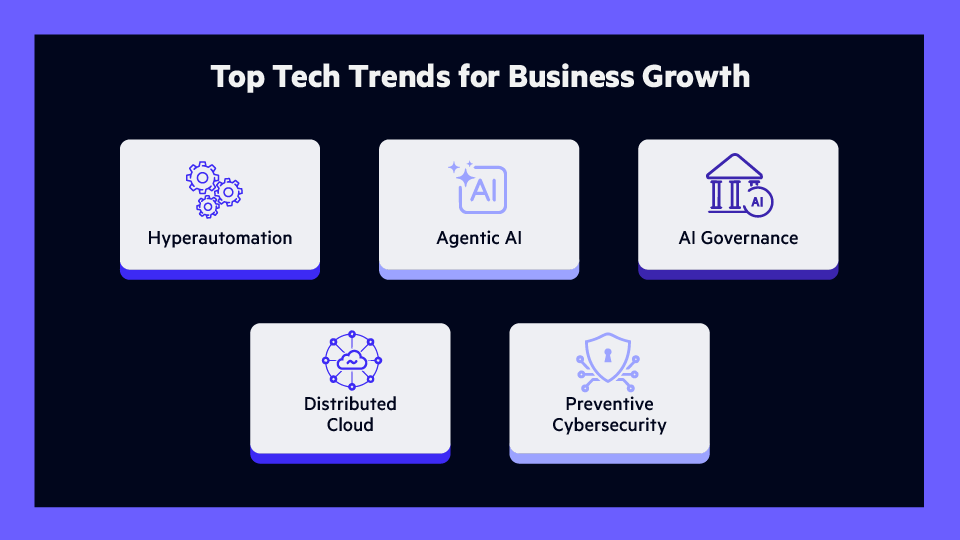
AI has been around for decades and has paved the way for hyperautomation. Hyperautomation, a digital transformation trend, enables organizations to move beyond simple task automation to end-to-end process automation, completing tasks more easily with less manual intervention.
This approach combines technologies such as AI, RPA, digital process automation, and process mining, with low-code. Low-code helps accelerate the development of automation solutions with minimal coding.
For instance, when hyperautomation is applied to a loan approval process, this is how it works:
In the traditional process, when a customer submits a loan application, a bank officer must manually review it to verify eligibility and ensure compliance with documentation requirements. Lenders manually check the applicant's credit rating. A bank representative may perform a physical visit to the applicant's home or workplace to verify residential and employment details. Final approval must be obtained after every manual step, which can overwhelm employees.
In hyperautomation, process and task mining tools act as the starting point. They analyze system logs and user interactions to identify inefficiencies in manual processing, visualize existing processes, and identify optimal opportunities for automation. Based on these insights, digital process automation (DPA) designs and orchestrates a streamlined end-to-end workflow. With low-code, the loan application is automatically converted into a case that progresses through stages such as document submission, verification, risk assessment, and final approval.
Within this flow, RPA bots handle repetitive rule-based tasks such as extracting customer data from forms, entering it into core banking systems, and cross-checking records across multiple platforms. The bots log into external systems to fetch the credit score and cross-check information across multiple sources.
AI analyzes documents for fraudulent patterns and even predicts credit risk to support decision-making. For unstructured data, AI relies on NLP and OCR to process and convert it into structured data.
A low-code platform allows the bank to quickly build and modify this entire system. Together, these technologies ensure the process is faster, more accurate, and scalable while reducing manual effort and errors.
Finally, once a decision is made, the process reaches its endpoint through execution and closure. If approved, the loan amount is disbursed, and all relevant systems are automatically updated. If rejected, the customer is notified with the appropriate details.
This digital transformation trend represents a maximum automation approach that aims for as close to complete automation as possible. Instead of isolated bots, the orchestration in case management connects RPA, AI, and data from multiple sources into a single, cohesive workflow.
Agentic AI, or autonomous AI, makes decisions and operates independently. It requires limited supervision for complex tasks or case management.
Unlike traditional AI systems, agentic AI systems don’t wait for human intervention, instead, it:
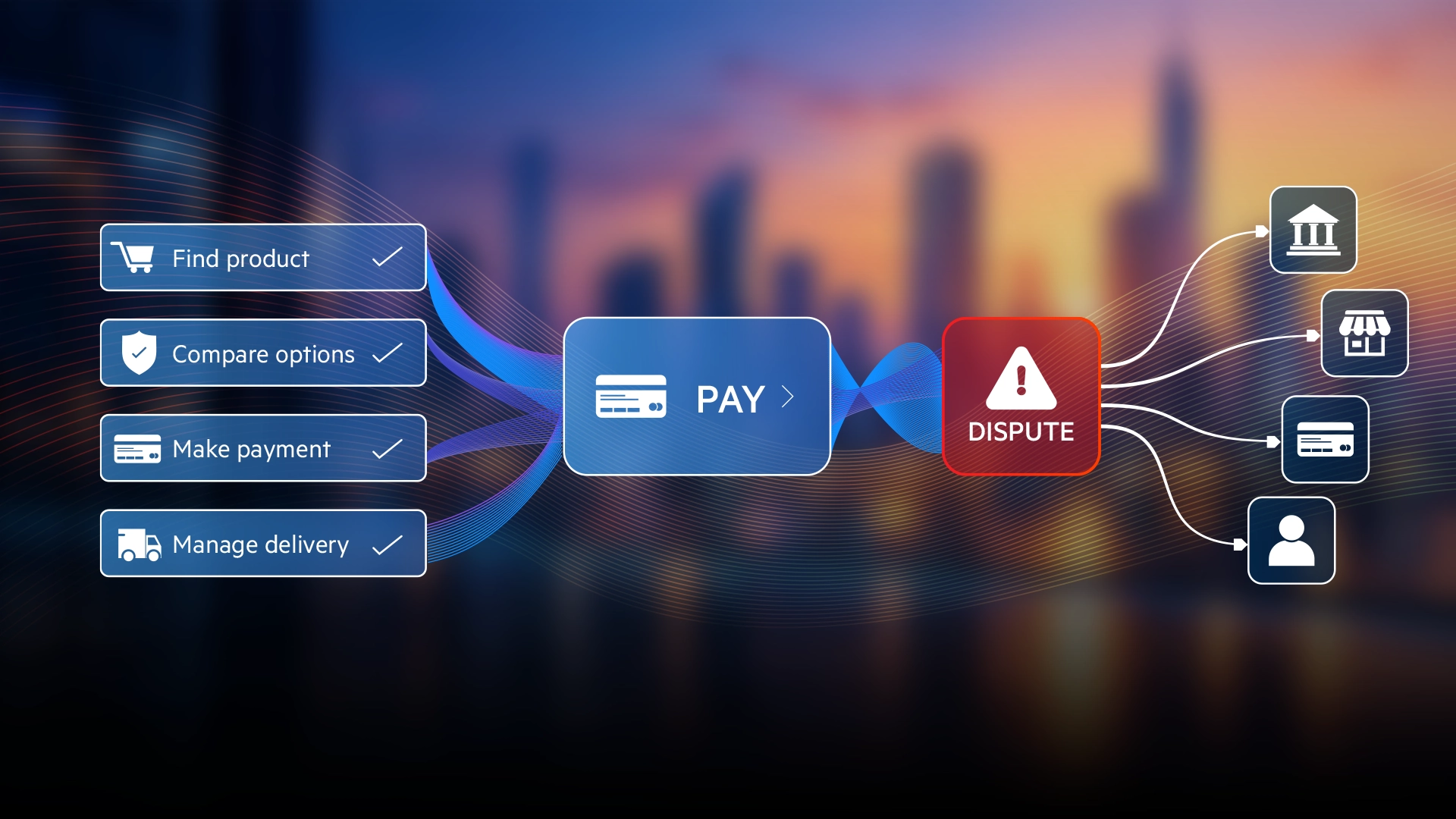
Let us understand how autonomous AI agents help detect fraud in domestic or international payment transactions through investigative intelligence.
Traditional fraud detection systems use AI and pre-defined rules to identify and stop unauthorized activities. It analyzes transaction patterns and detects anomalies based on past fraud patterns. But one major drawback is the high rate of false positives, where legitimate transactions are flagged or blocked. The system lacks context, adaptability, and continuous learning, as it is sensitive to past fraud patterns and cannot handle sudden changes in customer behavior.
Autonomous AI agents are not just trained on past incidents. They learn the complete investigative workflow, right from how experts analyze transaction histories and correlate multiple data points, to make decisions in ambiguous situations.
When a suspicious transaction occurs, it performs a multi-step investigation, including gathering additional data (user behavior, location patterns, transaction history), evaluating risk based on context, and weighing different signals before making a decision. It can also dynamically adjust its approach depending on the scenario.
The result is a system that combines the speed of automation with the depth of human expertise. It reduces unnecessary false alerts while improving detection quality.
Distributed cloud is a form of cloud computing that uses public cloud infrastructure from multiple locations and is emerging as a key part of broader digital transformation trends. Unlike traditional cloud setups that rely on a few centralized data centers, distributed cloud brings computing resources closer to where they are actually needed. This includes different geographic regions, edge locations, or even on-premises environments. This approach improves performance by reducing latency, enhances reliability by providing location-based redundancy, and helps organizations meet data residency and compliance requirements. By combining the scalability of the cloud with the flexibility of distributed infrastructure, businesses can deliver faster, more resilient, and locally optimized digital experiences.
AI has established a strong foundation across every industry, with its unique features and advantages, but its increasing adoption raises governance concerns.
AI governance refers to the framework of policies, processes, and controls that ensure artificial intelligence systems are used responsibly and ethically, in compliance with regulations. As organizations increasingly rely on AI for decision-making, governance helps maintain transparency, accountability, and trust by setting clear guidelines on how models are built, deployed, and monitored. It helps businesses reduce risks such as bias, data misuse, and compliance violations while ensuring consistent and reliable outcomes.
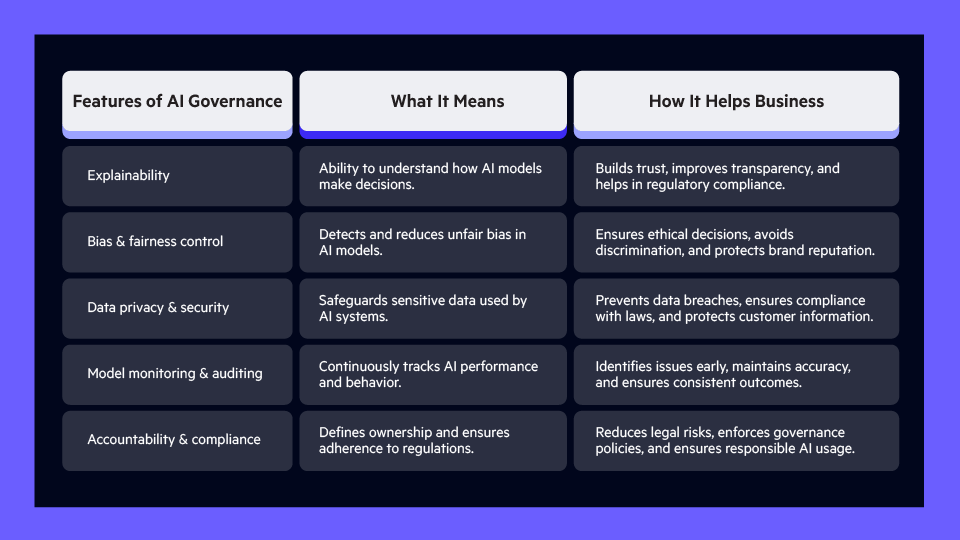
Together, these capabilities enable organizations to scale AI confidently, improve decision quality, meet regulatory requirements, and build trust with customers and stakeholders.
Preventive cybersecurity is a proactive approach to protecting systems, networks, and data by identifying and addressing potential threats before they can cause harm. As part of broader digital transformation trends, this approach shifts the focus from reactive attack response to continuous monitoring and early threat detection. It leverages advanced technologies such as AI and ML to analyze patterns, detect anomalies, and predict potential security breaches in real time.
Preventive cybersecurity practices demonstrate to customers that your organization takes security seriously. This enables you to build trust with customers when sharing data.
For businesses, preventive cybersecurity helps reduce downtime, protect sensitive data, ensure regulatory compliance, and maintain customer trust.
As businesses continue to evolve in an increasingly digital world, staying aligned with emerging and future technology trends is essential for survival and growth.
Organizations that proactively adopt and integrate these digital transformation trends will be better positioned to streamline operations, reduce risks, and deliver enhanced customer experiences. As we move beyond 2026, the real competitive advantage will depend on how effectively businesses combine automation, intelligence, and governance to drive sustainable growth.
Reference:

.png)


.png)





_New%20copy.webp)
