.png)

.png)
Business analysts often receive hundreds of pages of meeting notes, process documents, regulations, and stakeholder feedback. Before a developer writes a single line of code, someone must interpret that information, resolve ambiguities, identify dependencies, and convert it into epics, user stories, and acceptance criteria. This work determines how accurately the product reflects business needs.
AI for business analysis is changing how teams approach this phase. The conversation has moved beyond generating documentation faster. Enterprise teams now want AI that improves consistency, preserves context, and supports human decision-making throughout the requirements lifecycle.
This piece covers what teams do next. Once a delivery lead accepts that the manual process is the bottleneck, three routes open: keep it manual and try to manage the cost, hand it to a generic AI tool, or bring in something built specifically for requirements work. Each route has a real cost attached to it. None of them is free, and the right one depends on what a specific team can afford to spend: time, risk, or setup work.
Modern software projects begin with requirements spread across multiple sources. Analysts piece together scope from workshops, existing documentation, and whatever else the business has generated along the way. Requirements decomposition automation addresses three common issues.
Volume
Enterprise initiatives spread requirements across dozens of documents: workshops, legacy specs, regulatory guidelines, emails, spreadsheets. Decomposing one scope document by hand takes 3 to 5 days. A project with ten documents takes ten times that, and the clock doesn't start on development until it's done.
Consistency
Two analysts working from the same source document produce different backlogs. One flags an edge case, the other misses it. One writes a five-part acceptance criterion, the other writes two lines. Quality depends on who's staffed on the project, not on the document itself.
Traceability
Every user story should connect to a business objective or source requirement. Maintaining that relationship manually becomes increasingly difficult as projects grow. By the time a document has been decomposed, reviewed, and revised twice, tracking which story came from which requirement becomes its own job.
Staying Manual
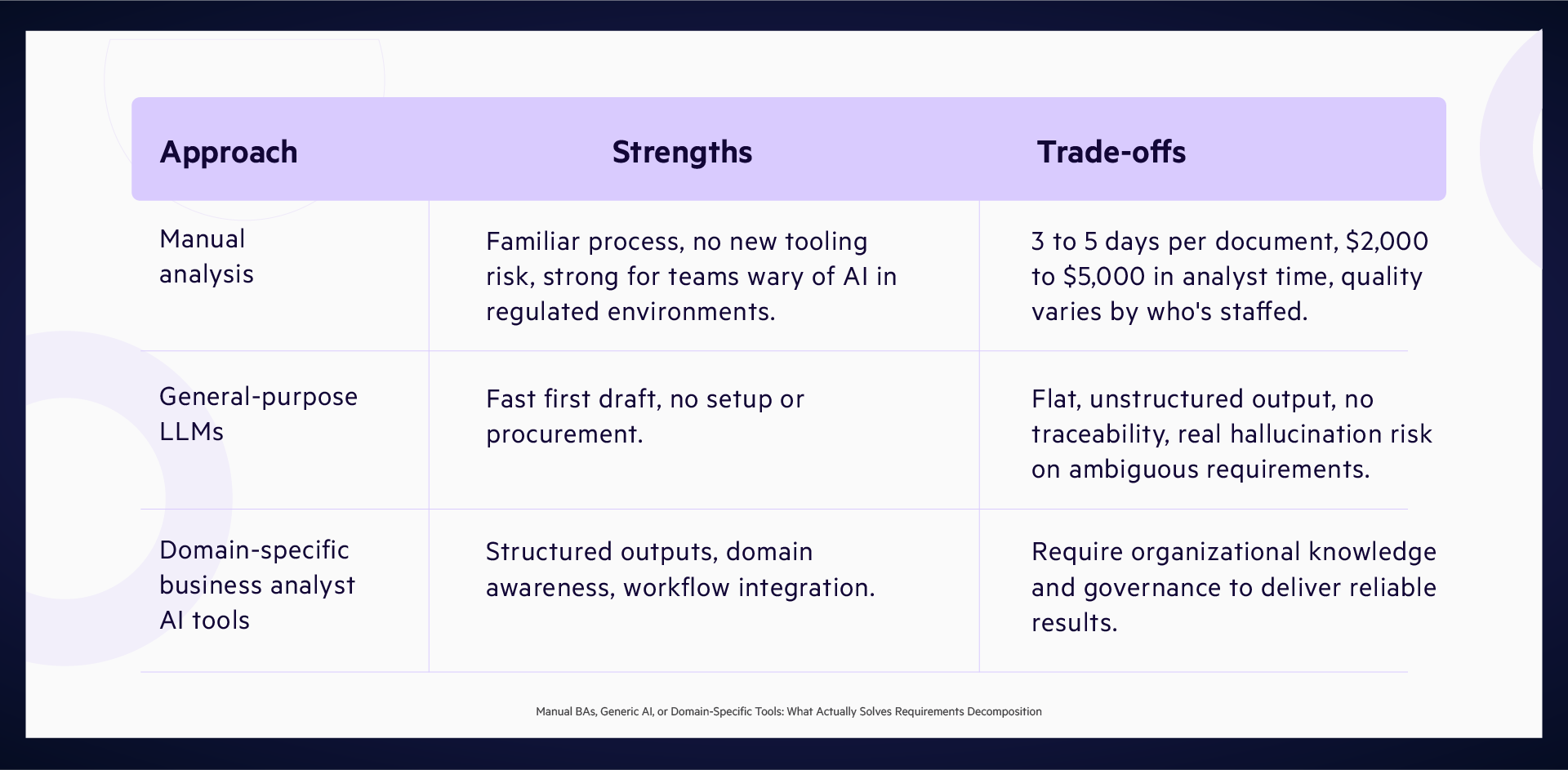
This keeps the process teams already know how to run. No new tool, no new risk, no procurement cycle. But it doesn't solve any of the three problems above. Adding headcount spreads the same 3-to-5-day cycle across more people. The $2,000 to $5,000 cost per document stays the same, just distributed differently.
Generic AI Tools
A chat window turns a document into a first draft in minutes. What comes out is flat text that has paragraphs with no hierarchy, no link back to the source, no structure that matches how Jira or Azure DevOps organize work. Someone still restructures it manually before a sprint can use it. There's also a real hallucination risk. When a document is silent on a requirement, a generic LLM often fills the gap with something plausible rather than flagging it, which is a serious problem on a compliance-heavy document.
Domain-specific AI Tools
EvonSys' Story Studio is one example. Instead of a single prompt and a single response, the process runs in stages: upload, context setting, epic generation, feature decomposition, story generation, review, export. Each stage includes a human review gate, so an analyst checks the epic before it becomes features and checks the features before they become stories.
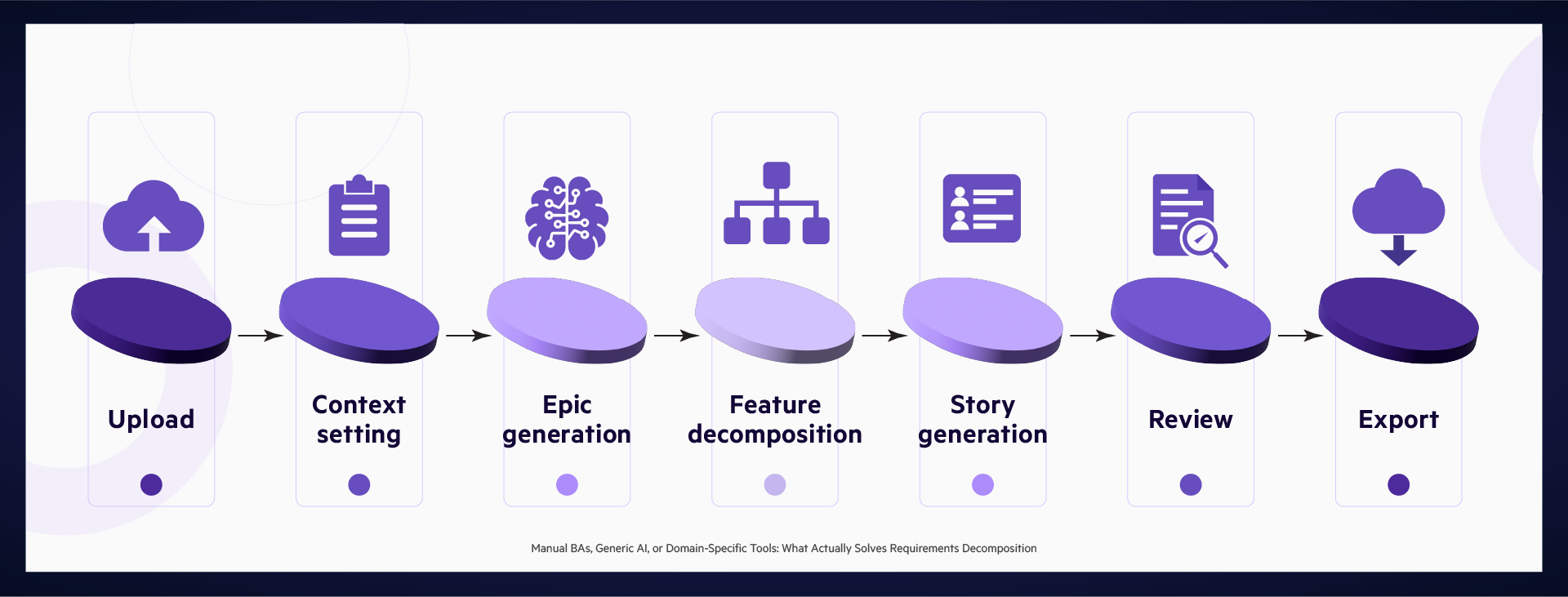
Comparing the Three Approaches
There is no single approach to applying AI in business analysis. Each methodology solves a different part of the problem.
What Good AI Support Looks Like
Organizations evaluating business analyst AI tools often compare features first. A better approach is to evaluate how AI supports the work of business analysis itself.
1. Context preservation
Business rules, dependencies, assumptions, and exceptions have to stay connected as a document moves from raw text to structured backlog. A staged pipeline, where each step builds on the last, keeps that context intact in a way a single prompt-and-response exchange doesn't.
2. Traceability
Look for a tool that shows its work, not just a final answer. Story Studio's approach is to mark a requirement as "TBD" when the source document doesn't cover it, rather than generating an invented detail. That's a different mechanism than a link back to a source paragraph: it tells the analyst exactly where the document runs out, before a missing requirement turns into an assumption baked into a user story.
3. Domain understanding
Enterprise projects carry industry-specific terms and regulatory language that a generic AI may not understand consistently. A domain-specific tool detects the type of project, financial services, healthcare, Pega implementation, and adjusts accordingly, without needing the same context re-explained in every prompt.
4. Human review
The goal of requirements decomposition automation is fewer hours spent on mechanical formatting, not fewer decisions made by analysts. BAs continue to validate priorities, resolve ambiguities, and make business decisions while AI handles repetitive documentation tasks.
5. Enterprise workflow integration
Requirements eventually move into delivery platforms such as Jira, SharePoint, or Azure DevOps. An AI tool becomes more useful when it supports existing delivery processes instead of creating another disconnected workspace.
Story Studio addresses the problem of volume, consistency and traceability through a specific mechanism.
Speed at the document level
The staged pipeline, upload through export, turns a 3-to-5-day manual process into a matter of minutes, without skipping the structure a document needs to become a usable backlog.
Domain-matched output
Auto-detection means the tool recognizes whether a document is financial services, healthcare, or a Pega implementation, and applies the correct personas and regulatory language automatically. A junior analyst working the same document as a senior one gets output shaped by the same domain logic, not by whoever happens to be staffed that week.
Built-in guardrails
Anti-hallucination checks run through the entire pipeline, not as a single check at the end. Every generated item traces back to a specific part of the source document. Where the source is silent, the system marks that item "TBD" instead of inventing an answer.
Knowledge that compounds
Each project run through Story Studio adds to a central knowledge base, capturing the domain patterns and edge cases a senior analyst would otherwise carry around in their own head. That's what EvonSys calls the Knowledge Flywheel. Tribal knowledge that used to leave with a departing analyst now stays inside the system, where each new project draws on what every earlier one added.
Choosing What Fits
Requirements decomposition doesn't have one fix. Manual decomposition keeps a process that teams already trust and understand. It also keeps the 3 to 5 day cycle and the $2,000 to $5,000 per document cost, no matter how many people are added to the work.
Generic AI tools cut that time down but hand back flat, unstructured text with a real risk of invented requirements. Domain-specific tools like Story Studio, ask for setup time in exchange for structure: a staged pipeline, a fixed hierarchy, and a visible record of where a source document stops giving answers.
The right choice is not about which route is fastest or cheapest on paper. It's about which cost, time, quality risk, or setup work, your team is positioned to absorb, and which of the original problems, speed, consistency, or traceability, is costing you the most right now.
Have questions about applying Story Studio to your projects?

.png)


.png)