

.png)

.png)

Cross-border payments have become considerably faster. With advances in payment infrastructure, ISO 20022 adoption, and Swift gpi, financial institutions can move and track funds with greater speed and visibility than ever before. Yet when a payment requires investigation, resolving the issue can still take six to eight days.
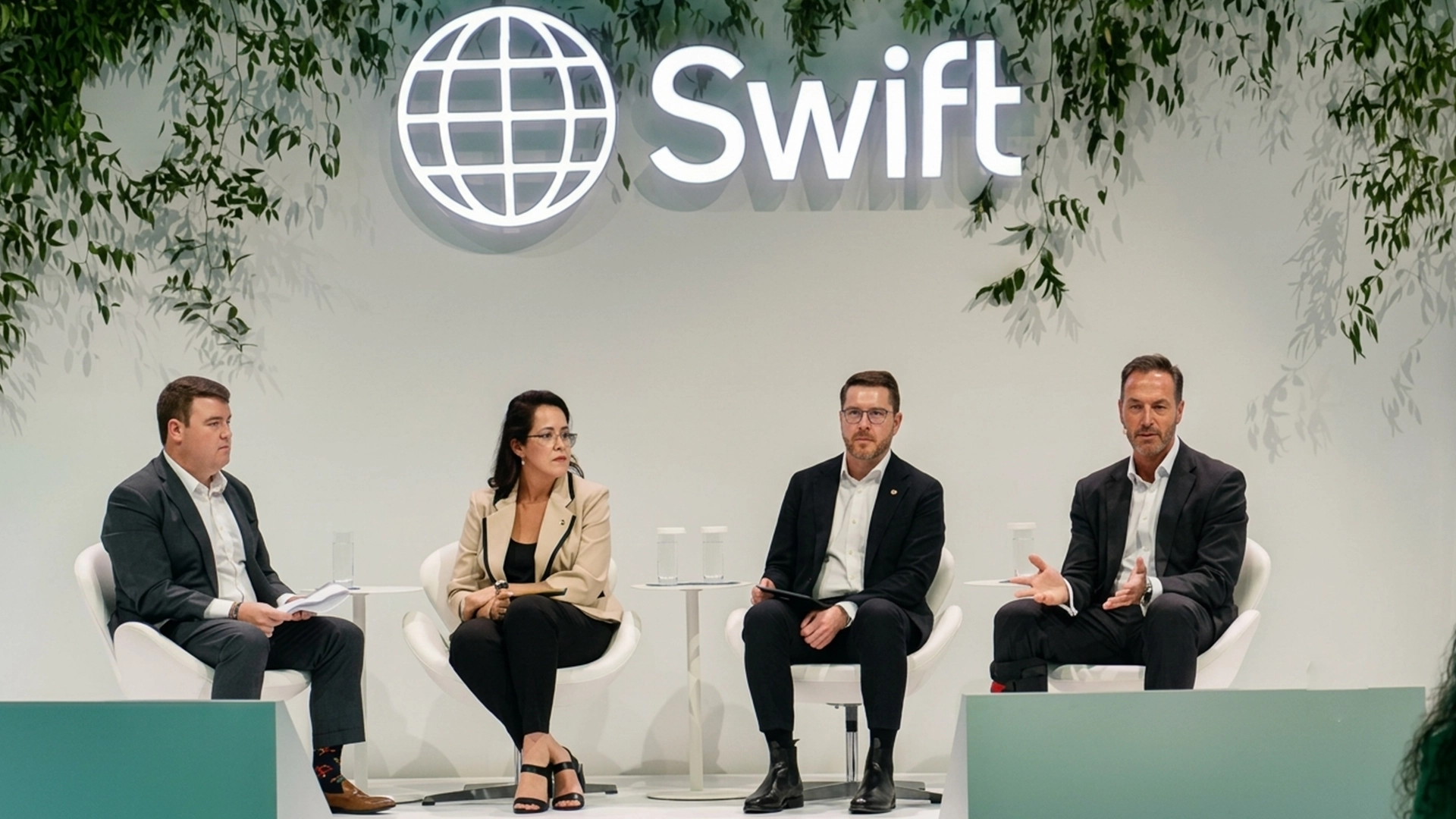
This disparity was at the centre of a discussion at Sibos 2026 in Miami, where industry leaders examined how banks can move beyond fragmented investigation processes toward more structured, coordinated case management.
The session, “From Exception to Opportunity: How Case Management Can Further Accelerate Payments,” was moderated by Edward Brady from Swift and brought together Andy Elliott, Vice President of Product Strategy at EvonSys; Larize Nel, Head of Swift & External Payment Gateways at Absa Group; and Tom Simpson, Global Head of Currency Clearing at HSBC.
Their discussion explored the operational challenges behind payment investigations, the lessons emerging from early adoption, and the opportunities that structured case management presents beyond meeting industry mandates.
While payment execution has benefited from years of modernization, the processes used to investigate exceptions have evolved more slowly.
An estimated 1% to 3% of cross-border payments require some form of manual payment investigation. These cases frequently depend on free-format MT199 messages, manual intervention, and communication across multiple institutions.
Unlike the payment itself, which may be completed within seconds or minutes, an investigation can move sequentially through correspondent banking relationships, accumulating delays as each institution identifies the request, researches the transaction, and prepares a response.
As Andy Elliott explained during the session, the problem extends beyond the technology used to exchange messages. Differences in operating procedures, terminology, case ownership, and service expectations can make investigations difficult to coordinate across institutions.
The financial implications are substantial. Industry estimates place the annual operational cost of payment investigations at approximately $1.6 billion. Beyond the direct expense of manual processing, prolonged investigations can affect customer service, operational capacity, and the visibility banks can provide into unresolved transactions.
Swift's move toward structured case management seeks to address these inefficiencies by establishing a more consistent framework for exchanging investigation requests and responses.
But as the Sibos discussion demonstrated, the benefits depend on more than adopting a new messaging format.
Two perspectives from the session illustrated how the industry is approaching the operational changes required for structured case management.
At HSBC, the emphasis has been on directing investigation cases to the teams best positioned to resolve them.
Tom Simpson highlighted the inefficiencies that arise when cases pass through multiple queues before reaching the appropriate team. Improving case assignment and reducing unnecessary handoffs can materially affect the time required to investigate and resolve an issue.
HSBC reported achieving a reduction of up to 60% in average resolution time through the application of these case management principles.
The result demonstrates the potential value of improving how investigations are routed and managed, rather than relying exclusively on faster message exchange.
Absa Group's experience brought a complementary perspective.
Larize Nel emphasized that migrating to structured case management also requires banks to examine the processes surrounding their existing investigation workflows.
The transition provides an opportunity to identify legacy practices that no longer serve a useful purpose, remove unnecessary steps, and determine which activities should be supported through the new messaging framework.
Improved case visibility is another important consideration. Through Swift's Case Management interface, investigation teams can track case status, monitor elapsed time, identify outstanding responses, and manage follow-ups within a more structured environment.
For banks, the question is no longer confined to how investigation messages are exchanged. It also concerns how effectively an inquiry moves from initiation to resolution.
The move to Swift Case Management establishes an important foundation for more standardized investigation processes. However, financial institutions differ considerably in their transaction volumes, technology environments, and operational requirements.
This distinction formed part of Andy Elliott's contribution to the Sibos discussion.
Large global banks may have the resources and transaction volumes to justify highly customized investigation platforms. Institutions processing fewer inquiries may be able to manage their requirements through the native Swift Case Management interface.
Between these approaches are banks handling substantial investigation volumes that require a greater degree of automation without necessarily undertaking a large-scale, bespoke implementation.
For these institutions, the challenge is to connect structured messaging with the capabilities needed to manage investigation workloads efficiently, including case routing, workflow automation, tracking, and integration with existing payment operations.
Elliott discussed how SaaS-based investigation solutions can address these requirements while supporting Swift Case Management and Stop and Recall processes across multiple payment channels.
The larger consideration is one of operational fit. Compliance with industry messaging requirements provides the starting point, but the level of automation needed to deliver meaningful efficiency gains will depend on each bank's investigation volumes, processes, and existing infrastructure.
Structured case management also creates opportunities that extend beyond the immediate transition from legacy investigation messages.
One area explored during the session was the potential to bring different types of payment investigations into a more unified operating environment.
As banks adopt common messaging structures and case management processes, there is scope to improve coordination across cross-border and domestic payment channels, reduce fragmented workflows, and develop a more consistent investigation experience.
The availability of structured case information could also support greater use of intelligent automation.
For example, AI-enabled capabilities may eventually assist with routine status requests, information gathering, case analysis, and identifying the next appropriate action. This could allow investigation teams to devote more attention to complex cases requiring specialist judgment.
Greater integration with payment tracking and pre-payment validation capabilities presents another opportunity. By connecting investigation processes with information available across the payment lifecycle, banks may be able to identify issues earlier, provide more timely updates, and reduce avoidable investigative work.
These developments remain dependent on the maturity of the underlying processes, data, and integration capabilities. Nevertheless, they suggest that the longer-term value of structured case management may extend well beyond replacing free-format messages.
The discussion at Sibos 2026 reinforced an important distinction between meeting the requirements of payment modernization and realizing its operational benefits.
Swift's Exceptions and Investigations transformation provides the industry with a framework for more structured communication and coordinated case handling. For banks, the opportunity lies in using that foundation to improve the way investigations are initiated, routed, monitored, and resolved.
HSBC's reported improvement in resolution times offers an indication of what more effective case management can achieve. Absa's experience highlights the importance of reviewing established operating practices rather than simply transferring them to new messaging standards.
Together with the perspectives shared by EvonSys and Swift, these observations point toward a common direction for the industry: payment investigations need to become more integrated, transparent, and responsive to the expectations created by faster payments.
As payment infrastructure continues to evolve, the quality of the payment experience will increasingly depend on what happens when a transaction requires attention, not only on how quickly it can be processed.
Explore a more efficient approach to payment investigations
Discover how EvonSys helps financial institutions modernize payment investigations through structured case management, workflow automation, and integration with existing payment operations.

.png)


.png)





_New%20copy.webp)
