.png)

.png)

For most digital commerce, the path between a customer’s intent and a payment has been relatively direct. Someone decides to make a purchase, authenticates themselves or their payment method, and the transaction is completed. If that transaction is later challenged, the dispute process works backwards through what happened: who initiated it, how it was authenticated, what the merchant can demonstrate, what the customer claims, and which rules apply.
The systems around that process have become considerably more sophisticated. Fraud controls have improved. Authentication has become stronger. Networks have created increasingly detailed rules around evidence, liability and chargebacks. Dispute platforms have become better at automating the work required to reach a resolution.
But the relationship between intent and execution has largely remained easy to locate. Somewhere close to the transaction sits a person who decided to proceed.
Agentic commerce begins to put some distance between the two.
A customer may no longer choose a specific product, merchant and transaction and then approve the purchase. Instead, they may give an AI agent a goal, a budget and a set of preferences, leaving the agent to interpret those instructions, evaluate alternatives and transact on their behalf.
The payment may still be authorized. The more difficult question is beginning to emerge one step earlier: what, exactly, was authorized?
Consumers have long allowed other people or systems to act on their behalf. Supplementary cardholders make purchases against a shared account. Businesses give employees purchasing authority within defined limits. Recurring payments allow merchants to initiate transactions after an initial agreement. Procurement platforms automate parts of purchasing without requiring someone to approve every individual step.
The payment system has learned to accommodate these arrangements because the boundaries of the delegation are usually relatively clear. A cardholder has access to an account. A merchant has permission to collect an agreed payment. An employee can purchase within an established policy. The execution may be delegated, but the underlying instruction remains reasonably explicit.
Agentic commerce introduces a different kind of delegation.
Instead of telling a system to execute a predetermined transaction, a customer may give it an objective and allow it to determine how that objective should be achieved. Find the most suitable flight within a budget. Replenish supplies when stock falls below a threshold. Renew a service if the new terms remain acceptable. Compare several products and purchase the one that best matches a set of preferences.
That distinction matters because the agent now sits between the customer’s intention and the eventual transaction. It may interpret preferences, weigh alternatives, respond to changing conditions and make decisions the customer never explicitly reviewed.
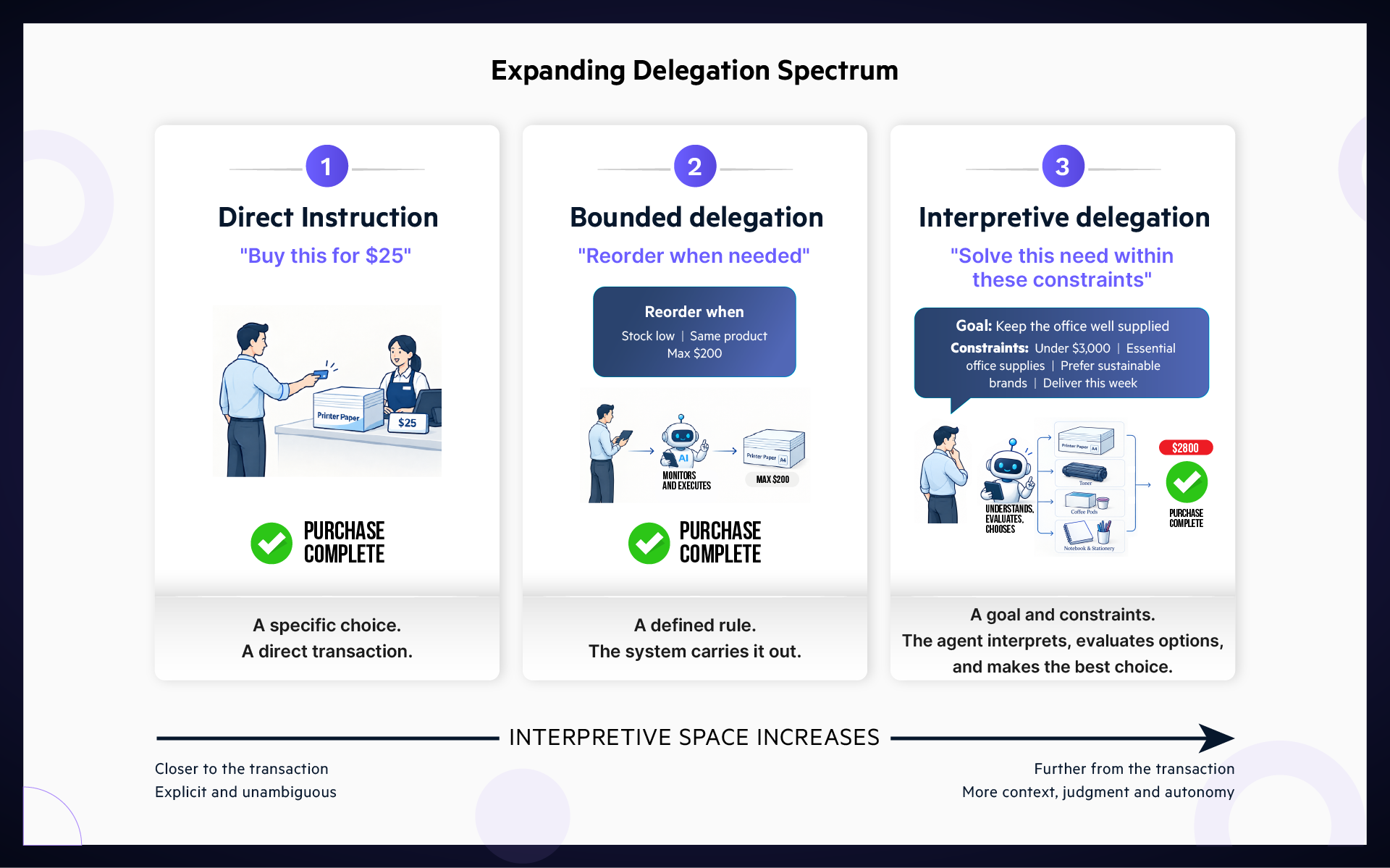
That interpretive layer introduces a distinction that payment systems have not always needed to make explicit.
A transaction can be authenticated correctly. The agent executing it can have legitimate authority to act. The payment itself can satisfy the technical requirements for authorization. Yet none of those things necessarily answers whether the resulting transaction remained within what the customer intended.
Consider the difference between asking an agent to buy a specific flight and asking it to arrange a trip within a budget and a set of preferences. In the first case, the instruction and the transaction sit close together. In the second, the agent has room to interpret what matters, weigh competing conditions and decide which compromises are acceptable.
That creates three related, but increasingly distinct, questions.
In conventional payment journeys, those questions often converge closely enough that the distinction carries little practical consequence. In delegated commerce, they may not.
An agent could act within a valid payment credential and still make a choice the customer later considers outside the mandate they provided. The issue would no longer be simply whether the transaction was authorized in the traditional sense. The more difficult question would be whether the authority granted to the agent extended to the decision it ultimately made.
This is where delegated commerce begins to become a dispute problem.
If authorization and intent can diverge, resolving a challenged transaction may require more than confirming who or what initiated the payment. It may require understanding the authority under which the decision was made in the first place.
Once that distinction enters a dispute, the evidence needed to understand the transaction may begin to change.
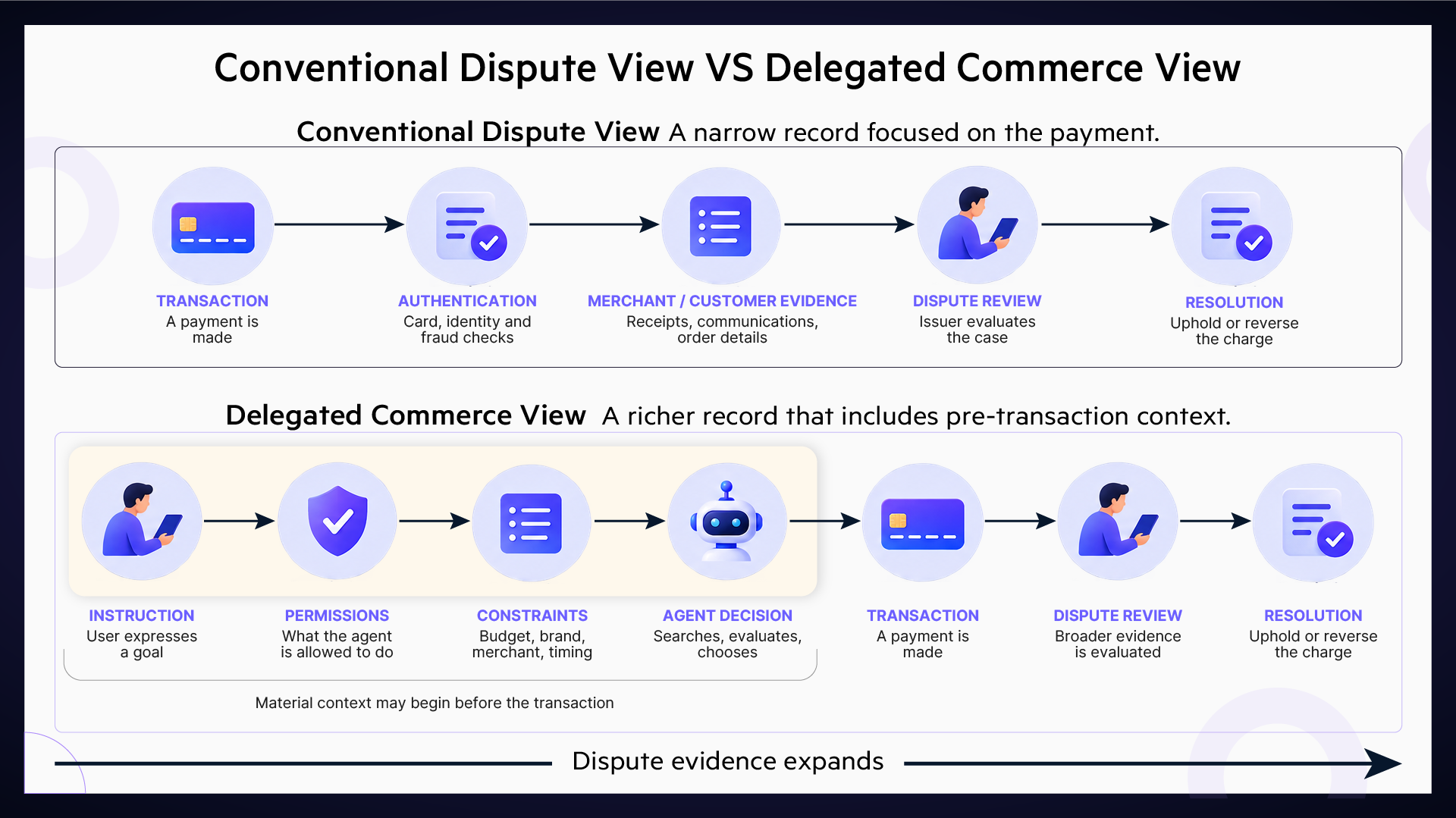
A conventional dispute investigation can often work backwards from the payment itself. Transaction records, authentication data, merchant evidence, customer statements and applicable network rules help establish what happened and how the case should be resolved.
In delegated commerce, the relevant story may begin earlier.
A transaction could be the final result of a series of decisions made within a broader instruction. The customer may have defined a budget, preferences, exclusions or limits. The agent may then have compared alternatives, interpreted those conditions and selected a course of action without returning to the customer for approval at every step.
If the resulting payment is challenged, confirming that the agent had permission to transact may answer only part of the question. The dispute may also depend on what permission was granted, what constraints surrounded it and whether the decision remained within those boundaries.
The evidentiary trail could therefore extend beyond the transaction itself to include the instruction that initiated the activity, the permissions attached to it and the decisions that connected one to the other.
This does not mean every agent-initiated transaction will require a reconstruction of the entire decision path. Many disputes will continue to be resolved through familiar evidence and established rules. But where the disagreement concerns whether an agent exceeded or misinterpreted its mandate, the context preceding the payment could become material to the outcome.
The dispute record, in other words, may increasingly need to explain not only what happened, but how the transaction came to happen.
The payments ecosystem is already beginning to address this problem at the point where authority is delegated.
The significance goes beyond securing an agent-initiated payment. It suggests that evidence of a transaction may increasingly be created before the transaction itself.
That changes what could become available to a dispute operation. Instead of relying primarily on evidence generated at or after payment, an institution may also be able to establish the mandate under which the transaction occurred: what the customer asked for, what authority was granted, which constraints applied, and how the eventual purchase related to those instructions.
This does not mean retaining every conversation, prompt or intermediate decision an agent makes. That would create its own problems around privacy, data volumes and relevance. The challenge will be determining which parts of the delegation are material and preserving them in a form that can be verified without unnecessarily exposing the customer’s broader interaction with the agent.
For dispute operations, this raises an important architectural question. If payment ecosystems begin producing new forms of verifiable intent and delegated authority, can the dispute environment ingest that evidence, interpret it alongside existing transaction and merchant data, and determine when it materially changes the case?
The evidence model may be moving upstream. Dispute operations will need to be able to follow it.
The arrival of richer evidence does not mean every dispute should become a forensic reconstruction of an agent’s decision-making.
Most disputes will continue to be resolved through familiar mechanisms. Transaction data, merchant records, authentication signals, customer statements and established network rules will remain sufficient for a large share of cases. In many situations, the fact that an agent initiated the transaction may have little bearing on the outcome.
The important shift is not that every case becomes more complex. It is that some cases may require a different level of context.
That puts greater emphasis on the dispute operation’s ability to distinguish between the two.
Where the facts are clear and the applicable rules are straightforward, additional evidence should not slow the process down. But where the dispute turns on whether an agent acted within the scope of its mandate, the system may need to identify that ambiguity early and bring the relevant context into the case.
This creates a different automation challenge. The objective is no longer simply to push more disputes through a straight-through path. It is to determine which disputes can be resolved with confidence using existing evidence, which require additional context, and which should move to human review.
In that sense, delegated commerce does not necessarily make payment dispute management more complicated across the board. It makes the ability to recognize complexity more important.
The mature dispute operation will be the one that can keep routine cases routine while knowing when the transaction alone no longer tells enough of the story.
For years, dispute modernization has focused on a familiar set of objectives: faster resolution, greater straight-through processing, better customer self-service, stronger compliance, and less manual effort.
Those priorities remain valid. But delegated commerce introduces another requirement that may become equally important: adaptability.
If the evidence surrounding a transaction changes, dispute operations need to be able to absorb new sources of context. If network rules evolve to account for delegated authority, the decision logic must evolve with them. If new payment types introduce different forms of authentication, liability or customer interaction, those differences need to be accommodated without rebuilding the operating model around each one.
That makes the underlying architecture increasingly important.
A dispute environment designed primarily around fixed workflows and familiar evidence may perform efficiently until the nature of the transaction changes. A more adaptable model separates the enduring parts of dispute management from the elements that will continue to evolve: payment type, evidence source, applicable rules, decision criteria and the level of human intervention required.
Delegated commerce makes this distinction more visible because it introduces a new layer of context around the payment. But the principle extends beyond AI agents. Payment ecosystems will continue to change, and every new form of commerce will bring its own questions about identity, authority, evidence and liability.
Modernization, then, cannot be measured only by how efficiently today’s disputes are processed. It also depends on how easily the operation can absorb tomorrow’s evidence, rules and transaction models without losing consistency or control.
In that sense, adaptability becomes less of a technical preference and more of an operating requirement.
AI already has an obvious role in dispute operations: reducing manual work, extracting information, classifying cases and helping move straightforward disputes toward resolution more quickly.
Delegated commerce points to a second role that may become more important.
If disputes begin to draw on a wider evidentiary trail, the challenge will not simply be processing more information. It will be determining which information matters, how different pieces of evidence relate to one another, and whether the available context is sufficient to support a decision.
That is where AI can add value beyond task automation.
It can help assemble relevant evidence from multiple sources, identify gaps in the record, compare an agent’s action against the permissions or constraints attached to it, and surface cases where the available facts remain ambiguous. In routine situations, that context may support greater automation. In more complex cases, it can help ensure that human reviewers are looking at the right evidence rather than reconstructing the entire journey manually.
The distinction is important.
As dispute evidence becomes broader and more distributed, the value of intelligence may lie less in making every decision autonomously and more in helping the operation understand what happened, why it happened, and where uncertainty still remains.
That would represent a meaningful evolution in how AI is used in payment dispute management: from accelerating the case to strengthening the understanding behind the case.
This is where the design of the dispute platform begins to matter.
The challenge is not to build a separate operating model for agentic commerce. It is to create a dispute environment capable of absorbing new forms of evidence, new decision criteria and new payment behaviors as they emerge.
That places a premium on orchestration.
A modern dispute platform needs to bring together transaction data, customer information, network rules, supporting evidence and decision logic without hardwiring the entire process around a single payment type or evidentiary model. As delegated commerce develops, additional sources of context may simply become another part of that environment.
Pega Smart Dispute reflects this broader approach. Its value lies less in any single automation capability than in the ability to orchestrate dispute processes across payment types, rules, evidence and human intervention while allowing those elements to evolve independently.
Again, that distinction matters.
No institution can know today exactly how agentic commerce will ultimately reshape dispute rules, liability models or evidence requirements. Networks, regulators, merchants and issuers are still working through those questions. Designing around a fixed answer would therefore be premature.
The more durable response is to build for change itself.
A dispute operation that can incorporate new evidence sources, adjust decisioning, apply evolving rules and change where human judgment enters the process will be better positioned for delegated commerce than one optimized only for the transaction models it already knows.
The question is not whether every future dispute will look fundamentally different. It is whether the operating model can adapt when some of them do.
For most payment disputes, authorization has been a practical anchor because the person, credential and transaction have remained closely connected. Delegated commerce begins to loosen that connection.
As AI agents take on more responsibility for interpreting instructions and acting within defined boundaries, the question behind a disputed transaction may become more nuanced. It may no longer be enough to establish that an authorized agent made the payment. In some cases, the dispute may depend on whether the action remained within the authority and intent that were delegated in the first place.
That does not make existing dispute models irrelevant. Nor does it mean every agent-initiated transaction will require a new framework. It does mean that the evidence surrounding a payment may begin to carry more weight than the payment event alone.
The institutions best prepared for that shift will not necessarily be those trying to predict every rule that agentic commerce will introduce. They will be the ones able to absorb new evidence, adapt decisioning and distinguish routine cases from those where the underlying mandate itself becomes part of the dispute.
Delegated commerce may ultimately change many things about payments. The implications of agentic commerce for payments could be particularly significant for dispute operations, where one of the most important shifts may be the growing distance between permission to transact and the intent behind the transaction.
Understanding that distance may become central to understanding the dispute.

.png)


.png)




_New%20copy.webp)