.png)

.png)

When the financial community gathers in Miami for Sibos 2026, artificial intelligence will be hard to avoid.
That much is clear from the event theme, Digital finance for AI-driven economies. But look more closely at the program and a more interesting story begins to emerge.
The industry's attention appears to be shifting from introducing new technologies and standards to making them work together in real operating environments.
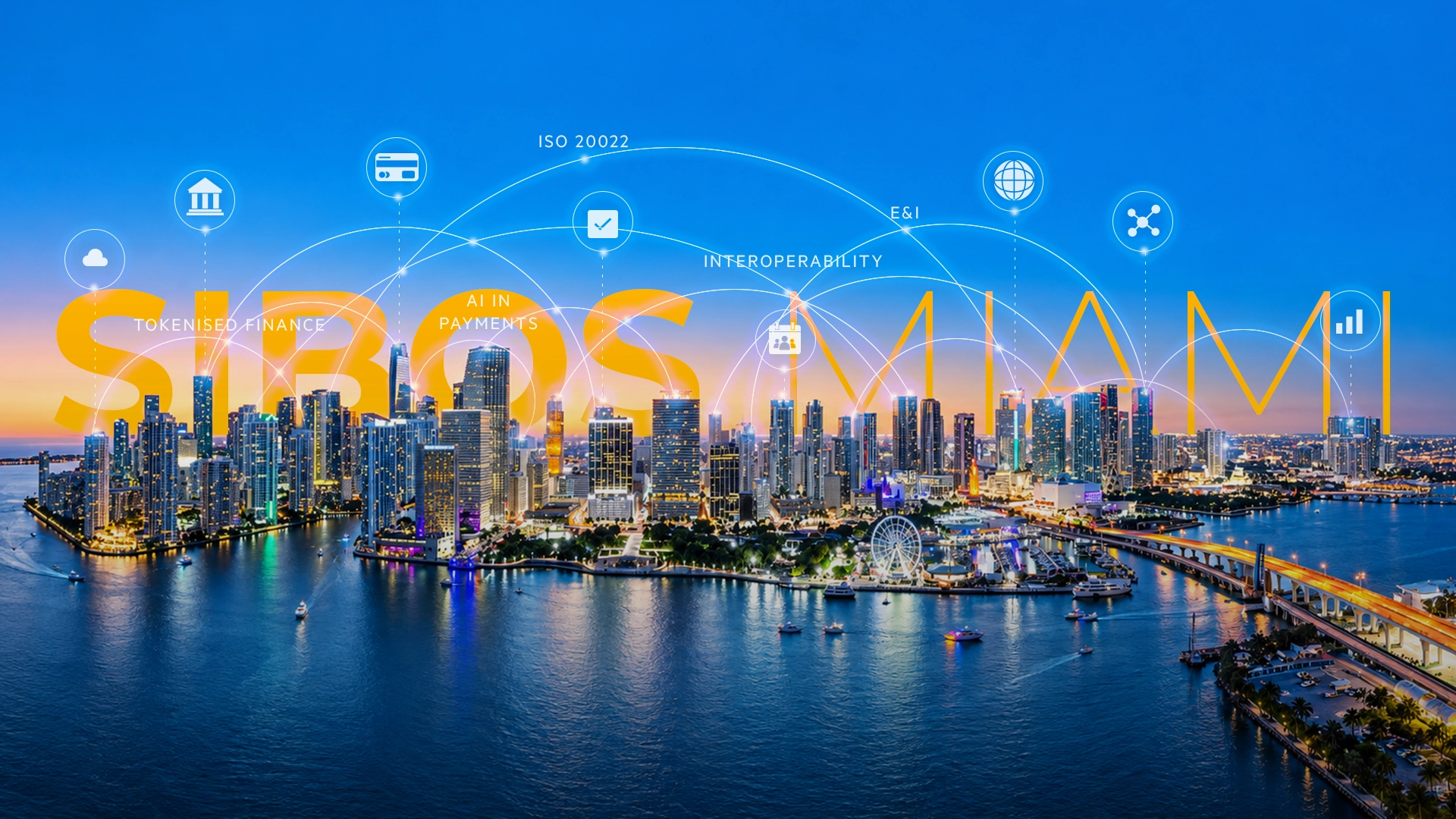
Dates: September 28 – October 1, 2026
Location: Miami Beach Convention Center, Miami, Florida, USA
Theme: "Digital finance for AI-driven economies"
Scale: 250+ sessions, 500+ speakers
Tracks: Payments, securities, trade, digital assets, regulation, resilience
ISO 20022 is moving beyond its biggest migration milestone. AI is getting closer to payment workflows. Tokenized money is moving from theory towards infrastructure. Cross-border payment initiatives are confronting the difficulty of connecting different systems. And as payment processing becomes faster, the parts of the journey that remain slow or manual are becoming harder to ignore.
For payments leaders, five conversations are likely to be particularly revealing.
For several years, much of the ISO 20022 conversation centered on migration.
That conversation is changing.
Following the end of coexistence for cross-border payment instructions in November 2025, more than 98% of payment instructions on Swift were being sent in ISO 20022 format by August 2026. The question is increasingly moving from whether institutions can process the standard to what they can do with the richer, more structured information it provides.
The Sibos program reflects that change. Sessions are looking beyond migration towards data quality, interoperability, AI-assisted use of structured information and the business value institutions can derive from ISO 20022.
That distinction matters.
Structured data creates the possibility of better reconciliation, more effective screening, improved routing and greater automation. None of those benefits arrives simply because the message format has changed. Banks still have to preserve the information through their systems and redesign processes capable of using it.
In that sense, ISO 20022's next phase may prove less about standards implementation and more about operating-model implementation.
AI at previous industry conferences could often feel like a conversation occurring around financial infrastructure rather than inside it.
That boundary is becoming less clear.
One Sibos 2026 session asks what a blueprint for agentic payments might look like, including the potential for AI agents to participate in payment processing. Others examine the use of AI to improve ISO 20022 data quality and the controls required when AI translates between financial standards and other data models.
That suggests a useful change in the debate.
The interesting question is no longer simply whether banks will use AI. Many already do.
It is where institutions are prepared to allow AI to act, what decisions remain human, how those boundaries are governed, and how the resulting activity can be explained and audited.
Payments provide a particularly demanding test. Speed matters, but so do certainty, accountability and control.
If Sibos 2026 tells us anything about the maturity of agentic finance, it may be through how much of the conversation moves away from demonstrations and towards those operating questions.
Cross-border payments have become substantially faster. Swift says 90% of transactions on its network now reach the destination bank within an hour.
When something goes wrong, however, the experience can look very different.
Swift's research with financial institutions found that payment investigations can take five to ten working days to resolve and estimated that inefficient investigation processes cost the industry more than $1.6 billion annually.
That gap between a faster payment and a comparatively slow investigation is one reason Exceptions and Investigations deserves attention in Miami.
The next ISO 20022 milestone for E&I arrives shortly after Sibos.
Swift's Case Orchestrator changes more than the message itself. It introduces central orchestration, structured requests and responses, end-to-end investigation references, automated checks and smarter routing of investigations to the institution best positioned to respond.
The operational question for banks is therefore larger than message readiness.
If new data and orchestration enter an investigation process that still depends heavily on manual extraction, disconnected systems and repeated handoffs, how much has really changed?
Expect that distinction between technical compliance and operational redesign to become increasingly important.
For years, speed dominated the cross-border payments discussion.
Speed still matters, but the industry now has multiple domestic instant-payment infrastructures, new cross-border schemes, APIs, digital-asset networks and emerging forms of money developing at the same time.
That creates another problem: connecting them.
Several Sibos sessions focus explicitly on interoperability, including connections between domestic and cross-border payment ecosystems and the challenge of improving end-to-end visibility across different infrastructures. Swift is also using the event to demonstrate scheme payments across corridors including Brazil to the United States and Europe to India.
The significance goes beyond individual corridors.
The industry may increasingly find that creating another fast payment mechanism is easier than creating an experience that remains predictable as value crosses institutions, networks and jurisdictions.
That makes standards, common references, visibility and orchestration less glamorous than a new rail, but potentially more consequential.
Digital assets are another area where the tone is changing.
The question is gradually moving from whether tokenization can work towards whether it can work across the existing financial system.
Sibos sessions this year cover tokenized deposits, stablecoins, CBDCs, tokenized assets and Swift's developing shared ledger. But interoperability appears repeatedly in those discussions too.
That is revealing.
Tokenization can create new ways to represent and move value. It can also create another layer of platforms, standards and settlement models that institutions have to connect.
The challenge for the industry will therefore be to gain the advantages of programmable and tokenized finance without recreating the fragmentation it has spent years trying to remove from conventional payments.
The eventual winners may not necessarily be the organizations that create the most novel infrastructure, but those that make new and existing forms of value work together.
AI, ISO 20022, payment investigations, cross-border interoperability and tokenized money can look like separate topics on a conference agenda.
They are increasingly connected by the same underlying problem.
Financial institutions have more data, more infrastructure and more ways to automate than they did a few years ago. They also operate across a growing number of systems, standards and networks.
The next phase of payments modernization is therefore unlikely to be defined simply by introducing another technology.
It will depend on whether institutions can connect what they already have, use the information moving through those systems more intelligently, automate without losing control and reduce the friction that remains when transactions do not follow the happy path.
That is what makes Sibos 2026 worth watching.
The most revealing conversations in Miami may not be about what the industry intends to build next.
They may be about whether everything it has already built can finally begin to work together.
Supports the event dates, theme, program scale and the broader discussion across payments, AI, digital assets, regulation and resilience.
Sibos 2026 Conference Programme
Primary reference for the sessions and themes discussed throughout the article, including agentic payments, ISO 20022, Exceptions and Investigations, interoperability and digital assets.
Supports the shift beyond the main CBPR+ payment migration milestone and the evolving role of structured data in investigations.
Transforming Exceptions and Investigations
Supports the current ISO 20022 adoption context and the distinction between the broader migration and the more recent adjustment to Standards Release 2026 payments changes.
Swift Standards Release 2026 update
Supports the November 2026 and November 2027 milestones for camt.110, camt.111, Case Management and the eventual end of in-flow translation for Exceptions and Investigations.
Swift ISO 20022 Exceptions and Investigations roadmap
Supports the role of Case Management and Case Orchestrator in structured investigation workflows, central orchestration and routing.
Provides further detail on Case Orchestrator, investigation references, validation, routing and structured camt.110/camt.111 exchanges.
Swift Case Orchestrator overview
Supports the comparison between faster cross-border payment processing and slower investigation resolution, including the five-to-ten-working-day investigation timeframe and estimated industry costs.
Swift research on payment investigation costs
Additional source for the broader Sibos 2026 discussion around AI, tokenization, interoperability and evolving financial infrastructure.
Swift on Sibos 2026 and AI-driven economies
Supports the discussion of Swift's shared-ledger work and its broader exploration of interoperability across emerging forms of digital value.
Provides additional context around AI readiness, operational resilience, cybersecurity and the wider technology themes shaping this year's event.
Sibos 2026 Conference at a Glance
The concluding observations in this article represent an editorial interpretation of these developments and the Sibos 2026 program rather than statements attributed directly to Sibos or Swift.
_New%20copy.webp)

.png)


.png)