.png)

.png)
As businesses reassess how they operate, compete, and grow, the real advantage lies in understanding not just what is changing, but why it matters. Business leaders today are navigating a landscape shaped by shifting customer expectations, increasing operational complexity, evolving regulations, and rapid advances in technology. The organizations that succeed will not necessarily be those that adopt every new innovation first, but those that can evaluate, govern, and scale change with confidence.
Artificial intelligence sits at the center of many of these conversations. Once viewed primarily as a tool for efficiency and automation, AI is increasingly influencing decisions that affect customers, employees, risk management, and business performance. As its role expands, so do the expectations placed upon it. Leaders are no longer asking only whether AI can generate outcomes, but whether those outcomes can be trusted, explained, and aligned with organizational objectives.
This shift is driving growing interest in approaches such as Responsible AI, Agentic AI, and Predictable AI. While conventional AI can deliver speed and intelligence, it can also introduce challenges around transparency, accountability, and governance. For organizations operating in highly regulated or customer-centric environments, these concerns are becoming strategic business considerations rather than technical issues. In this blog, we examine the trust challenges associated with conventional AI and explore why Predictable AI is gaining attention as a way to bring greater confidence and control to AI-driven decision-making.
Gartner forecasts global AI spending will exceed $2 trillion in 2026. Organizations are increasingly investing in AI-powered workflows and automation. It has become a key driver of business transformation, helping organizations automate processes, improve decision-making, and enhance customer experiences. AI is increasingly embedded in critical business operations.
However, as AI adoption grows, so does a significant challenge: understanding how AI arrives at its decisions. This creates a trust challenge for organizations using conversational AI.
Many AI models operate as “black boxes,” producing recommendations, predictions, or actions without providing clear insight into their reasoning. While the output may appear accurate, business leaders, employees, and stakeholders often have limited insight into the factors that influenced the outcome.
For instance, an AI system may recommend prioritizing one customer request over another, flag a transaction for potential fraud, or suggest a specific business action. These suggestions may not always be accurate and often raise important questions:
Without sufficient visibility and control, organizations may struggle to manage risk, maintain compliance, and build trust in AI-powered processes. As a result, overcoming the AI black box problem is becoming a priority for enterprises seeking to scale AI adoption responsibly.
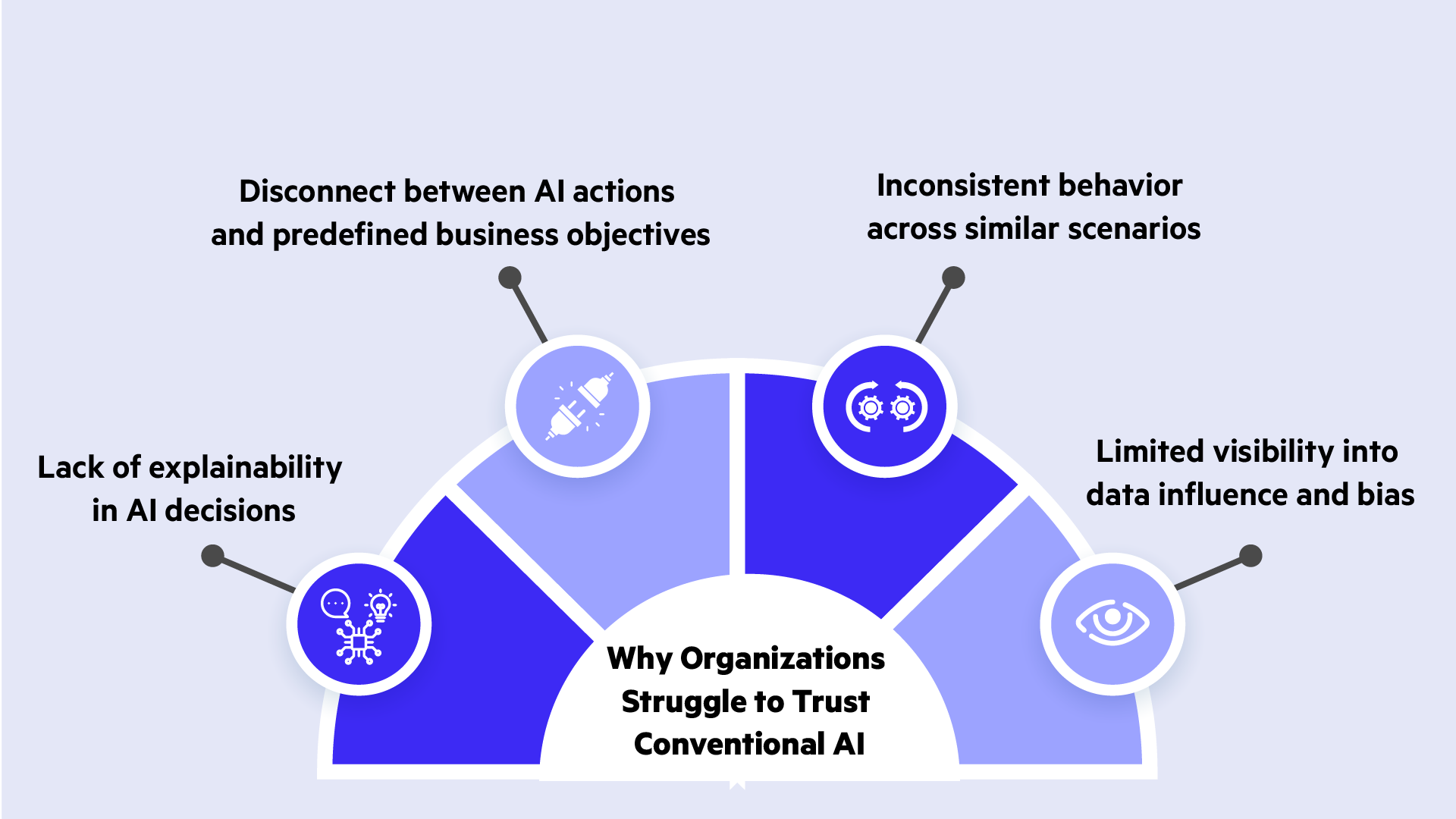
Lack of explainability in AI decisions
One of the most critical aspects of the AI trust challenge is the inability of conventional AI systems to clearly explain how they make decisions. While these models can process vast amounts of data and generate accurate predictions, they often fail to provide transparency into the reasoning behind those outputs. This creates a fundamental problem: organizations are expected to trust and act on decisions they cannot fully interpret or justify.
For enterprise AI solutions to scale effectively in such environments, explainability is a core factor.
Without it, organizations face not only customer distrust but also legal, compliance, and reputational risks. In highly regulated sectors like banking, every AI-driven decision must be traceable and defensible. Without visibility into how outcomes are derived, AI becomes a liability rather than a strategic advantage.
Disconnect between AI actions and predefined business objectives
Another critical dimension of the AI trust challenge is the gap between what AI systems optimize for and what businesses actually require. Conventional AI models are designed to identify patterns and maximize statistical outcomes based on historical data, not to inherently understand business policies, regulatory frameworks, or operational constraints. This often leads to decisions that are technically accurate but contextually incorrect.
Inconsistent behavior across similar scenarios
While AI models are designed to generalize from data, even minor variations in input can lead to significantly different outputs. This lack of consistency creates uncertainty for business users who expect standardized and repeatable decision-making.
Limited visibility into data influence and bias
A critical yet often underestimated aspect of the AI trust challenge is the lack of visibility into how different data points influence AI-driven decisions. While AI models rely heavily on historical data to generate predictions, organizations often lack insight into which variables carry the most weight or how certain patterns are interpreted. This makes it difficult to detect hidden biases, data imbalances, or unintended correlations.
This challenge becomes even more significant when organizations encounter scenarios that fall outside historical patterns. Popularized by Nassim Taleb, the Black Swan theory highlights how rare and unexpected events can have a disproportionate impact, even though they are absent from historical observations. Because AI models learn from past data, they can struggle to recognize or appropriately respond to situations that differ significantly from what they have previously encountered. Without transparency into decision-making logic, organizations may have limited ability to identify these blind spots until they affect customers, operations, or business outcomes.
As a result, organizations are increasingly seeking AI solutions that provide greater transparency into decision-making and the factors that influence outcomes.
Predictable AI helps organizations move beyond intelligent recommendations by ensuring that AI-driven decisions and actions comply with established business policies, workflows, and governance requirements. Using statistical analysis and machine learning, Predictable AI assesses system behavior and safety.
As organizations embed AI deeper into their core operations, the question is no longer whether AI works, but whether it can be trusted to work consistently, transparently, and in alignment with business intent.
Predictable AI represents a fundamental shift in how enterprises approach AI adoption. It moves beyond performance metrics and accuracy scores to focus on reliability, governance, and explainability. By ensuring that AI systems operate within defined boundaries and produce consistent, auditable outcomes, organizations can transform AI from a black box into a strategic asset.

.png)


.png)