.png)

.png)
AI has become a core component of enterprise operations. Enterprises are increasingly implementing AI to automate processes, improve customer experiences, enhance decision-making, and uncover new business opportunities. The productivity gains are real and measurable.
For example, payment investigations have traditionally required operations teams to manually review transaction details, compare payment messages, identify exceptions, and coordinate with multiple stakeholders before determining the next course of action. Today, AI can analyze payment data, identify similar historical cases, recommend the most appropriate investigative path, and assist caseworkers with relevant insights. This enables investigators to resolve cases faster while improving consistency across investigations.
While AI can automate decisions, generate insights, and improve operational efficiency, it does not inherently understand business context, organizational policies, or ethical considerations. Those responsibilities remain with the enterprise.
This is where enterprise AI challenges begin to surface. These gaps do not stem from the technology itself, but from the mismatch between how quickly AI is being deployed and how slowly governance keeps pace.
Teams deploy AI to solve immediate operational problems, but without clearly defined policies, oversight, and accountability, organizations can struggle to understand how AI makes decisions, who is responsible for those outcomes, and how to address issues as they arise.
The challenge becomes even greater as organizations scale AI across the enterprise:
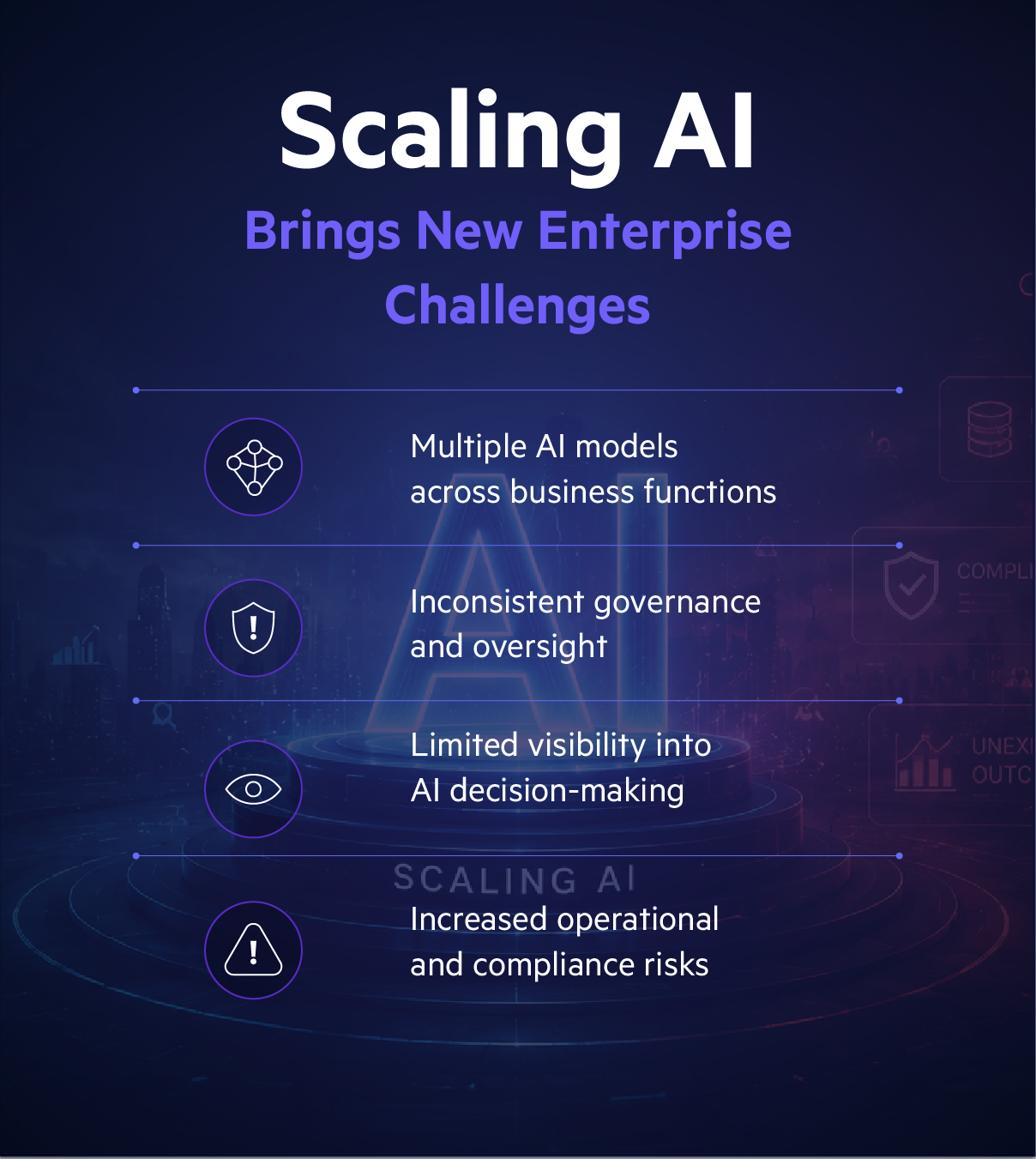
AI learns from the data it is trained on. While this enables AI to identify patterns and make predictions at scale, it also means that AI systems can inherit the limitations, inconsistencies, and historical biases present in that data. If these issues are not identified and addressed, AI may reinforce existing patterns rather than produce fair and objective outcomes.
Consider a bank that uses AI to evaluate loan applications. If the model is trained primarily on historical lending data where certain customer segments were approved more frequently than others, the AI may learn those historical patterns as indicators of lower risk. As a result, applicants with similar financial profiles may receive different recommendations based on patterns embedded in the training data rather than their actual creditworthiness.
Although the AI is following the data it has learned from, the outcome may unintentionally reinforce existing biases rather than evaluate each application fairly.
As AI becomes increasingly involved in business decisions, compliance is no longer limited to meeting industry regulations through manual processes. Organizations must also demonstrate that their AI systems operate transparently, consistently, and in accordance with evolving regulatory expectations. Without proper governance, compliance can quickly become one of the most significant challenges for enterprise AI.
Many industries, including banking, insurance, and healthcare, operate under strict regulatory frameworks that require organizations to justify decisions, maintain audit trails, protect sensitive customer data, and have accountability.
For example, a bank may use AI to prioritize suspicious payment transactions for investigation. If the AI consistently assigns risk scores without recording the factors that influenced its recommendations, compliance teams may struggle to explain why one transaction was investigated while another was not. During an internal audit or regulatory review, the absence of traceable decision-making can make it difficult to demonstrate that the process was fair, consistent, and aligned with established policies.
As AI becomes more involved in business-critical decisions, generating accurate outcomes is no longer enough. Organizations also need to understand how those outcomes were reached. Explainability refers to the ability to interpret, justify, and communicate the reasoning behind an AI-generated recommendation or decision. Without this level of transparency, it becomes difficult for employees, customers, and regulators to trust AI-driven processes.
Many modern AI models can process vast amounts of information and identify complex patterns that are difficult for humans to detect. However, some of these models provide little visibility into how they arrived at a particular conclusion.
Consider a bank that uses AI to recommend whether a payment should be flagged for further investigation. The AI identifies a transaction as high risk, but the investigator cannot determine which transaction attributes, behavioral patterns, or risk indicators influenced the recommendation. Without a clear explanation, the investigator may either accept the recommendation without sufficient validation or spend additional time manually reviewing the case to justify the decision.
In both situations, the intended efficiency gains are reduced, while confidence in the AI system gradually declines. Building explainability into AI systems enables organizations to understand, validate, and confidently act on AI-generated insights.
The challenges surrounding AI are no longer about the technology itself but about how it is designed, deployed, and governed. As AI becomes increasingly embedded in enterprise operations, organizations need a structured approach to ensure that AI systems remain trustworthy, transparent, and aligned with business objectives. This is where Responsible AI becomes essential.
Responsible AI is the practice of developing, deploying, and managing AI systems in a way that promotes fairness, accountability, transparency, security, and human oversight throughout the AI lifecycle. Rather than treating governance as a checkpoint before deployment, Responsible AI embeds these principles into every stage of AI adoption.
The AI challenges enterprises face today are driven not solely by technological complexity but also by the need to ensure AI continues to operate reliably as it evolves. Addressing these challenges requires a long-term approach that balances innovation with responsible decision-making, enabling enterprises to scale AI confidently while minimizing Enterprise AI risks.

.png)


.png)