.png)

.png)
Hyperautomation is more than a collection of technologies. Rather than automating isolated tasks, it brings together multiple technologies to streamline and orchestrate end-to-end business processes. Its success depends on how these components work together to connect systems, data, people, and workflows while supporting business objectives. Understanding the technologies that power hyperautomation and the frameworks that guide implementation is essential for organizations looking to maximize their value.
To explore the operational challenges that make traditional automation fall short and how hyperautomation connects systems, processes, data, and people, read our previous blog.
In this blog, we'll explore the core components of hyperautomation, the DAOG (Discover, Automate, Orchestrate, Govern) framework, and review practical banking use cases to understand how organizations are applying hyperautomation to transform business operations.
Hyperautomation is a comprehensive approach to automating as many tasks as possible across business workflows. To understand how hyperautomation works, it is important to identify its core components and how they interact.
Process Mining - Successful hyperautomation starts with understanding workflows across the organization. Process mining helps businesses gain that visibility by analyzing process data across systems and identifying how tasks are executed. It helps organizations discover bottlenecks, inefficiencies, and process variations that impact performance. This enables teams to identify automation opportunities that can deliver the greatest operational value. Beyond initial implementation, process mining supports continuous improvement.
Robotic Process Automation - RPA acts as the foundational engine within hyperautomation, enabling organizations to automate high-volume, rule-based tasks with speed and accuracy. It operates as a key component within a broader ecosystem of advanced technologies, including AI, machine learning, process mining, and intelligent document processing. When combined with AI capabilities, RPA can extend beyond structured data to process unstructured information and documents effectively. Organizations can deploy both attended and unattended bots across departments, integrating them seamlessly with enterprise systems such as ERP, CRM, and BPM platforms.
AI – AI serves as the intelligence layer in hyperautomation, enabling systems to go beyond rule-based execution and make context-aware decisions. By incorporating AI, hyperautomation systems can understand, learn, and make informed decisions. Within a hyperautomation framework, AI technologies such as machine learning, natural language processing, and computer vision empower systems to interpret unstructured data, recognize patterns, and adapt over time. This allows organizations to automate processes that traditionally required human judgment, such as customer sentiment analysis, document classification, fraud detection, and predictive decision-making.
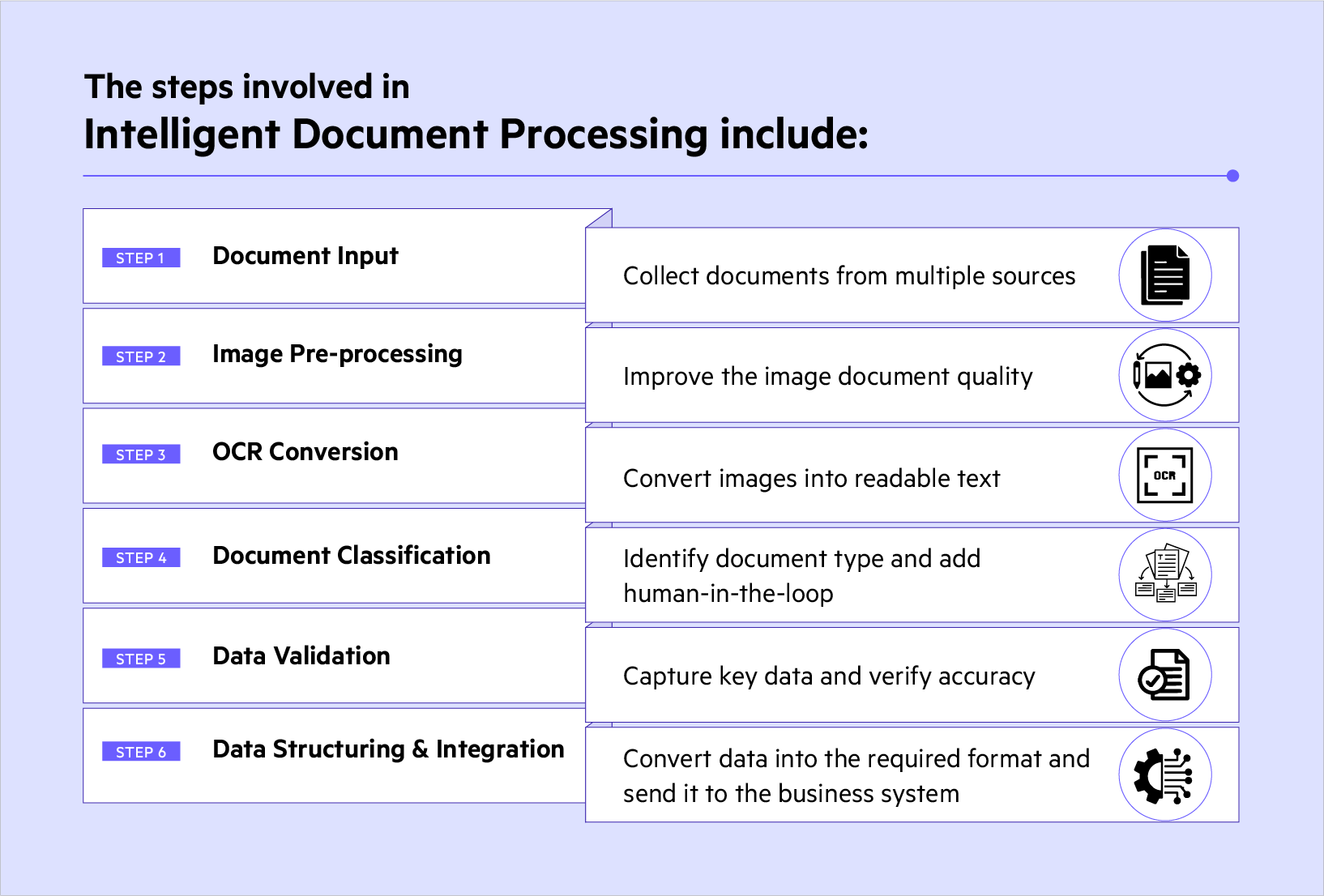
Intelligent Document Processing (IDP) – It enables organizations to capture, interpret, and process information from documents such as forms, invoices, emails, and images. By transforming document-based information into usable business data, IDP reduces manual review efforts and accelerates process execution.
Integrations and APIs – One of the main components of hyperautomation, where it acts as an orchestration engine connecting disparate systems and AI models to communicate and share data in real-time. This enables data sharing among RPA, AI, and other hyperautomation components.
Low-code or No-code – Low-code and no-code platforms play a crucial role in enabling hyperautomation by making automation faster, scalable, and accessible to both developers and business users. With drag-and-drop interfaces and pre-built templates, they significantly reduce development time and allow organizations to automate workflows quickly. These platforms empower non-technical users (citizen developers) to build and modify automations, reducing dependency on IT teams and accelerating innovation across departments. They also simplify integration with systems such as ERP and CRM via APIs, enabling seamless end-to-end automation rather than isolated tasks.
Hyperautomation goes beyond task automation by transforming how work flows across the enterprise, reshaping operations for speed, intelligence, and resilience:
Intelligent-led Continuous Process Optimization
With integrated process intelligence, businesses gain ongoing visibility into performance, allowing continuous refinement rather than one-time automation gains.
End-to-end Business Operations
Unlike traditional automation that focuses on individual tasks, hyperautomation connects workflows across departments, systems, and channels. This enables organizations to automate complete business processes, reducing handoffs, delays, and operational silos.
Enhanced Operational Agility
Hyperautomation enables organizations to adapt processes, workflows, and automation strategies as business requirements evolve. Low-code platforms, AI-driven insights, and orchestration capabilities make it easier to respond to market changes, customer expectations, and regulatory requirements.
The DAOG (Discover, Automate, Orchestrate, Govern) layer serves as the strategic backbone of hyperautomation, ensuring initiatives are scaled, aligned, and continuously optimized for business outcomes.
Discover
The journey begins with identifying automation opportunities across business processes. Using tools like process and task mining, organizations gain visibility into workflows, uncover inefficiencies, and prioritize high-impact areas for automation.
Automate
Apply technologies such as RPA, AI, ML, IDP, and workflow automation to eliminate manual effort, improve efficiency, and automate repetitive tasks.
Orchestrate
Connect people, systems, applications, data, and automated workflows into end-to-end business processes. This ensures that automation initiatives work together rather than operating as isolated solutions.
Govern
As automation expands across the enterprise, organizations must ensure automated processes operate responsibly and securely, and in accordance with business and regulatory requirements. The governance phase focuses on establishing oversight, defining ownership, monitoring performance, and managing risks associated with automation initiatives. Effective governance helps organizations maintain consistency, ensure compliance, and continuously evaluate whether automation investments are delivering the intended business value.
KYC and Customer Onboarding
Opening a new account often requires banks to verify customer identities, perform KYC and AML checks, validate documents, and create records across multiple systems. Hyperautomation streamlines this process by combining intelligent document processing, workflow automation, AI-driven verification, and system integrations. This reduces manual effort, accelerates onboarding, and helps deliver a smoother customer experience while maintaining regulatory compliance.
Back-office Operations and Reconciliation
To complete a banking transaction, back-office operations plays a crucial role, and accuracy should be emphasized. However, reconciliation processes often require employees to compare data across core banking platforms, payment systems, general ledgers, and external financial networks. When discrepancies occur, teams must manually investigate exceptions, gather supporting information, and coordinate with multiple stakeholders to resolve issues.
Hyperautomation streamlines reconciliation by combining workflow orchestration, AI, intelligent document processing, and system integrations. Transaction data can be automatically collected and matched across systems, exceptions can be identified in real time, and cases can be routed to the appropriate teams for resolution. AI can also help prioritize high-risk discrepancies and recommend corrective actions based on historical patterns. As a result, banks can reduce manual reconciliation efforts, accelerate exception handling, improve data accuracy, and gain greater visibility into back-office operations.

.png)


.png)