.png)

.png)
When a customer contacts the bank to dispute a transaction on their account, the service representative must follow several steps. This includes reviewing account information, verifying transaction details, checking fraud indicators, consulting dispute management systems, and initiating the appropriate workflow.
In many organizations, these activities involve switching between multiple applications, manually entering data, sending emails, and tracking progress through disconnected workflows. The representative needs to coordinate with back-office teams responsible for investigations and resolution.
The challenge is no longer the absence of automation but the inability to connect systems, teams, and processes to deliver a seamless end-to-end resolution journey.
This is where orchestration becomes critical. Hyperautomation helps banks connect people, systems, data, and workflows to streamline complex operations at scale. In this blog, we'll explore the operational challenges that prevent organizations from achieving seamless automation and why businesses are increasingly looking beyond traditional automation approaches.
While automation initiatives have become increasingly common, organizations continue to face challenges that limit their effectiveness. Key challenges include:
When Critical Information Lives in Disconnected Systems
Most organizations operate with a growing ecosystem of applications, databases, and business systems that have been implemented over many years. While each system serves a specific purpose, they often function in isolation, creating data silos across departments and business functions. As a result, information required to complete a single business process may be distributed across multiple platforms.
Consider a customer applying for a new bank account through a digital channel. To complete the onboarding process, the bank must verify customer information, validate documents, perform KYC and AML checks, and create records in the core banking system.
Although many of these activities are automated, the required data and workflows often span multiple systems. Employees may need to switch between applications, gather information manually, and coordinate with different teams when exceptions occur. Onboarding can take longer than expected, creating delays for both customers and employees.
The Hidden Manual Work Behind "Automated" Processes
Many organizations view automation as a way to reduce manual effort and improve operational efficiency. However, even after implementing automation technologies, employees often still perform numerous manual tasks behind the scenes. This occurs because most automation initiatives focus on automating individual tasks rather than the entire business process.
Why Every Customer Journey Feels Different
Customers expect consistent experiences regardless of how they interact with an organization. However, many businesses struggle to deliver this consistency because their processes, systems, and channels operate independently of one another. As automation initiatives are often implemented within individual departments, customer interactions can vary depending on the channel, team, or process involved. Information captured in one system may not be available in another, resulting in inconsistent responses.
Consider a customer who starts a credit card application online but later contacts the bank's call center for assistance. While the digital channel may have captured the customer's information, the service representative may not have immediate access to the application status or previously submitted documents. As a result, the customer is asked to repeat information and restart parts of the process.
These disconnected experiences create operational challenges for employees who must manually bridge the gaps between systems and channels.
Hyperautomation is a business-driven approach that combines advanced technologies such as AI, ML, RPA, IDP, digital twins, and analytics to automate complex processes. It automates as many business and IT processes as possible, creating seamless, interconnected workflows across the organization.
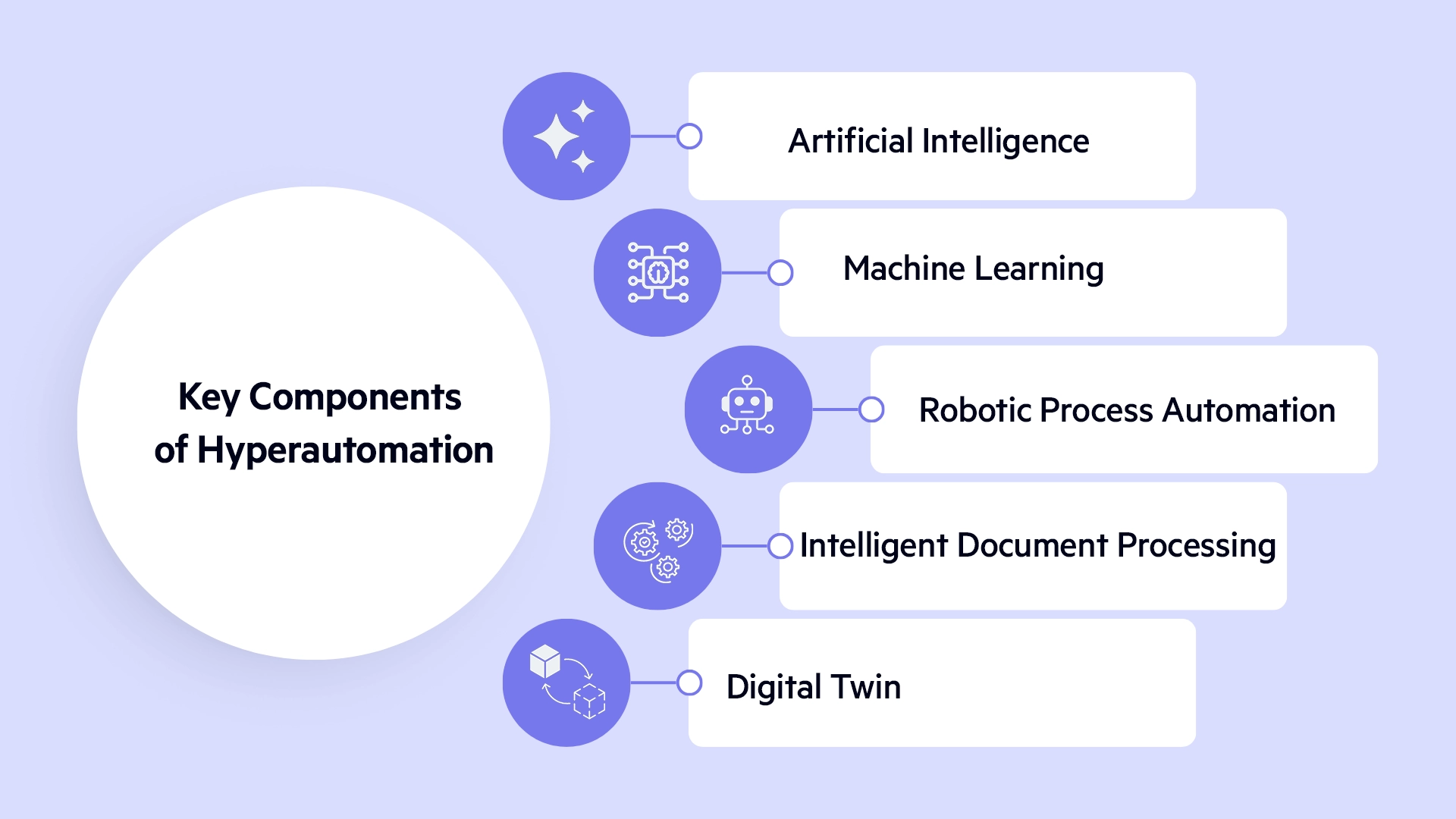
AI – It helps organizations automate tasks that require reasoning, interpretation, or contextual understanding.
RPA – RPA uses software bots to automate repetitive, rule-based tasks such as data entry, data transfer, and report generation, reducing manual effort.
IDP – IDP combines AI, OCR, and machine learning to extract, classify, and process information from structured and unstructured documents.
Digital Twin – A virtual representation of a business process, system, or operation that enables simulation, analysis, and optimization.
While hyperautomation has the potential to transform business operations, successful implementation requires more than deploying advanced technologies. Organizations must address challenges related to people, processes, data, and technology to realize their full value. Without a clear implementation strategy, even well-planned automation initiatives can struggle to deliver the expected outcomes. Below are some of the most common challenges organizations encounter when adopting hyperautomation.
The Human Side of Digital Transformation
Digital transformation extends beyond technology, as people play a critical role in adopting and utilizing new systems. Staff require targeted training to learn how to manage and interact with new, advanced technologies. Leaders must work on the cultural shift and clearly communicate the long-term benefits to the team. Without these elements, organizations may face challenges in adopting hyperautomation.
Navigating Legacy Technology Landscapes
Legacy systems heavily impact hyperautomation implementations by introducing strict integration barriers, data quality hurdles, and rigid operational processes. A legacy system often stores fragmented, unstructured data, but AI and ML models require clean, consistent data to function accurately.
Automating Without a Clear Roadmap
Implementing hyperautomation without a clear strategy or roadmap creates operational challenges and increases the risk of project failure. It can lead to budget overruns and reduced return on investment. The implementation plan should align with specific business requirements, objectives, and budget constraints.
Managing Integration and Architecture Complexity
Hyperautomation brings together multiple technologies, including AI, machine learning, RPA, intelligent document processing, process mining, and enterprise applications. For these technologies to work effectively, they must seamlessly exchange data and coordinate actions across the organization. However, many enterprises operate with a complex mix of legacy systems, cloud platforms, third-party applications, and custom integrations. Connecting these technologies while maintaining data consistency, security, and performance can be a significant challenge. As the number of automation initiatives grows, organizations may also face difficulties managing dependencies, maintaining integrations, and ensuring that different automation components work together as a unified ecosystem.
As organizations continue to invest in automation, many still struggle with disconnected systems, manual processes, inconsistent customer experiences, and challenges in scaling automation initiatives. These operational barriers highlight a critical reality: automating individual tasks alone is not enough to drive enterprise-wide transformation.
Hyperautomation addresses this challenge by combining technologies such as AI, machine learning, RPA, intelligent document processing, and workflow orchestration to create more connected, intelligent business operations.
Continue exploring how hyperautomation creates measurable business value and accelerates digital transformation across industries.

.png)


.png)





_New%20copy.webp)