Organizations are moving quickly to adopt enterprise AI agents that can automate tasks, assist employees, and enhance customer experiences. As these initiatives expand across departments, many enterprises are discovering that deploying more intelligent agents doesn't automatically create better business outcomes. When agents operate independently, without shared context, coordinated workflows, or clear governance, they often become isolated pockets of automation rather than contributors to enterprise-wide transformation.
The challenge is ensuring that individual agents work together within a larger business ecosystem. The next evolution of agentic automation is about enabling them to operate within governed business workflows. Through effective AI agent orchestration, organizations can connect intelligent agents with enterprise processes, business rules, and human oversight, transforming isolated automation into coordinated, reliable, and scalable work.
In this blog, we'll explore why enterprises must move from free-floating agents to governed work, what this shift means for enterprise AI adoption, and the capabilities organizations should prioritize to build AI that delivers lasting business value.
Organizations quickly introduced AI agents to automate repetitive tasks, assist employees, streamline customer interactions, and improve productivity across individual business functions. These early successes demonstrated the potential of AI and encouraged enterprises to expand their adoption across the organization.
Free-floating AI agents are intelligent systems that operate independently to accomplish specific tasks without being fully connected to the broader business ecosystem. They can answer customer or employee questions, automate business activities, generate content, or make recommendations. However, they typically operate within a narrow scope and have limited awareness of enterprise workflows and business policies.
In many organizations, these agents are introduced to solve individual business problems or improve team-level productivity. While they can deliver measurable value on their own, they often work in isolation.
For instance, when a bank deploys an AI agent to help customers raise credit card disputes:
The agent can:
From the customer's perspective, the interaction is seamless. After submitting the dispute, the agent has no visibility into what happens next. It doesn't verify whether the dispute meets the bank's policies.
If additional information is required, another employee or system must step in to continue the process.
As the AI agent lacks orchestration and defined business guardrails, it has limited visibility into the case lifecycle. It delivers intelligence at an individual touchpoint but operates outside the governed workflows that connect people, systems, policies, and decisions across the enterprise.
As organizations move from AI experimentation to enterprise-wide adoption, the role of AI agents must evolve. The success of AI agent adoption depends on how effectively those agents contribute to end-to-end business outcomes. This is where governed work becomes essential. Governed work is an operating model where enterprise AI agents function as part of a coordinated business process rather than as standalone assistants. Every action an AI agent takes is guided by business rules, enterprise policies, workflow context, and human oversight where required.
For example, an AI agent handling a loan application shouldn't simply recommend an approval or rejection based on customer information. It should initiate the appropriate workflow, validate policy requirements, collaborate with fraud and risk systems, route exceptions for manual review, and ensure every decision is transparent and auditable. The agent's intelligence remains valuable, but its real impact comes from how well it operates within the broader business process.
This evolution is also reshaping agentic automation. Rather than treating AI agents as independent workers, organizations are focusing on AI agent orchestration, which coordinates multiple agents, enterprise applications, and human experts to achieve a common business outcome. The result is not just faster task execution, but more consistent decisions, improved compliance, greater operational visibility, and AI initiatives that can scale confidently across the enterprise.
Moving from free-floating agents to governed work is about redefining how they operate within the enterprise. Rather than functioning as isolated problem-solvers, AI agents become part of a connected ecosystem in which every action contributes to a broader business objective. It requires an enterprise foundation that brings together AI, workflows, business rules, data, and human expertise into a single operating model.
The architectural building blocks of governed work vary depending on business processes, industry regulations, operational workflows, and enterprise policies. The most common blocks include:
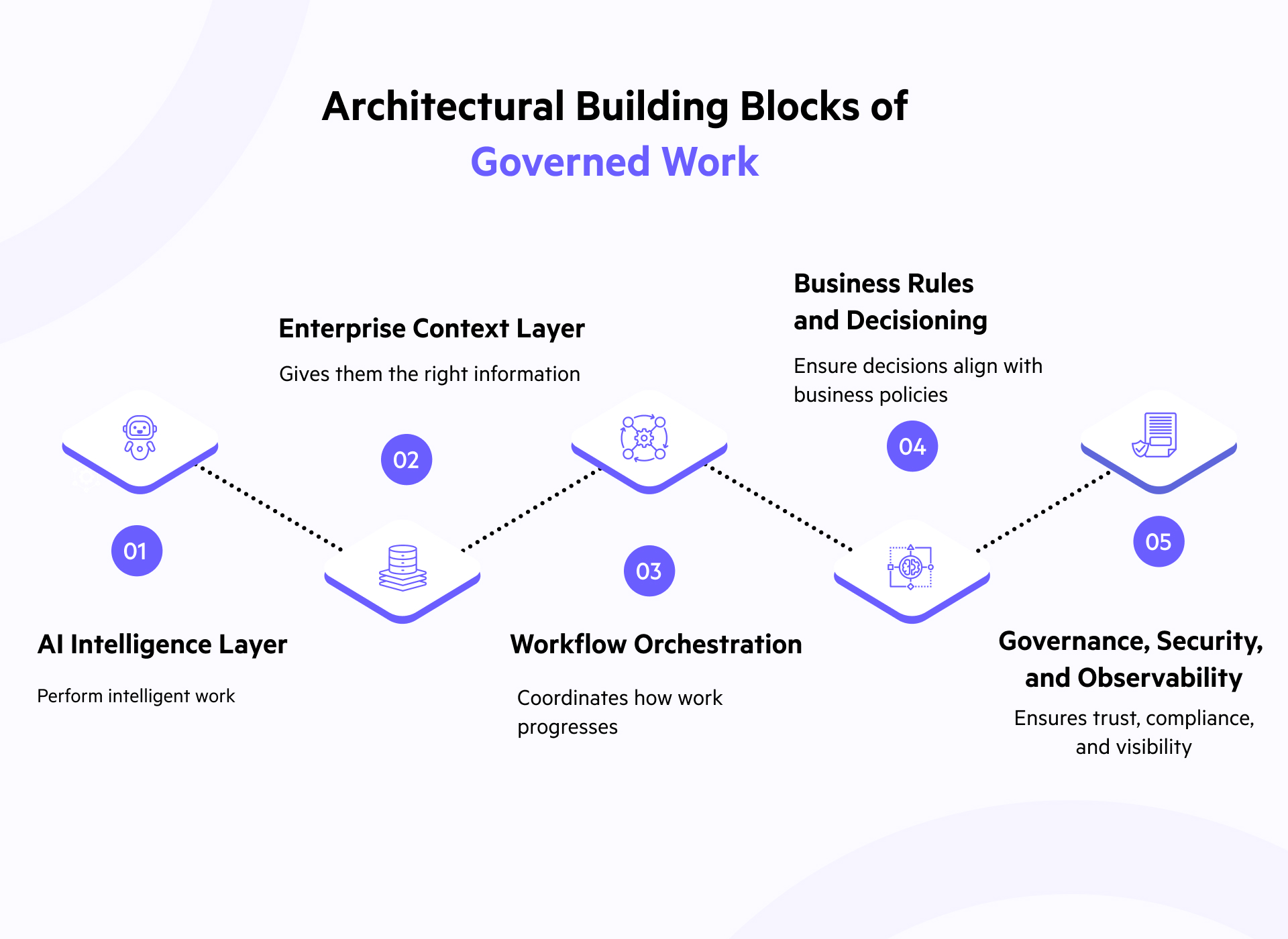
AI intelligence layer – This is where AI agents perform cognitive tasks such as understanding intent, generating responses, summarizing information, extracting data, making recommendations, or reasoning over a problem. While AI provides the reasoning capabilities needed to support business operations, intelligence alone does not determine how work should be executed. It forms the foundation on which the remaining architectural components are built.
Enterprise Context Layer - AI is only as effective as the context it can access. When enterprise information is accessible, AI agents are less likely to fabricate responses or rely on outdated information. This enables AI agents to ground their responses in enterprise data rather than generalized model knowledge.
Workflow Orchestration – AI agent orchestration serves as the coordination layer that transforms isolated, free-floating agents into a connected enterprise system. Instead of allowing individual agents to operate independently, orchestration connects people, AI, and enterprise systems into a unified execution model.
Business Rules and Decisioning - Enterprise decisions cannot rely entirely on AI-generated reasoning. Every organization operates under defined business policies, regulatory obligations, and operational guidelines. This layer ensures that AI recommendations are evaluated against established rules before actions are executed.
Governance, Security, and Observability - Governance is the outcome of connecting AI to enterprise operations, not the starting point. Organizations need complete visibility into how AI decisions are made, what actions are performed, and whether those actions comply with internal policies and external regulations. This building block provides auditability, monitoring, security controls, policy enforcement, and performance insights, helping organizations build trusted and responsible AI systems.
While free-floating AI agents can automate individual tasks and improve productivity, lasting business value comes from connecting intelligence with enterprise context, workflows, business rules, and governance.
As organizations continue to expand their AI initiatives, success will depend on how effectively those agents collaborate with people, systems, and business processes. This approach helps improve decision consistency, reinforce compliance controls, and give teams greater insight into how work progresses across the organization.
Connect AI capabilities with enterprise workflows, business processes, and governance to drive meaningful digital transformation.