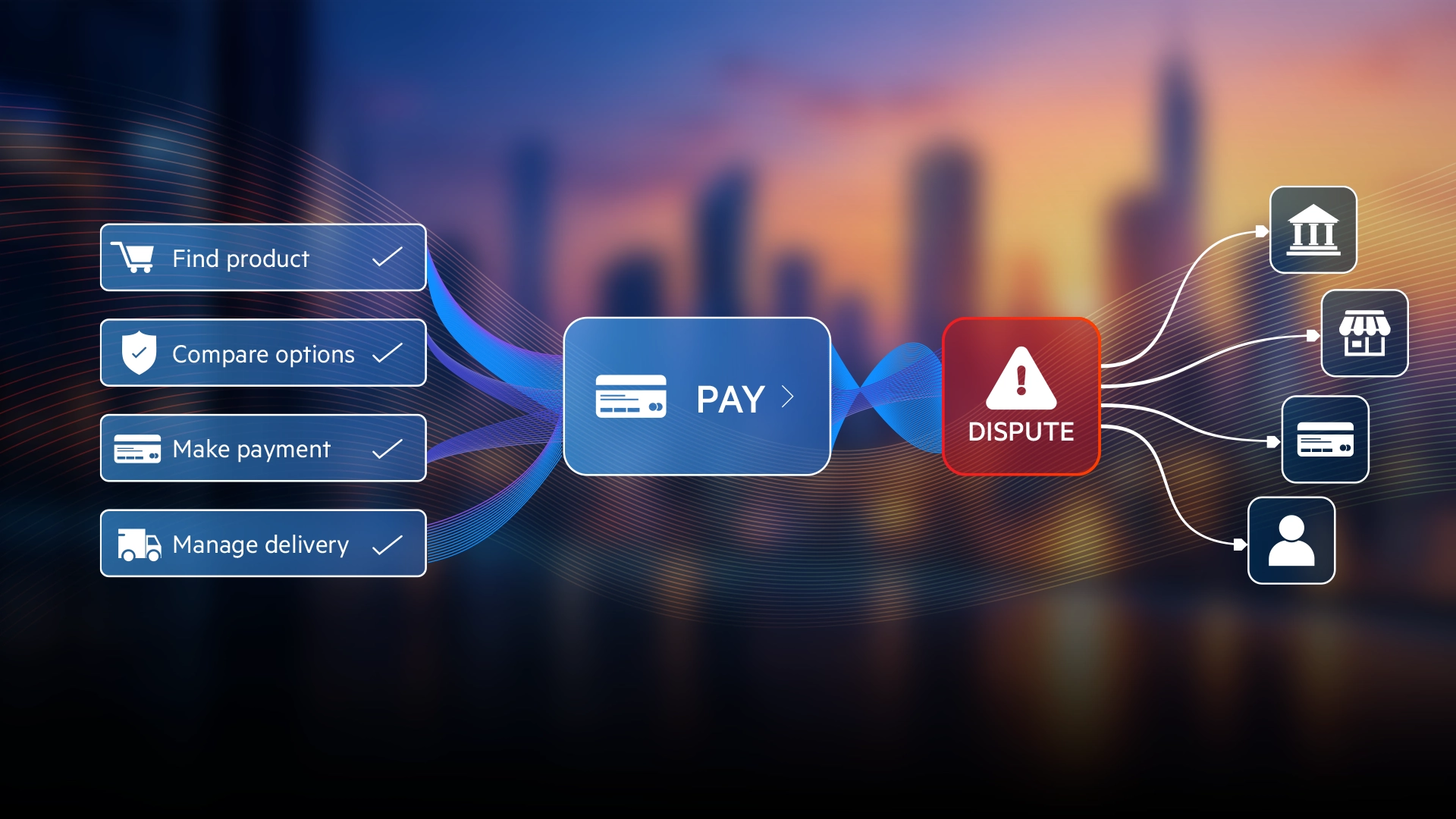
Financial institutions generate thousands of predictions every day. They estimate which transactions may be fraudulent, which customers might leave, which loans carry higher repayment risk, and which payment disputes could require immediate attention.
Predictive AI makes those forecasts possible by analyzing historical and current data to estimate what is likely to happen next. Organizations across banking, insurance, and financial services are investing in these capabilities to improve decision-making, reduce operational risk, and respond faster to changing customer needs.
The quality of those predictions depends on the quality of the data behind them. The 2026 Global AI in Financial Services Report by the University of Cambridge found that 72% of technology vendors working with financial institutions identify data quality and completeness as the biggest challenge in AI implementation.
Data quality is only one part of the equation. Organizations also need to understand how Predictive AI works, which models are suited to different business problems, and how those predictions become part of everyday operational decisions.
Predictive AI uses historical data, current information, statistical techniques, and machine learning models to estimate the probability of future events. It identifies patterns that indicate what is likely to happen next.
Banks have used predictive models for years in areas such as credit scoring and fraud detection. Recent advances in machine learning have expanded those capabilities across many parts of the business.
Common applications include:
Each prediction gives decision-makers more time to respond. That extra time often determines whether an issue is resolved quickly or develops into a larger operational or customer problem.
Predictive AI and Generative AI solve different business problems, even though they are often discussed together.
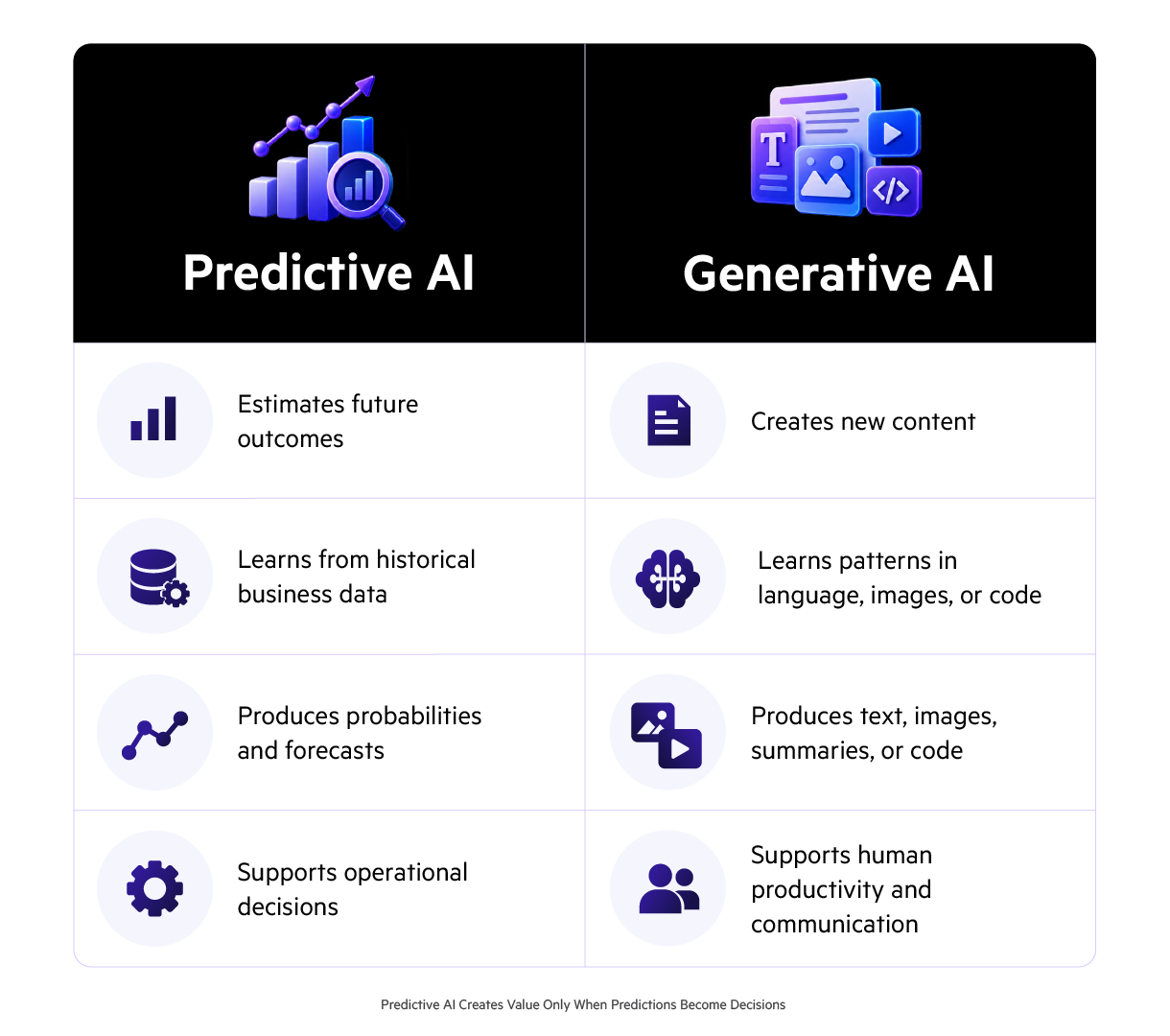
Organizations increasingly use both technologies together because they address different stages of the same business process.
Different business problems require different predictive models. Choosing the right one depends on the type of outcome an organization wants to predict.
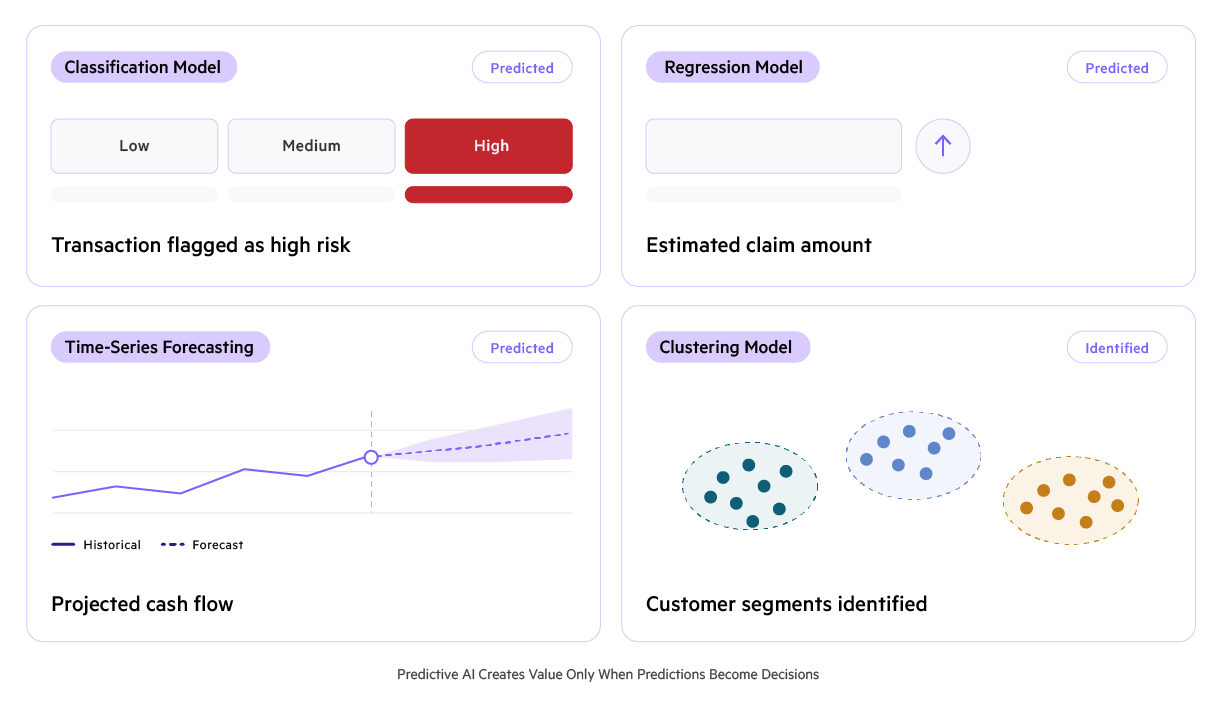
When the objective is to place data into predefined categories, classification models are the preferred choice. They estimate whether an outcome falls into a specific class, such as fraudulent or legitimate, approved or declined, or low, medium, or high risk.
Best for: Fraud detection, credit risk assessment, loan approvals, customer attrition, and claim classification.
Some business decisions depend on estimating a numerical value rather than assigning a category. Regression models calculate expected outcomes based on historical patterns and existing data.
Best for: Claim amount estimation, customer lifetime value, loan repayment forecasts, revenue forecasting, and financial loss estimation.
Historical trends often reveal how demand, transactions, or financial activity may change over time. Time series models use those patterns to estimate future values across sequential data.
Best for: Cash flow forecasting, transaction volume prediction, staffing requirements, payment trends, and seasonal demand planning
Large datasets often contain groups with similar characteristics that aren't immediately visible. This model identifies those groups without relying on predefined categories, making it easier to understand customer behavior and transaction patterns.
Best for: Customer segmentation, product recommendations, behavioral analysis, marketing campaigns, and portfolio management
Every predictive model learns from data. If that data is inaccurate, incomplete, outdated, or biased, the model can produce unreliable predictions. Consider a fraud detection model trained on historical transactions. If fraudulent transactions were incorrectly labeled as legitimate, the model learns the wrong patterns. If customer behavior changes but the model isn't updated, prediction quality can decline over time.
Predictive models should be treated as continuously evolving systems. Data quality checks, model monitoring, periodic retraining, and governance all play a role in maintaining reliable predictions.
Predictions become useful when they influence operational decisions. In an online payment, a predictive model identifies the transaction as high risk based on spending behavior, device information, location, and historical fraud patterns. That prediction should immediately influence how the organization responds. The case can be prioritized for review, routed to the right investigation team with the relevant customer information, and verified without waiting for manual intervention.
The same principle applies across financial operations. A customer showing early signs of leaving can enter a retention program before closing an account. A loan application with elevated default risk may require additional review. A payment dispute that shows signs of becoming more complex can move to the front of the queue instead of following the standard process. Every prediction should guide the next business decision.
Organizations achieve better outcomes when predictive models become part of everyday workflows. They help teams determine which cases need immediate attention, who should handle them, and what action should follow.
The success of a Predictive AI initiative depends on more than selecting the right model. Organizations need a clear plan for how predictions will influence everyday decisions.
Before investing, leaders should identify the business decision they want the model to support, who will receive the prediction, and what action should follow. They should also determine whether that response can be automated or requires human review, and how success will be measured once the model is in use.
When these questions are answered early, Predictive AI becomes part of the decision-making process. The impact is easier to measure through outcomes like fewer fraud losses, faster investigations, improved customer retention, and greater operational efficiency.
Predictive AI continues to expand across banking, insurance, and financial services as organizations look for earlier insight into future risks and opportunities. As adoption grows, the focus is shifting from implementing AI to delivering measurable business outcomes.
According to PwC's 2026 Global CEO Survey, 56% of CEOs report no revenue or cost benefits from AI so far, and only 12% say AI has delivered both higher revenue and lower costs. Predictive AI initiatives face the same challenge. Models can estimate fraud risk, identify customers who may leave, or forecast payment failures. Business impact comes from the decisions those predictions enable and the workflows they improve.
As enterprises continue to invest in AI, success will depend on connecting predictions with business processes, governance, and timely decision-making. Organizations that treat predictions as the starting point for informed decisions will be better positioned to create measurable business value.
Put your predictions to work in every customer conversation with EvonSys.