Live webinar | Seconds to Settle, Weeks to Resolve: The Payment Investigations Paradox
Register Now


An insurance provider has spent years digitizing its operations. Claims submissions are online, underwriting workflows are automated, and AI models help assess risk and detect fraudulent activities. For routine cases, workflows run smoothly and as expected.
The challenge begins when a case does not follow the predefined path. A claimant submits incomplete documentation. A fraud model flags suspicious activity, but the confidence score is inconclusive. In each of these scenarios, a series of decisions must be made that cannot be addressed through predefined rules alone.
As exceptions increase, cases move between departments, decisions wait in queues, and employees continuously switch contexts to determine the next best action. While traditional automation efficiently manages predictable work and AI models provide recommendations, neither is designed to independently reason through complex situations, coordinate actions across systems, and drive resolution.
This growing gap between automated processes and real-world complexity is driving the need to explore a new approach: Agentic AI for enterprises.
As part of a broader enterprise AI transformation strategy, Agentic AI helps enterprises move beyond task automation toward autonomous execution. Agentic AI comprises autonomous agents that can reason, adapt, and act independently of rigid, predefined workflows to achieve a desired business outcome. With minimal human intervention, autonomous agents can manage complex, multi-step workflows, especially in highly regulated industries.
For years, enterprises have invested heavily in automation to improve efficiency, reduce manual effort, and accelerate business outcomes. While these initiatives often deliver measurable business value, many enterprises eventually reach a point where adding more automation produces progressively smaller returns.
The automation ceiling is the point at which traditional, rules-based automation can no longer effectively handle complex and unpredictable business scenarios. To move beyond this ceiling, organizations must adopt more adaptive and intelligent approaches as part of their enterprise AI transformation strategy.
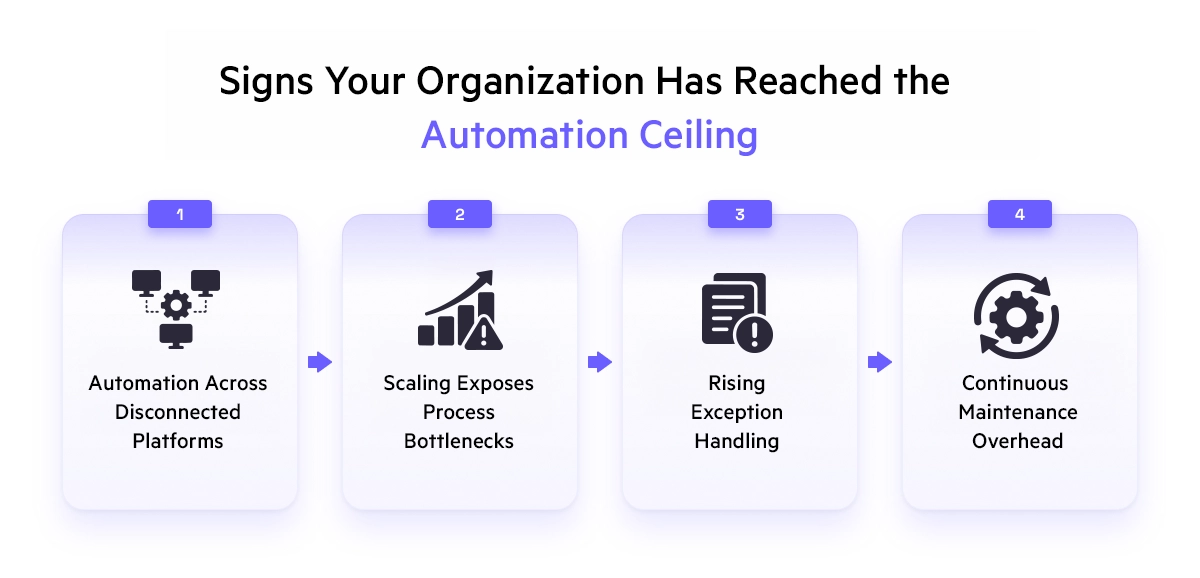
Relying on Multiple Fragmented Tools: With no native sync, it results in a swivel-chair process, where employees need to re-enter or copy the same data across multiple unintegrated systems, jumping between different software or screens to complete a single task. This makes employees spend more time coordinating than completing tasks.
Process Breakdown during Scaling: As transaction volumes, customer requests, or cases increase, the enterprise must continuously add resources to maintain service levels rather than relying on automation or AI for the transformation.
Exceptions Grow Faster Than Automation: Automation handles routine work efficiently, but an increasing number of cases require human intervention due to exceptions. When enterprises expand their digital operations, this creates a significant challenge for ongoing enterprise AI transformation initiatives.
Maintenance Debt Continues to Accumulate: Even minor changes to regulations, products, or business processes can require significant updates, testing efforts, and cross-functional coordination. Instead of accelerating innovation, teams spend an increasing share of their time maintaining existing automations.
Many organizations assume that the answer to operational complexity is simply to add more automation or invest in additional AI initiatives. However, the challenges associated with the automation ceiling often persist because traditional automation and AI are designed to solve a different class of problems.
Traditional automation excels at executing predefined tasks. It follows predefined workflows, applies business rules, and performs repetitive activities with speed and consistency. This approach works effectively when processes are predictable and outcomes are known in advance.
Similarly, traditional AI has enhanced enterprise operations by generating insights, identifying patterns, and supporting decision-making.
The challenge arises when business operations become dynamic, interconnected, and exception-driven. Modern enterprises must constantly adapt to changing customer expectations, regulatory requirements, market conditions, and operational priorities.
These challenges highlight why organizations are exploring how Agentic AI is transforming enterprise platforms by enabling more autonomous decision-making and execution.
The automation ceiling is a sign that business complexity has evolved beyond what predefined rules, static workflows, and human-led orchestration can effectively manage at scale. Breaking through this ceiling requires moving beyond automating individual tasks and enabling systems that can reason, adapt, and act. This is why Agentic AI for enterprises is rapidly emerging as the next stage of enterprise AI transformation, helping organizations move beyond execution based on predefined rules toward autonomous, outcome-driven operations
Ready to explore what's beyond traditional automation?