Live webinar | Seconds to Settle, Weeks to Resolve: The Payment Investigations Paradox
Register Now


AI is no longer viewed as a single capability. It has evolved into a collection of specialized technologies that help organizations create content, predict business outcomes, automate decisions, and improve operational efficiency. As enterprises expand AI across critical business functions, the challenge is no longer whether to adopt AI, but how to operationalize AI responsibly and at scale.
As AI moves into business-critical operations, enterprise leaders are facing a new challenge. Can AI deliver consistent, explainable, and accountable outcomes, and not just intelligent responses?
This shift is changing how organizations evaluate AI. Increasingly, success is measured not only by what AI can do, but by how reliably it performs in real-world enterprise environments. That is why predictability is becoming the new intelligence.
Not long ago, enterprise AI initiatives were largely evaluated by their capabilities. Organizations primarily evaluated whether AI could generate content faster, automate repetitive tasks, improve customer interactions, or assist employees in making better decisions. As large language models and agentic AI matured, the conversation shifted toward a greater emphasis on reasoning, autonomy, and AI's ability to complete increasingly complex tasks.
Business leaders are asking questions that go beyond technical capability:
As agentic AI moves from experimentation to enterprise deployment, the challenge is to build a system that organizations can depend on.
That shift leads to an important realization: in enterprise AI, intelligence may capture attention, but predictability earns trust.
The more responsibility and data that AI takes on, the less the enterprise can afford unpredictable behavior.
In the early days of enterprise AI adoption, it was used to generate content, summarize documents, and assist employees with individual tasks. If two responses differed slightly, the business impact was usually minimal.
The expectations of enterprise AI are fundamentally different. Once AI becomes part of processes such as customer onboarding, payment investigations, loan origination, claims handling, fraud detection, or regulatory compliance, every recommendation has the potential to influence business outcomes, customer trust, and regulatory obligations. At this stage, enterprises are no longer evaluating AI based on whether it can produce the most sophisticated response. They are evaluating whether it can consistently produce the right outcome in line with the defined business policies.
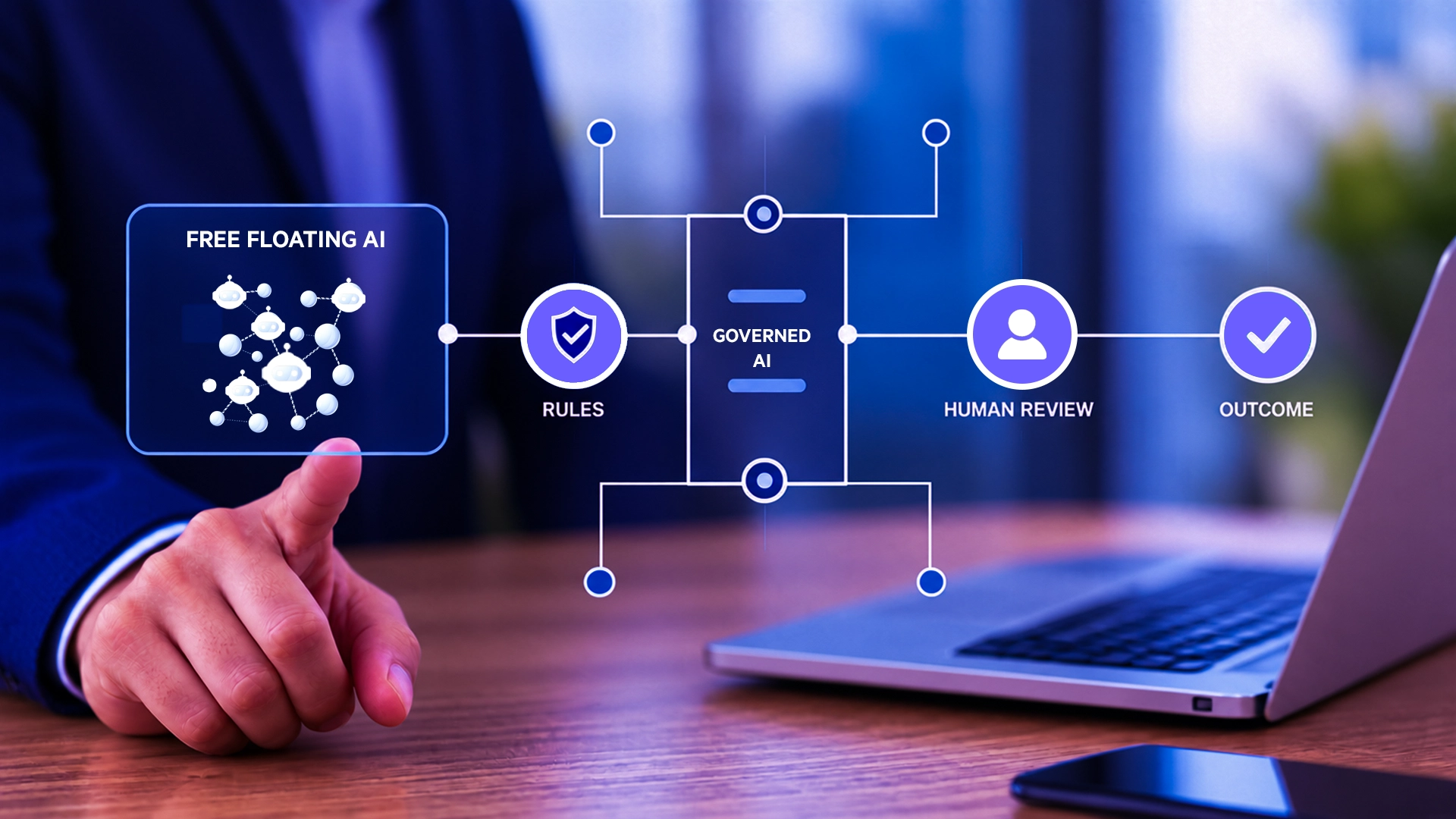
Consider what happens when AI operates with and without enterprise governance:
Consider a commercial bank that uses AI to speed up loan approvals. The AI evaluates financial statements, credit scores, repayment history, and cash flow, then recommends whether to approve or reject applications.
The AI reviews a $100 crore corporate loan application. The AI analyzes the applicant's financial data and determines that the application meets the bank's eligibility requirements, thereby recommending approval. However, under the bank's governance policy, any corporate loan exceeding $50 crore must be reviewed and approved by the credit committee before a final decision is made.
Since the AI operates independently, it bypasses the mandatory approval process and issues an approval recommendation directly to the customer. Although the AI's credit assessment may be accurate, the bank now faces serious governance concerns. This is where predictability plays a crucial role.
Now consider the same scenario with predictable AI embedded within enterprise applications.
Rather than bypassing governance, the enterprise AI system:
The outcome is a governed, transparent, and auditable decision.
Whether AI is processing a loan application, resolving a customer dispute, detecting fraud, or assisting an employee, organizations need assurance that it will operate within established business policies and governance frameworks. When AI behaves predictably, employees know when to rely on its recommendations. Business leaders gain confidence that AI aligns with organizational objectives rather than acting independently. Compliance teams can verify that regulatory requirements are consistently enforced, while auditors have a clear record of how decisions were reached. This transforms AI from a productivity tool into a trusted enterprise capability.
A lack of trust is one of the biggest barriers to enterprise AI adoption. Organizations may recognize AI's ability to automate work, improve productivity, and accelerate decision-making, yet remain cautious about deploying it in mission-critical operations. The concern lies in whether AI can consistently operate within established business policies and governance frameworks once deployed at scale. Predictability helps bridge that confidence gap. When AI consistently operates within business policies and governance frameworks, it becomes easier for organizations to trust its recommendations and scale its use.
The benefits extend beyond governance. Predictable AI in enterprise applications reduces unnecessary exceptions, minimizes manual rework, and creates a more consistent customer experience. Teams spend less time investigating unexpected AI behavior and more time focusing on higher-value work. Customers receive fair and consistent treatment, regardless of which channel they use or when they interact with the organization.
Ultimately, enterprise AI succeeds not because it makes every decision autonomously, but because it makes every decision responsibly. Trust is earned when organizations know that AI will consistently deliver outcomes that are aligned with their policies, governance standards, and business goals.
Organizations should assess AI through the lens of enterprise readiness.
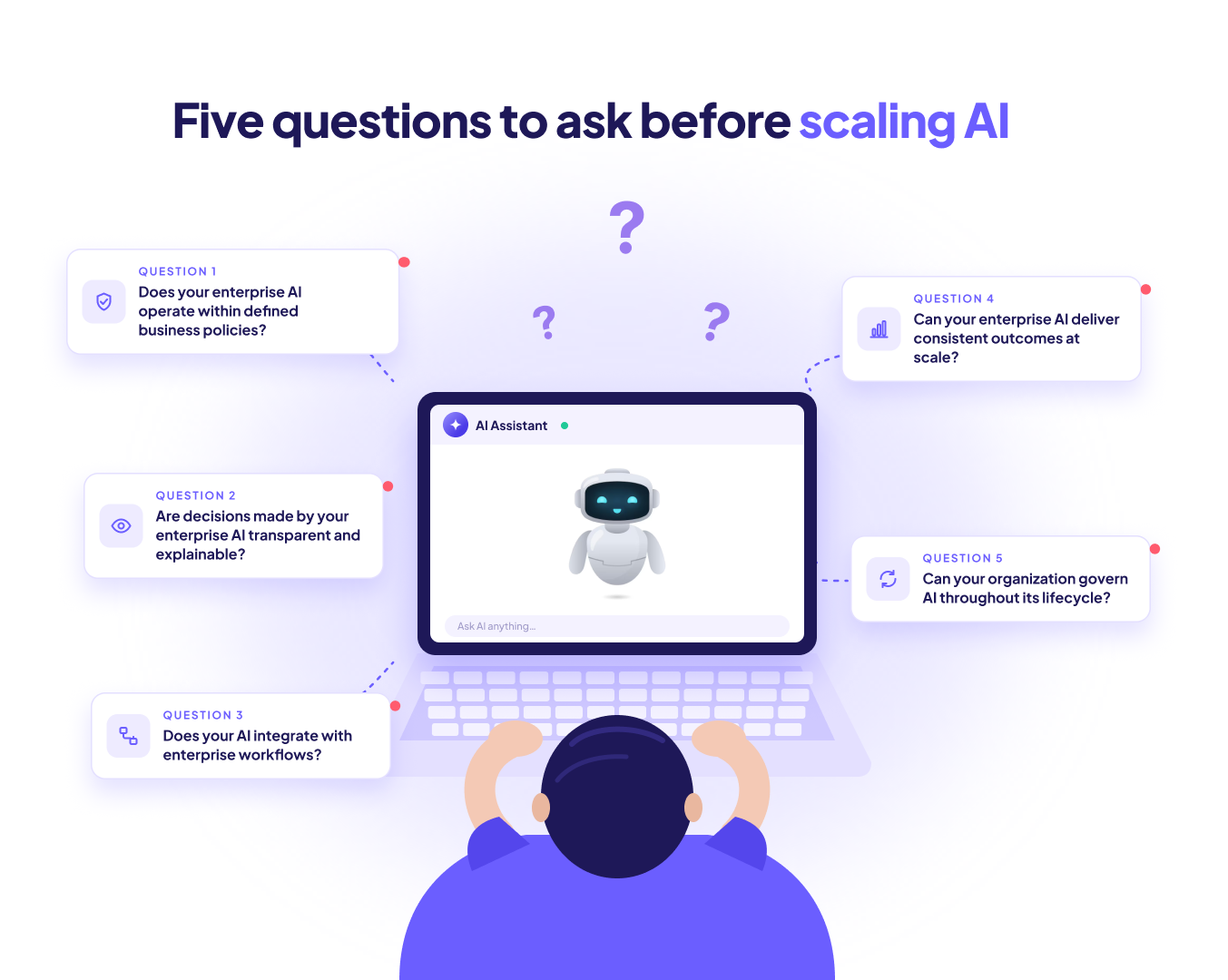
Does your enterprise AI operate within defined business policies?
Enterprise AI should consistently follow business rules, approval hierarchies, and compliance requirements. It should understand when it can act autonomously and when a decision must be routed to an employee for review.
Are decisions made by your enterprise AI transparent and explainable?
Business users, auditors, and regulators need to understand why a recommendation was made. AI should provide clear reasoning and maintain an audit trail that supports accountability and governance.
Does your AI integrate with enterprise workflows?
The most effective AI solutions don't operate as standalone assistants. They become part of existing business processes, interacting with enterprise systems, employees, and customers while following the same operational controls.
Can your enterprise AI deliver consistent outcomes at scale?
An AI solution may perform well in isolated demonstrations, but enterprise success depends on handling thousands of similar business scenarios consistently across teams, channels, and regions without introducing unnecessary variability.
Can your organization govern AI throughout its lifecycle?
Enterprise AI requires continuous oversight. Organizations should be able to monitor AI performance, enforce evolving business policies, review decisions, and adapt governance controls as regulations and business needs change.
These questions shift the evaluation from "How intelligent is this AI?" to "Can this AI become a trusted part of our enterprise operating model?"
Building enterprise trust requires more than deploying a powerful AI model. It requires an architecture that combines intelligence with governance, workflows, business rules, and human oversight. These elements ensure AI not only delivers recommendations but also operates within the same policies and controls that govern the rest of the business.
Organizations are increasingly evaluating AI on a different set of criteria: Can it operate consistently? Can it follow business policies? Can it support enterprise governance initiatives, compliance, and human oversight? Most importantly, can it be trusted to deliver predictable business outcomes at scale?
The answers to these questions will determine which AI initiatives move beyond pilots and become integral to enterprise operations.
Looking to move beyond AI pilots?
Build an enterprise AI foundation that combines intelligence with governance, compliance, and workflow orchestration.