.png)

.png)
For the past few years, the conversation around AI has largely focused on what Large Language Models can do. They can draft reports, answer questions, summarize documents, and power increasingly natural conversations.
Today, the conversation is shifting in a different direction.
Business leaders are asking a different set of questions. Can LLM provide responses based on the latest company policies? Can it understand customer-specific context? Can it support governed business decisions? Can it keep pace with information that changes every day?
These questions highlight an important reality: deploying AI in an enterprise environment requires far more than a powerful language model. It requires an architecture that can combine language intelligence with trusted business knowledge, paving the way for Retrieval Augmented Generation (RAG).
An LLM (Large Language Model) is a type of artificial intelligence model trained on vast amounts of text data to understand, generate, summarize, translate, and respond to human language. Instead of storing information like a database, it learns patterns, relationships, and context from trillions of words, enabling it to generate contextually relevant, human-like responses to a wide range of prompts. Unlike traditional software that follows predefined rules, an LLM predicts the most appropriate response based on the context of a user's request. This allows it to perform a wide range of tasks, including:
For instance, banks are increasingly using LLM-powered assistants to provide 24/7 personalized customer support, answer routine banking inquiries, and generate contextual responses to everyday queries. Through automation, human agents can focus on more complex, high-value customer needs.
Another example is risk assessment. LLMs can analyze large volumes of financial reports, customer information, current market trends, and historical data to identify patterns that support lending and investment decisions. This enables teams to identify potential risks and develop informed lending and investment strategies.
An LLM can generate fluent, human-like responses, but for enterprise AI, generating an answer is only the starting point. Organizations need AI that understands their business, stays up to date with the latest policies, retrieves trusted information, and supports operational workflows. While LLMs excel at language generation, they are not built to deliver these enterprise capabilities on their own. They operate without inherent awareness of an organization's knowledge or constantly evolving business information. That gap becomes a critical limitation in enterprise environments.
The limitations include:
LLM Hallucinations - When AI Sounds Right but Gets It Wrong
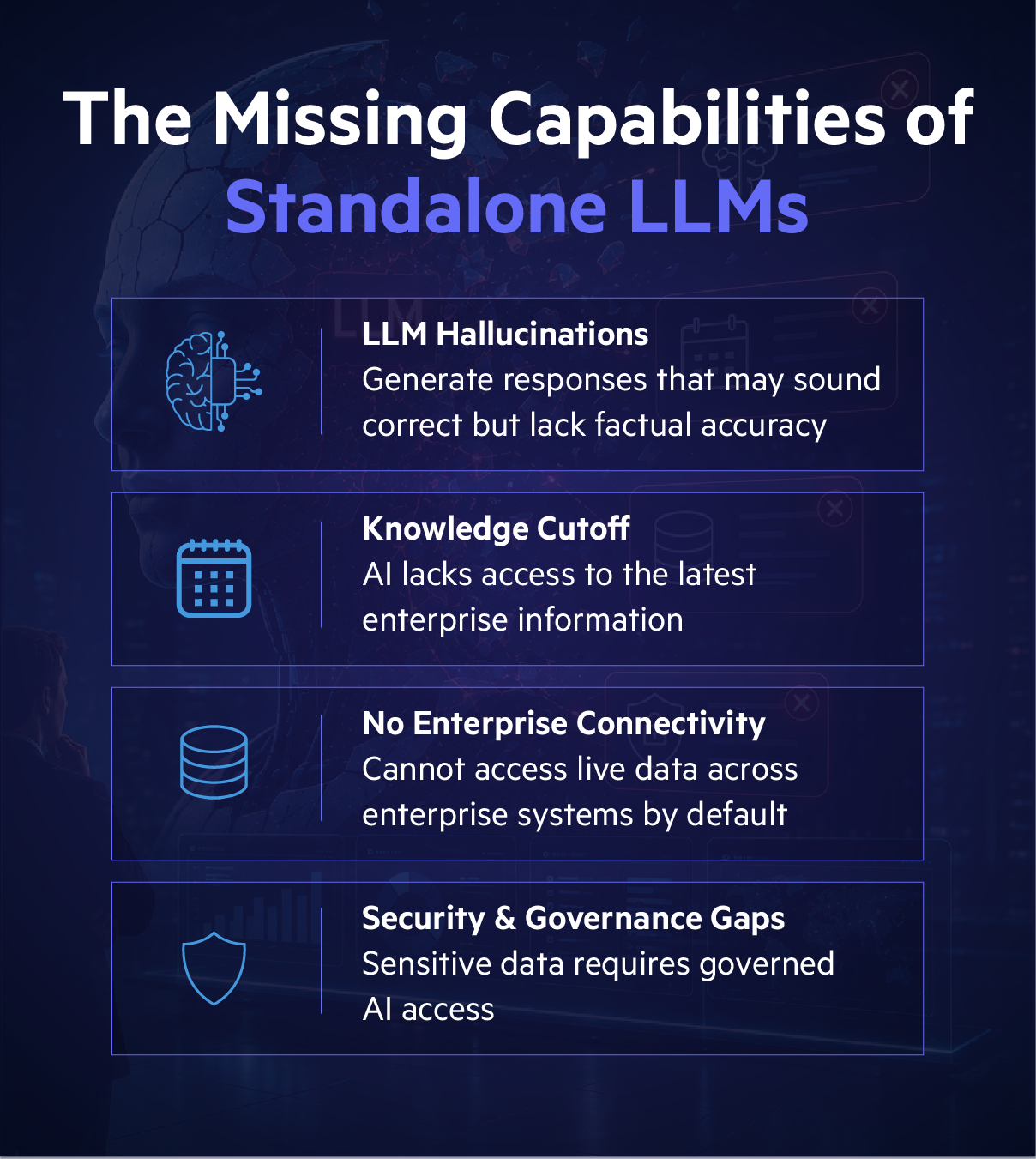
An LLM generates responses based on patterns learned during training. While this may seem to enable human-like conversations, it does not inherently verify information against trusted enterprise sources before responding. As a result, when the model lacks sufficient context, it may generate responses that sound accurate and convincing but are factually incorrect or entirely fabricated, a phenomenon known as LLM hallucinations.
For organizations evaluating the use of LLMs in enterprise environments, hallucinations present a serious limitation. They can lead to misinformation, inconsistent customer experiences, increased compliance risks, and additional manual effort as employees verify AI-generated responses before taking action.
For instance:
A customer contacts a bank to ask whether they qualify for a newly introduced home loan with revised interest rates and eligibility criteria. An LLM without access to the bank's latest product guidelines may confidently provide outdated eligibility requirements or incorrect interest rates. While the response appears credible, it can mislead the customer, create compliance concerns, and require follow-up corrections from the service team. This example illustrates one of the most critical enterprise LLM deployment challenges: ensuring AI-generated responses remain accurate, current, and grounded in trusted business information. A single incorrect recommendation can undermine customer trust, expose the organization to regulatory scrutiny, and reduce employee confidence in AI-assisted decisions.
Organizations need AI that can generate responses grounded in current, trusted business information, rather than relying solely on patterns learned during training.
Knowledge That Doesn't Keep Pace with Business Change
LLMs in enterprise settings have fixed knowledge cutoffs because they are trained on static data. As enterprise information evolves, standalone LLMs cannot automatically access the latest updates without retrieval or search capabilities.
Although they can assist with business operations, they have inherent limitations in retrieving up-to-date information on company policies, compliance, and customer information. Relying on outdated information can lead to inconsistent customer responses, operational inefficiencies, and compliance risks.
Generic Intelligence Can't Deliver Personalized Experiences
An LLM can generate contextually relevant responses, but it cannot execute business decisions. Enterprise operations require AI to interpret business rules, evaluate multiple conditions, comply with regulations, and determine the most appropriate action within a defined process. While LLMs can generate recommendations, they do not understand organizational policies or consistently apply business logic. As a result, they cannot independently support complex enterprise decision-making or execute governed workflows.
This often results in AI experiences that feel generic rather than personalized. Instead of delivering business-specific guidance, employees receive broad recommendations that still require manual interpretation.
Enterprise Knowledge Lives Beyond the Language Model
Critical business information resides across CRM platforms, case management systems, ERP applications, knowledge repositories, and other enterprise systems. By default, an enterprise LLM cannot retrieve or interact with this information.
Unless it is integrated, it cannot answer questions based on live customer records, transaction histories, inventory levels, or internal case data.
Enterprise AI Must Balance Intelligence with Trust
Enterprise AI frequently interacts with confidential customer information, financial records, and proprietary business data. Protecting this information is essential to maintaining regulatory compliance and customer trust.
Organizations need confidence that sensitive information is accessed securely, governed appropriately, and handled in accordance with internal policies and industry regulations.
For instance, a relationship manager uses AI to summarize a customer's financial portfolio. Without appropriate governance and access controls, the AI could expose sensitive financial information beyond authorized users, creating security, privacy, and regulatory risks.
While training an LLM with enterprise data may seem like a straightforward solution, it doesn't address one of the biggest challenges organizations face: enterprise knowledge is constantly evolving. Product information, internal policies, pricing, regulatory requirements, customer records, and operational procedures are updated regularly, sometimes multiple times a day. Keeping an LLM synchronized with this pace of change through continuous retraining is neither practical nor economically viable.
Beyond the computational cost, retraining requires specialized AI expertise, rigorous testing, validation, and governance before an updated model can be deployed. This makes it difficult for organizations to ensure that AI consistently reflects the latest business knowledge.
For example, a bank may revise its fraud detection policies in response to new regulatory requirements or emerging fraud patterns. Retraining an LLM every time these policies are updated would introduce delays, increase operational overhead, and risk the AI continuing to provide outdated guidance while the updated model is being prepared and validated.
As enterprises scale AI across customer service, operations, and decision-making, they need an approach that keeps AI aligned with the latest business information without requiring continuous model retraining. This is where RAG comes in.
RAG is an AI architecture that enhances an LLM by retrieving relevant information from trusted enterprise knowledge sources before generating a response. It optimizes enterprise LLM outputs by using real-time, organization-specific context to produce responses that are more accurate, relevant, and aligned with the business.
LLMs have become a powerful foundation for enterprise AI, enabling organizations to automate communication and enhance customer experiences. However, enterprise success requires far more than the ability to generate human-like language. Challenges such as LLM hallucinations and outdated knowledge can significantly impact accuracy, trust, and business outcomes.
This is why organizations are increasingly looking beyond standalone LLMs toward AI architectures that combine language intelligence with trusted enterprise knowledge. RAG has emerged as a foundational capability in this evolution, enabling AI to deliver responses that are not only conversational but also relevant, reliable, and grounded in business context.
_New%20copy.webp)

.png)


.png)