Most digital transformations fail in execution, where teams patch one workflow, bolt on one tool, and migrate one system,

Most digital transformations fail in execution, where teams patch one workflow, bolt on one tool, and migrate one system, and still end up with delays, rework, and customer experiences that expose the cracks.

At the same time, digital transformation is clearly delivering value when done right. According to Grand View Research, digital transformation is expected to reach USD 4,617.78 billion by 2030, with a growing CAGR of 28.5% from 2025 to 2030. While many succeed with digital transformation, others stall or fall short. The difference rarely comes down to investment, it comes down to the strength of the strategy guiding execution from start to finish.

A well-planned digital transformation strategy distinguishes between executing projects and genuinely changing how the business operates. Let’s explore the key elements that define a practical approach.

Harness Digital Transformation Strategies to Drive Measurable Business Outcomes

Anchor Transformation to Business Outcomes

Digital transformation works only when it is grounded in clear business outcomes. Instead of starting with tools or programs, organizations must first define why change is necessary. It can shorten turnaround times, remove operational blind spots, or deliver more consistent service.

This outcome-first approach helps to filter unnecessary steps throughout the transformation journey. Every process change, automation effort, and technology investment is measured against its ability to move the business closer to these goals.

Prioritize Customer Experience

Customer expectations are continually evolving, and to stay competitive, businesses must focus on delivering an enhanced customer experience. They have endless choices and are overwhelmed when experiences become complex. Simplicity drives stronger loyalty, organizations must define what “simple” means for their business, reduce unnecessary options, and design not just simple products but frictionless end-to-end customer journeys. Achieving this often demands significant internal effort, trade-offs, and a deep understanding of real customer needs, while still allowing flexibility where it adds value.

Scale Faster by Connecting with the Right Ecosystem

To increase long-term resilience and drive near-term goals, connecting with the right ecosystem is essential. Sustainable digital transformation does not occur in isolation; it relies on how effectively systems, partners, platforms, and data sources collaborate.

A strong transformation ecosystem should:

  1. Integrate existing core systems, cloud platforms, and third-party applications without extensive rewrites.
  2. Adapt to advanced technologies without disrupting ongoing operations.
  3. Respond faster to market or regulatory changes by leveraging proven tools and partnerships.

Transformation for Change, Not Stability

Transformation efforts should support future growth, rather than limiting it. Planning for scalability means designing processes, systems, and automation that can handle increased volume, new integrations, and evolving requirements. When scalability is considered early, organizations avoid costly rework and ensure that digital capabilities grow in tandem with the business.

Choose a Partner Who Can Execute, Not Just Advise

The market is crowded with digital transformation partners, but finding the right one is rarely straightforward. On the surface, many providers appear similar. The real difference lies in their ability to translate strategy into execution and offer the best post-implementation support.
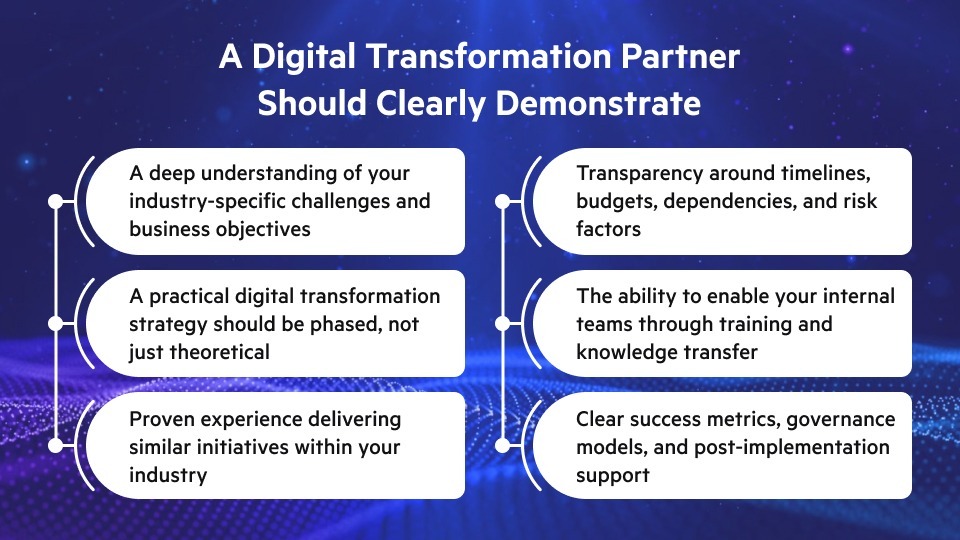
EvonSys combines industry experience, realistic roadmaps, and long-term enablement to ensure transformation delivers measurable business value.

How Low Code Is Accelerating Digital Transformation

Low-code helps companies build applications with minimal coding effort. Low-code platforms allow teams to design workflows, user interfaces, and integrations using visual models. This reduces development time, making it easier for business and IT teams to collaborate. As requirements change, updates can be implemented quickly, preventing projects from stalling or restarting.

Understanding digital transformation is the first step toward meaningful change. Successful transformation shows in how smoothly an organization eliminates the need for manual follow-ups. The transformation should integrate strategy, people, process, and technology together to create expected business value. With the right approach, a digital transformation partner by your side turns the process into a manageable, ongoing journey rather than a complex project.

Heading 1

Heading 2

Heading 3

Heading 4

Heading 5
Heading 6

Lorem ipsum dolor sit amet, consectetur adipiscing elit, sed do eiusmod tempor incididunt ut labore et dolore magna aliqua. Ut enim ad minim veniam, quis nostrud exercitation ullamco laboris nisi ut aliquip ex ea commodo consequat. Duis aute irure dolor in reprehenderit in voluptate velit esse cillum dolore eu fugiat nulla pariatur.

Block quote

Ordered list

  1. Item 1
  2. Item 2
  3. Item 3

Unordered list

  • Item A
  • Item B
  • Item C

Text link

Bold text

Emphasis

Superscript

Subscript

Most digital transformations fail in execution, where teams patch one workflow, bolt on one tool, and migrate one system, and still end up with delays, rework, and customer experiences that expose the cracks.

At the same time, digital transformation is clearly delivering value when done right. According to Grand View Research, digital transformation is expected to reach USD 4,617.78 billion by 2030, with a growing CAGR of 28.5% from 2025 to 2030. While many succeed with digital transformation, others stall or fall short. The difference rarely comes down to investment, it comes down to the strength of the strategy guiding execution from start to finish.

A well-planned digital transformation strategy distinguishes between executing projects and genuinely changing how the business operates. Let’s explore the key elements that define a practical approach.

Harness Digital Transformation Strategies to Drive Measurable Business Outcomes

Anchor Transformation to Business Outcomes

Digital transformation works only when it is grounded in clear business outcomes. Instead of starting with tools or programs, organizations must first define why change is necessary. It can shorten turnaround times, remove operational blind spots, or deliver more consistent service.

This outcome-first approach helps to filter unnecessary steps throughout the transformation journey. Every process change, automation effort, and technology investment is measured against its ability to move the business closer to these goals.

Prioritize Customer Experience

Customer expectations are continually evolving, and to stay competitive, businesses must focus on delivering an enhanced customer experience. They have endless choices and are overwhelmed when experiences become complex. Simplicity drives stronger loyalty, organizations must define what “simple” means for their business, reduce unnecessary options, and design not just simple products but frictionless end-to-end customer journeys. Achieving this often demands significant internal effort, trade-offs, and a deep understanding of real customer needs, while still allowing flexibility where it adds value.

Scale Faster by Connecting with the Right Ecosystem

To increase long-term resilience and drive near-term goals, connecting with the right ecosystem is essential. Sustainable digital transformation does not occur in isolation; it relies on how effectively systems, partners, platforms, and data sources collaborate.

A strong transformation ecosystem should:

  1. Integrate existing core systems, cloud platforms, and third-party applications without extensive rewrites.
  2. Adapt to advanced technologies without disrupting ongoing operations.
  3. Respond faster to market or regulatory changes by leveraging proven tools and partnerships.

Transformation for Change, Not Stability

Transformation efforts should support future growth, rather than limiting it. Planning for scalability means designing processes, systems, and automation that can handle increased volume, new integrations, and evolving requirements. When scalability is considered early, organizations avoid costly rework and ensure that digital capabilities grow in tandem with the business.

Choose a Partner Who Can Execute, Not Just Advise

The market is crowded with digital transformation partners, but finding the right one is rarely straightforward. On the surface, many providers appear similar. The real difference lies in their ability to translate strategy into execution and offer the best post-implementation support.

EvonSys combines industry experience, realistic roadmaps, and long-term enablement to ensure transformation delivers measurable business value.

How Low Code Is Accelerating Digital Transformation

Low-code helps companies build applications with minimal coding effort. Low-code platforms allow teams to design workflows, user interfaces, and integrations using visual models. This reduces development time, making it easier for business and IT teams to collaborate. As requirements change, updates can be implemented quickly, preventing projects from stalling or restarting.

Understanding digital transformation is the first step toward meaningful change. Successful transformation shows in how smoothly an organization eliminates the need for manual follow-ups. The transformation should integrate strategy, people, process, and technology together to create expected business value. With the right approach, a digital transformation partner by your side turns the process into a manageable, ongoing journey rather than a complex project.

Related Articles

The Role of Visual Application Development in Scalable Low-Code Modernization

Read More
March 3, 2026

The EvonSys Approach to De-Risking Enterprise Digital Transformation with Low Code

Read More
February 25, 2026

Understanding Digital Transformation and the Challenges Businesses Face

Read More
February 17, 2026