.png)

.png)
A banking operations team processing thousands of customer requests often spends hours on repetitive tasks such as data entry, document validation, account updates, and report generation. After implementing Robotic Process Automation (RPA), software bots handle these rule-based activities across existing banking systems, enabling back-office teams to focus on complex cases, decision-making, and customer service improvements.
RPA uses software bots to handle repetitive tasks according to predefined business rules, thereby enhancing speed and accuracy. For banks, RPA implementation reduces manual effort, minimizes errors, and helps operations teams process requests faster without replacing existing core systems.
However, successful RPA adoption requires a secure and scalable approach aligned with compliance, governance, and business objectives. This blog explores how RPA implementation in banking automates repetitive business tasks, improves operational efficiency, and helps banks build scalable, audit-ready automation environments.
Banking organizations implement automation to manage the increasing volume of data and operational complexity that manual processes can no longer support at scale.
This is where automation shifts from being an efficient initiative to a necessary operational tool. Every task handed over to the bots is applied consistently across multiple systems, without variation. Tasks run on schedule, validations are enforced uniformly, and exceptions are surfaced immediately without delay. Importantly, this consistency is achieved without altering core banking systems, allowing automation to stabilize operations while existing platforms remain unchanged.
According to Grand View Research, the global RPA market was valued at approximately USD 3.79 billion in 2024 and is expected to reach USD 30.85 billion by 2030, expanding at a CAGR of 43.9% from 2025 to 2030.
The moment when the transition from experimenting with RPA implementation in banking to scaling it up occurs, the focus shifts quickly from what can be automated to what should be automated.
Let’s explore the key RPA implementations in the banking sector.
Transaction processing sits at the center of RPA implementation in the banking industry. Teams need to validate transactions, cross-check customer data across multiple systems, update records, and generate confirmations or reports. These steps follow defined logic, yet still depend heavily on manual execution.
RPA implementation in banking automates repetitive business tasks by removing dependency through automated execution. They validate transactions against predefined rules, synchronize updates across the systems, and surface exceptions immediately. No manual handoffs are necessary during the RPA audit, since every action is logged and traceable.
For operating teams, this means less time spent clearing queues and correcting errors. For business owners, it means predictable turnaround times, stable service levels, and the ability to automate repetitive business tasks without changing core banking platforms, even as transaction volumes increase.
Routine activities, such as updating customer details, changing account status, processing service requests, and verifying documents, must adhere to strict regulatory guidelines. While each task is simple, executing them consistently at scale is not.
This approach demonstrates how RPA implementation in banking enables teams to automate repetitive business tasks at scale without introducing operational risk or audit gaps. Bots apply predefined rules to update records across systems, validate mandatory fields, and complete end-to-end servicing workflows. Every step is logged automatically, creating a clear audit trail that supports internal controls and simplifies the RPA audit process. There is no reliance on manual checklists or individual judgment for rule-based actions.
For operations teams, this eliminates repetitive service work and reduces rework caused by missed steps or incomplete updates. For business owners, it delivers faster turnaround, uniform service quality, and the ability to automate repetitive business tasks without adding operational risk or headcount as volumes grow.
An audit-ready RPA environment is built around comprehensive governance and rigorous documentation in a controlled environment. This ensures that every automated action is logged, controlled, traceable, and compliant, thereby increasing security.
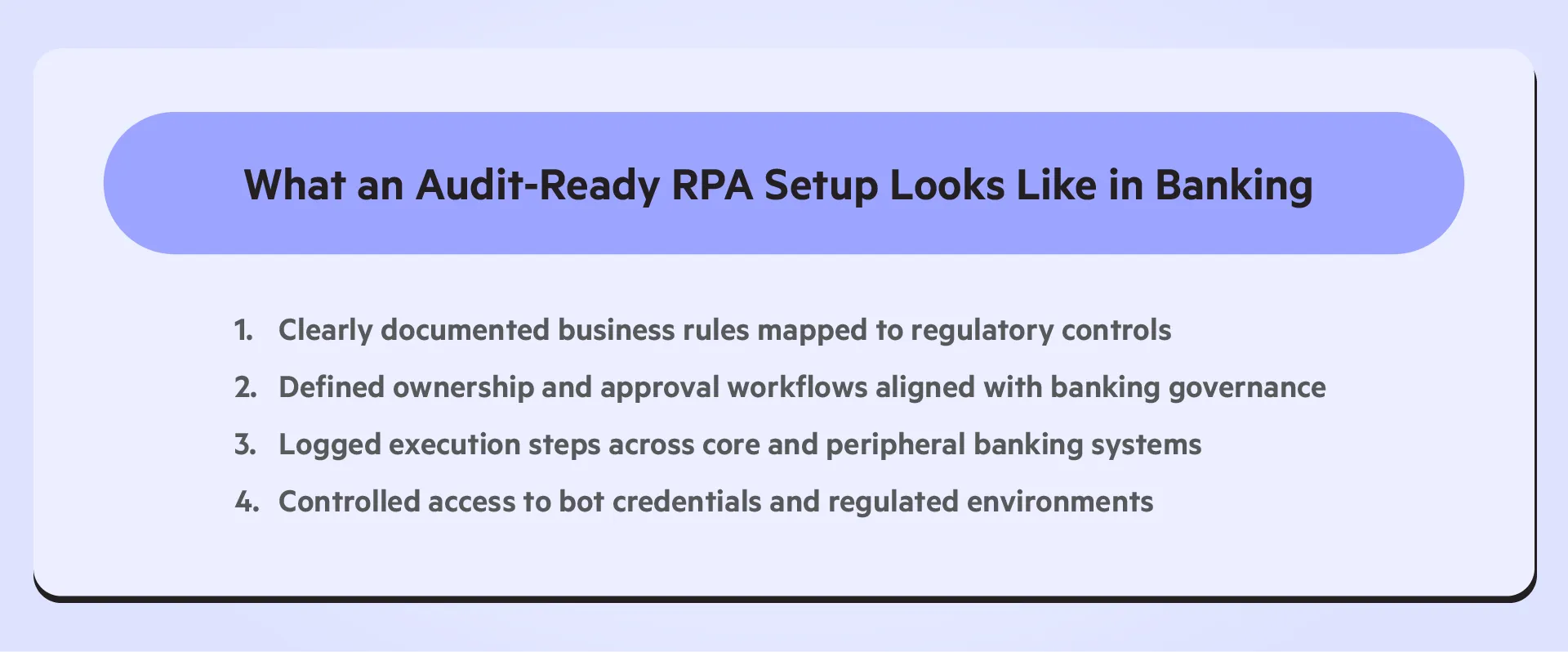
For operations teams, governance reduces the need for firefighting. Changes are predictable, exceptions are visible, and responsibilities are clear.
For business owners, it delivers confidence; automation can scale without creating hidden risks or audit surprises.
This is why RPA implementation in banking treats governance and audit readiness as foundational. Automation succeeds not because bots are fast, but when execution remains controlled, explainable, and resilient as complexity grows.
As banking operations become increasingly interconnected, execution consistency becomes a business requirement, not just an efficiency goal. It provides a controlled way to automate repetitive business tasks while maintaining accuracy, traceability, and turnaround predictability.
However, automation delivers value only when it operates within a disciplined framework. RPA audit readiness, governance controls, and standardized execution determine whether it strengthens operational control or creates risk. Banks that treat auditability, ownership, and partner-led delivery as core design principles can scale automation without compromising compliance or oversight.
At EvonSys, we support banks across the full automation lifecycle. Our RPA services are delivered as part of a broader digital transformation approach that includes low-code application development, workflow automation, system integration, and governance-led execution. This enables banks to modernize operations without disrupting core systems, protect existing investments, and build automation as a sustainable, enterprise capability.
Build an audit-ready RPA strategy that scales with your banking operations

.png)


.png)