.png)

.png)
A business analyst opens a 60-page scope document on a Monday morning. Before any stakeholder conversation happens or any judgment gets applied, there are days of mechanical work ahead. Reading, breaking the document into epics, splitting epics into features, writing user stories, drafting acceptance criteria. By the time the backlog is ready for Jira, most of the week is gone, and business analyst productivity has taken a direct hit before the real work even started. This is not an unusual project. It's standard practice across enterprise software delivery, repeated on scope document after scope document, across team after team.
This blog takes a closer look at why this problem has quietly persisted for so long, and why the common fixes haven't solved it. By the end, you'll see why requirements decomposition deserves to be treated as a solvable problem, not just an unavoidable cost of enterprise delivery.
Four characteristics explain why manual requirements decomposition remains a stubborn drag on business analyst productivity.
Unworkable
BAs currently spend 60-70% of their effort on the mechanical task of decomposing scope documents. This is not judgment work. It's repetitive, error-prone, and disconnected from the parts of the job that require expertise, like stakeholder negotiation or domain interpretation.
Urgent
Traditional decomposition takes three to five days per scope document. That delay creates an immediate drag on project velocity from day one, pushing every downstream milestone later before the team has written a single line of code.
Unavoidable
Requirements analysis is the mandatory foundation of any delivery effort. There is no backlog without decomposition, and there is no build without a backlog. Teams cannot skip this phase, yet it remains where projects consistently bleed the most time.
Underserved
No existing option solves manual requirements decomposition well. Doing it by hand is slow but reliable. Turning to a generic AI chatbot is fast but risky, since it can produce requirements that were never in the source document.
These characteristics explain why an activity everyone agrees is necessary remains one of the least optimized parts of enterprise delivery.
Manual decomposition typically costs an enterprise between $2000 - $5000 in analyst time per scope document, a figure that compounds quickly across a portfolio of active projects running in parallel. Multiply that by the number of scope documents moving through a delivery pipeline in any given quarter, and the requirements phase alone starts to look like a meaningful line item rather than a rounding error.
The cost doesn't stop at the requirements phase either. QA teams can't write test scenarios until the requirements are decomposed into clear, testable criteria. So the same three-to-five-day wait that slows down BAs also pushes back when QA can start, often by a full sprint or more. That means a slow start to requirements decomposition doesn't just delay one team. It delays the entire project timeline before development has even begun, making this both a cost problem and a velocity problem, not just a staffing inconvenience for the BA team. Delivery leaders who track sprint velocity or budget variance are often looking at symptoms of this bottleneck without realizing where the delay originates.
The instinct to hand mechanical decomposition to junior analysts, freeing seniors for higher-value work, seems reasonable on paper. In practice, output quality depends heavily on the experience of whoever is assigned. A junior analyst may take longer, miss domain nuances, or produce an inconsistent structure that introduces scope creep risk downstream. The same scope document can produce meaningfully different backlog quality depending on who decomposes it, which means redistributing the mechanical burden doesn't remove the risk. It just relocates it to a less experienced set of hands.
This is also why business analyst productivity is difficult to solve through hiring or restaffing alone. Adding headcount doesn't fix a process problem. It just adds more people running the same slow, inconsistent process, which can introduce more variability into backlog quality rather than less.
Generic large language models (LLMs) were never built for this specific task. They produce flat, unstructured text with no awareness of domain context, regulatory language, or enterprise conventions. General-purpose AI chatbots carry a real risk of hallucinating requirements that don't exist anywhere in the source document, introducing new risk into a process that is already fragile.
For a workflow where traceability and accuracy matter, that risk often outweighs the time it claims to save. A backlog can look complete and well-written, while containing requirements the generic AI invented rather than pulled from the source document. Because these fabricated details often read just as convincingly as real ones, they tend to go unnoticed until development is already underway and building against something that was never part of the original scope.
Myth vs Reality
Requirements decomposition comes with a few assumptions that rarely get questioned, because they have been the default for so long. Here's how those assumptions about junior BAs, generic AI, and bottleneck hold up.
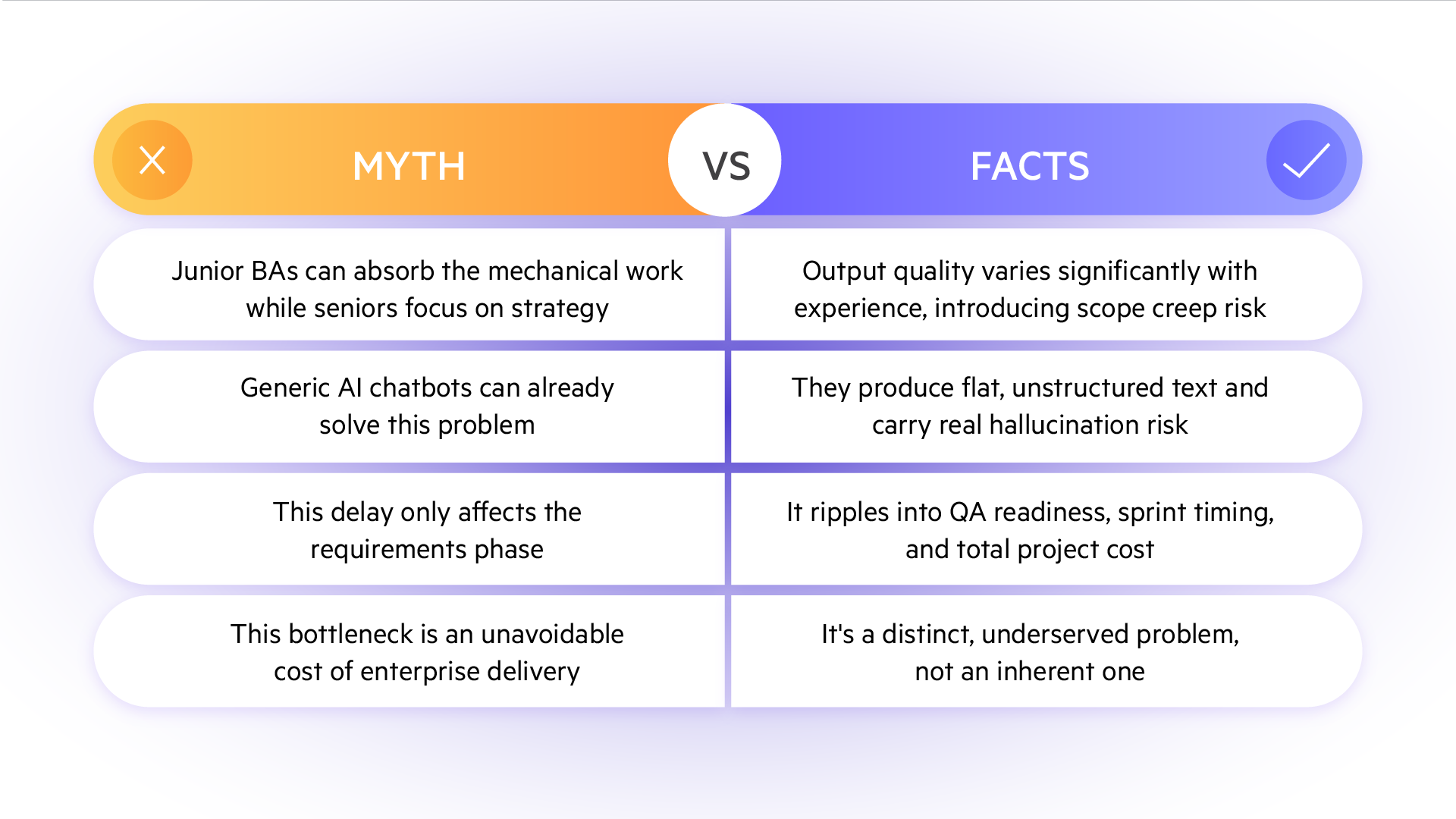
Manual decomposition is slow but reliable. Generic AI is fast but unreliable. Neither approach was built to solve the specific problem of turning unstructured requirements into structured, enterprise-ready work items without introducing new risk. That gap between "slow and safe" and "fast and unreliable" has defined this space for years, and it's the real story behind why business analyst productivity keeps suffering long after most other parts of software delivery have modernized.
What's starting to shift is the recognition that this gap is solvable. The industry is beginning to treat requirements decomposition as a distinct problem worth solving directly, rather than an unavoidable cost baked into every delivery timeline. The teams that figure this out first will move faster and will free their most experienced analysts to spend their time on the judgment calls that require a senior BA, instead of the mechanical work that doesn't.
Ready to rethink requirements decomposition?

.png)


.png)