

.png)

.png)
Every unresolved payment exception costs more than time. It consumes skilled operational capacity, triggers internal escalations, amplifies customer dissatisfaction, and ultimately erodes trust while exposing critical gaps in process control.
Yet in many banks, payment investigations are still handled through manual coordination across emails, spreadsheets, and disconnected systems.
Operations teams spend most of their time chasing information, clarifying ownership, and tracking case status instead of resolving issues. Industry benchmarks show that up to 30 percent of payments operations capacity is absorbed by investigation-related work, much of it driven by repeated data handling and follow‑ups rather than actual resolution.
As payment volumes grow and expectations tighten, these inefficiencies become harder to manage. What was once a manageable back‑office function starts to impact service levels, operational costs, and regulatory confidence.
Banks that continue to rely on fragmented investigation processes find themselves reacting instead of controlling outcomes. This is why leading financial institutions are rethinking payment investigations, not as a necessary overhead, but as a process that must be automated, visible, and scalable.
This is where TracEI - an intelligent payment investigations software plays a critical role in transforming how banks manage their payments exceptions and investigations.
While a payment investigation might appear straightforward on the surface, the reality is a high-stakes coordination of systems, stakeholders, and regulatory requirements. Resolving a single failed or delayed transaction often demands:
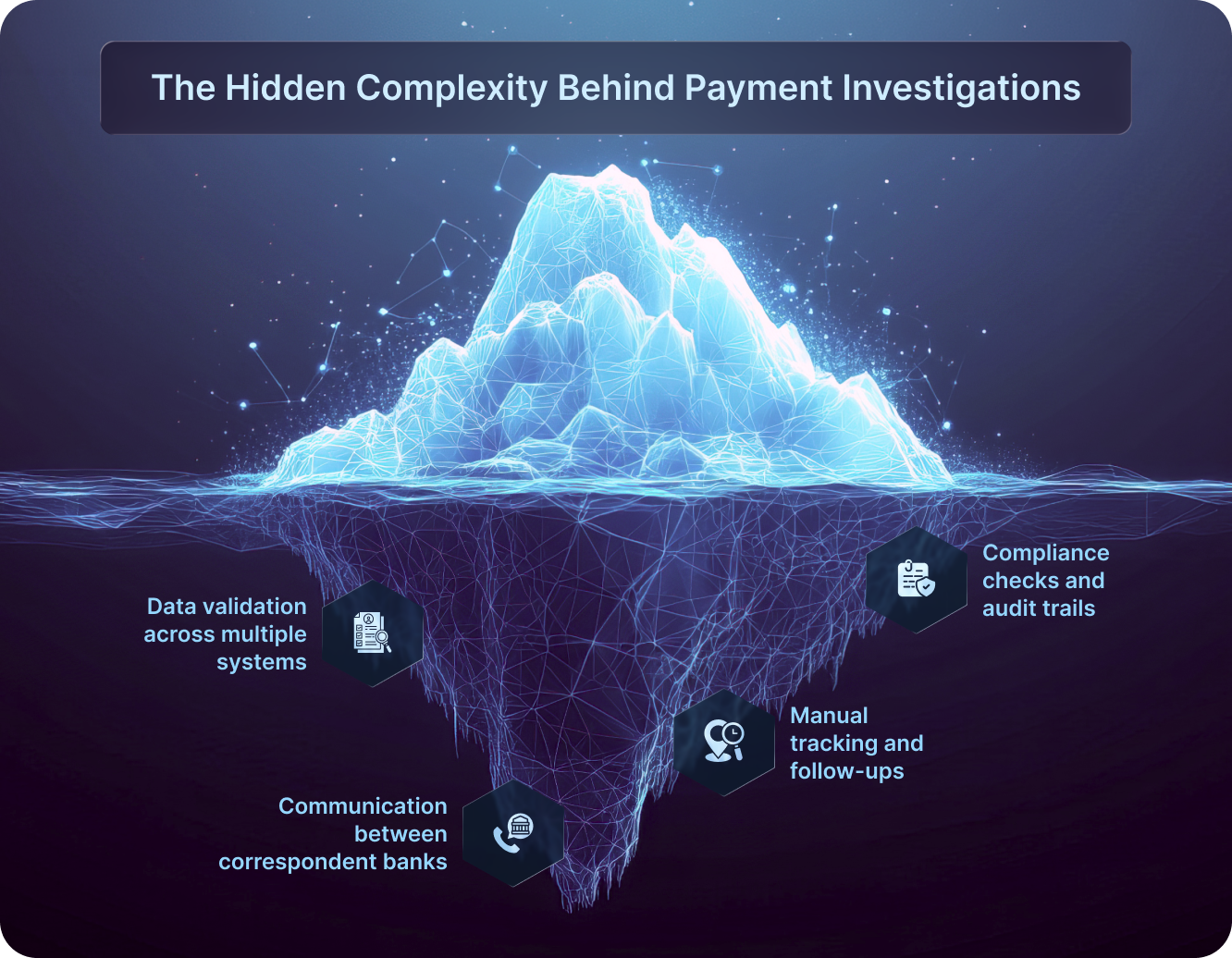
Despite the digital nature of payments, many financial institutions still navigate this complexity using legacy tools like fragmented spreadsheets, endless email chains, and siloed case management systems. Recent surveys show that over 88% of US respondents acknowledge that their company relies heavily on spreadsheets for reconciliation and exception handling, leading to poor data transparency and operational strain.
This fragmented approach creates inefficiencies such as:
As global transaction volumes scale, these manual bottlenecks don’t just persist; they multiply, eroding service levels and driving up operational costs.
Traditional payment investigation models struggle with speed because they are built around reactive workflows. Sequential handoffs, unclear ownership, and after-the-fact reconciliation slow down progress at every stage. This approach may have worked when resolution timelines stretched over days, but it does not hold up in today’s near real-time payment environment.
The core issue is not always complexity, but the absence of a unified payment investigations software to coordinate actions and enforce accountability. Without orchestration, cases lose momentum as they move across teams and counterparties, creating avoidable delays.
As transaction volumes grow, these inefficiencies become more evident. Manual handling increases dependency on individual expertise, introduces rework, and limits scalability. Investigation workloads begin to rise in proportion to payment volumes, driving higher operational costs without improving resolution speed.
The result is a widening gap between fast payment execution and slow issue resolution, impacting customer experience, liquidity management, and operational efficiency. Addressing this gap requires a shift to modern payment investigation software that can bring structure, visibility, and speed to the process.
TracEI is a purpose-built, automation‑driven Exceptions and Investigations (E&I) platform developed to address the operational realities of payment investigations in modern banks. It is an intelligent payment investigations software designed to support investigation workflows across domestic and cross‑border payments, where speed, accountability, and transparency are increasingly critical.
By combining automation, orchestration, and real‑time visibility, TracEI provides banks with a structured way to manage investigations more efficiently and with greater operational control. For institutions reassessing how investigations fit into modern payment operations, TracEI offers a clear alternative to fragmented, manual approaches.
Instant Case Creation Through Automated Case Intake
In many banks, investigation timelines are extended before work even begins because requests arrive through multiple channels and require manual interpretation. TracEI is designed to remove this early‑stage friction through automated case intake.
Investigation requests can be captured across channels, classified intelligently, and converted into structured cases without manual intervention. By automating how cases enter the system, TracEI is designed to ensure investigations begin as soon as an issue is raised, reducing avoidable delays at the most critical point in the lifecycle.
Orchestrated Workflows That Keep Cases Moving
Once a case is opened, progress often depends on informal coordination across teams and systems. TracEI addresses this by introducing workflow orchestration aligned with banking investigation processes.
Cases can be routed automatically based on defined rules, assigned clearly at each stage, and progressed through structured steps rather than ad‑hoc follow‑ups. Alerts and escalation logic are built into the workflow to help teams identify stalled cases early and take corrective action before service levels are impacted.
Unified Visibility Across the Investigation Lifecycle
Fragmented visibility is a common constraint in investigation operations. When case information is spread across systems, teams lose time tracking status instead of resolving issues.
TracEI is designed to provide a centralized view of all investigations, offering real‑time insight into case progress, turnaround expectations, and SLA exposure. This shared visibility supports faster decision‑making, clearer prioritization, and improved operational oversight as investigation volumes grow.
Structured Collaboration Without the Email Overhead
Payment investigations frequently involve multiple internal teams and external counterparties. Traditional email‑driven communication introduces delays, inconsistencies, and incomplete audit trails.
TracEI replaces these informal exchanges with structured collaboration embedded within the investigation workflow. Interactions are standardized, context is preserved, and a complete activity history is maintained for each case. This approach is intended to reduce friction between stakeholders while supporting audit and compliance requirements.
Automation Designed to Improve Consistency and Control
Manual investigation handling increases both effort and risk. Repetitive tasks consume skilled resources and create opportunities for error as cases move across teams. TracEI applies payment investigations automation across key investigation steps to reduce these dependencies.
Routine activities can be system‑driven, decision logic applied consistently, and case handling made more predictable. This design supports faster progression without sacrificing accuracy, governance, or traceability.
Reframing Investigations as an Operational Capability
Payment investigations have traditionally been treated as a reactive cost center. TracEI supports a shift toward managing investigations as a controlled operational capability, with defined ownership, measurable performance, and scalable processes.
For banks focused on strengthening operational resilience and customer confidence, this shift is increasingly important as payment execution speeds continue to rise.
Payment ecosystems are evolving rapidly, driven by higher transaction volumes, tighter regulatory scrutiny, and increasing expectations for transparency. TracEI provides a foundation designed to support this evolution by enabling scalable, automated investigation management. It allows banks to prepare for future demands without relying on manual coordination as a primary control mechanism.
If payment investigations are becoming a limiting factor in your payment operations, experiencing TracEI in action can help clarify what a more controlled and efficient model looks like. A TracEI demo walks through how case intake, orchestration, visibility, and collaboration come together to address delays across the investigation lifecycle.
Ready to transform your payment investigations?
Discover how TracEI can help you eliminate delays, automate workflows, and achieve real-time resolution across your payment operations.
.png)
.png)

.png)


.png)