
.png)

.png)
The adoption of ISO 20022 marks one of the most significant transformations in global payments. Designed to improve interoperability, transparency, and straight-through processing, the standard introduces richer, more structured payment data that enables financial institutions to process and monitor transactions with greater accuracy.
For banks, however, the migration has revealed a challenge that extends far beyond payment messaging.
While payment networks have modernized rapidly, many payment investigation platforms continue to operate on architectures built for the Swift MT era. As payment messages become richer and more complex, these legacy systems are finding it increasingly difficult to support the investigation workflows needed to resolve payment exceptions efficiently.
The coexistence period between Swift's MT and ISO 20022 MX messages officially ended on November 22, 2025. Today, all cross-border payment instructions are exchanged using ISO 20022. By the end of the migration, more than 80 percent of daily Swift traffic had already transitioned to the new standard, with over 3.1 million payment messages exchanged every day across more than 210 countries.
While the payments ecosystem has successfully adopted the new messaging standard, many investigation systems have not evolved at the same pace. As a result, operations teams are experiencing longer investigation cycles, greater manual effort, and increasing operational complexity.
ISO 20022 has not created these challenges. It has simply made the limitations of legacy investigation platforms much more visible.
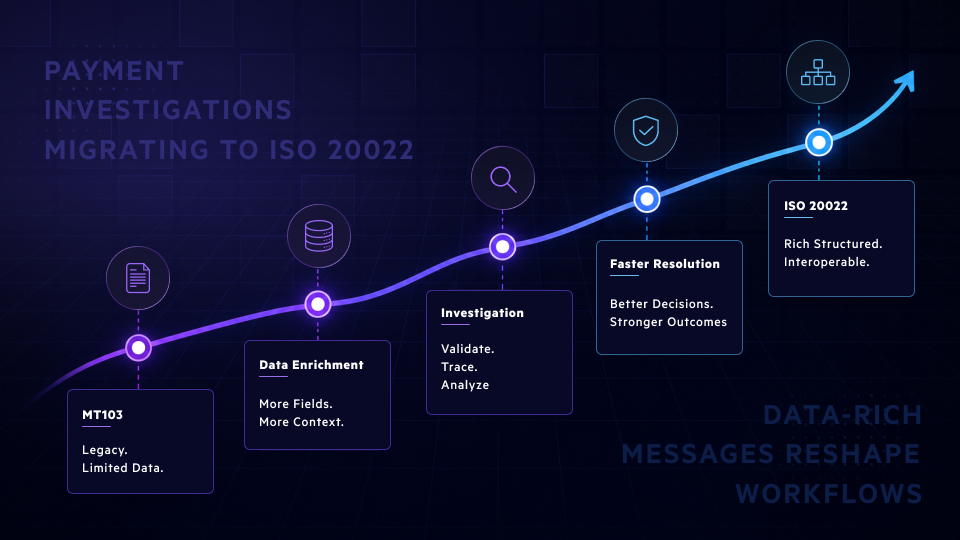
Most payment investigation platforms were designed during a time when Swift MT messages formed the foundation of cross-border payments. These messages contained relatively simple, flat data structures, allowing investigation systems to process payment information using predefined workflows and limited data models.
ISO 20022 introduces a fundamentally different approach.
MX messages are XML-based and contain significantly richer information, including structured remittance details, extended party information, regulatory data, and enhanced payment references. Instead of relying on free-text fields, the standard provides a level of detail that supports better automation, improved compliance, and greater visibility throughout the payment lifecycle.
The challenge is that many existing investigation platforms were never designed to interpret or utilize this level of structured information.
Rather than making investigations easier, the additional data often creates more manual work. Information may be truncated, mapped incorrectly, or stored outside the investigation workflow, forcing analysts to switch between multiple applications to understand what happened to a payment.
The value of ISO 20022 lies in its structured data. Legacy investigation platforms often prevent organizations from realizing that value.
The Growing Limitations of Traditional Case Management
The impact of legacy architecture is particularly evident in payment case management.
For many years, Swift Case Manager has provided banks with a standardized way to manage payment inquiries, recalls, cancellations, and investigations. It remains an important part of cross-border payment operations. However, its original design reflects the messaging models and case structures of the MT environment.
As financial institutions process a growing volume of ISO 20022 messages, fitting richer MX data into legacy investigation workflows becomes increasingly difficult.
Operations teams frequently encounter incomplete case information, manual workarounds to capture additional payment details, and fragmented investigation processes. What should be a data-driven workflow often becomes a series of manual activities across multiple systems.
The business impact is significant.
Industry estimates suggest that many financial institutions collectively spend more than USD 1.6 billion each year handling payment investigations. Although analysts may spend only one or two hours actively working on a case, investigations often remain open for five to ten days because of multiple handoffs, disconnected systems, and limited operational visibility.
As payment volumes continue to increase, these inefficiencies become increasingly difficult to sustain.
The transition to ISO 20022 has highlighted several areas where traditional investigation platforms struggle to meet modern operational requirements.
Inability to Utilize Structured Payment Data
ISO 20022 was designed to provide richer and more meaningful payment information. Yet many investigation platforms cannot fully display or process these structured fields. Analysts often need to search across multiple systems to retrieve information that should already be available within the investigation workflow.
Dependence on Message Translation
During the migration period, many financial institutions relied on Swift's In-flow Translation service to convert MX messages into MT formats before they reached downstream systems.
While this simplified migration, it also removed much of the structured information that ISO 20022 was designed to deliver. The result is reduced visibility, limited automation opportunities, and investigation processes that continue to depend on legacy message structures.
Limited Investigation Automation
Modern payment messages provide sufficient context to automate many routine investigation activities, including case creation, payment identification, duplicate detection, routing, and prioritization.
Legacy platforms, however, continue to depend on static business rules and manual intervention, increasing operational costs while limiting investigator productivity.
Increasing Compliance Challenges
Regulatory reporting and compliance processes are increasingly built around ISO 20022's structured data model. Investigation systems that cannot capture or report this information accurately place additional pressure on compliance teams while increasing operational risk.
For many institutions, payment modernization has traditionally been viewed as a long-term technology initiative.
ISO 20022 has changed that perspective.
The standard is reshaping how payments are processed, monitored, and investigated. Organizations that continue relying on platforms designed for older messaging standards are likely to experience increasing operational costs, slower investigation cycles, and greater difficulty meeting customer expectations.
Conversely, banks that process ISO 20022 messages natively are already realizing measurable benefits.
Industry research indicates that native ISO 20022 implementations can reduce sanctions screening false positives by 25 to 30 percent. This translates into fewer unnecessary investigations, lower operational costs, and improved productivity for payment operations teams.
Modernization is no longer simply about replacing legacy technology. It is about enabling payment operations to fully leverage the intelligence that already exists within today's payment messages.
The Operational Cost of Legacy Investigation Systems
The cost of maintaining legacy investigation platforms extends well beyond technology maintenance.
Every delayed investigation increases operational expenses, extends customer resolution times, and creates additional compliance exposure. As payment volumes continue to grow and real-time payment expectations become the norm, these inefficiencies become increasingly expensive.
There is also another important milestone approaching.
By November 2026, fully unstructured postal addresses will be removed from CBPR+ payment messages. Financial institutions that continue relying on investigation systems designed around free-text data will face another wave of modernization requirements.
ISO 20022 was introduced to improve transparency and traceability across payment ecosystems.
Without modern investigation platforms, many organizations are unable to take advantage of these capabilities.
Building Payment Investigations for the ISO 20022 Era
Modern payment investigation platforms need to do far more than process payment messages.
They should provide a unified operational environment capable of handling MT, MX, Fedwire, and future payment formats while using structured payment data to automate investigations from the moment a case is created.
Successful modernization initiatives typically include native ISO 20022 support, intelligent case orchestration, API-driven integration with banking systems, automation for repetitive investigation activities, and scalable architectures that can evolve alongside future payment standards.
More importantly, they allow operations teams to focus on resolving payment exceptions instead of managing disconnected systems and manual processes.
TracEI, developed by EvonSys on Pega Launchpad, was designed to address these operational challenges.
Rather than extending fragmented investigation environments, TracEI provides a unified platform that supports payment investigations across MT, MX, Fedwire ISO messages, RFIs, recalls, and payment exceptions within a single workflow.
The platform automatically extracts structured payment information, creates investigation cases, identifies duplicate requests, prioritizes workloads, and routes investigations using Swift Case Manager logic. By leveraging the richness of ISO 20022 data instead of relying on message translation, TracEI helps banks reduce manual effort while improving investigation speed and operational visibility.
By bringing domestic and cross-border investigations together on one platform, financial institutions can simplify operations, improve collaboration, and deliver faster payment resolutions.
ISO 20022 represents more than a messaging standard. It represents a new foundation for payment operations.
As payment ecosystems continue to evolve, investigation platforms must evolve alongside them. Organizations that continue relying on legacy systems will find it increasingly difficult to manage growing payment volumes, meet regulatory expectations, and deliver the level of service customers now expect.
Banks that modernize their payment investigation capabilities, however, can use structured payment data to automate investigations, improve operational efficiency, strengthen compliance, and deliver a more transparent payment experience.
The true value of ISO 20022 will be realized not just through successful migration, but through the transformation of payment investigation operations to fully unlock the potential of the new standard.
Don't Let Legacy Systems Limit ISO 20022 Benefits
Discover how TracEI helps banks automate payment investigations, reduce manual effort, and unlock the value of richer ISO 20022 payment data.
.png)


.png)


.png)