

.png)

.png)
Payment investigations are no longer a secondary operational concern inside banks. They have evolved into a direct reflection of customer trust and operational resilience.
Industry estimates show that around 5% of cross-border payments encounter friction requiring manual intervention, creating major downstream investigation workloads. At the same time, financial institutions collectively spend more than USD 1.6 billion every year on labor-intensive payment investigations, highlighting the scale of inefficiency in current processes.
While payment processing has accelerated significantly, with the majority of cross-border payments now reaching beneficiary banks within an hour. But investigation timelines have not kept pace. In many institutions, resolving an exception or inquiry still takes five to ten working days, exposing a persistent gap between payment speed and operational response.
This growing disconnect between payment speed and investigation efficiency is creating a measurable business impact.
As ISO 20022 adoption accelerates and SWIFT Case Manager workflows become standard across global payment ecosystems, banks are under increasing pressure to rethink how they handle payment exceptions, recalls, RFIs, and investigation cases.
The question in 2026 is no longer whether your bank can process payment investigations.
The real question is whether your investigation framework can scale with rising volumes, structured data, stricter compliance expectations, and customer demand for instant visibility.
This is where the decision becomes strategic.
Choosing the right payment investigation software is no longer an operational upgrade. It is an investment in long-term efficiency, compliance readiness, and customer experience differentiation.
Modern platforms like TracEI are redefining how banks approach payment investigations. Instead of extending fragmented in-house systems, TracEI introduces a unified investigation layer that combines automation, centralized orchestration, ISO 20022 readiness, and real-time visibility.
The result is a shift from reactive, manual investigation handling to a scalable, intelligence-driven investigation framework built for the future of payments.
Payment investigations are becoming more complex, more regulated, and far more time-sensitive. With ISO 20022 adoption accelerating and SWIFT modernization reshaping cross-border operations, banks can no longer rely on fragmented investigation processes and legacy workflows.
If you are evaluating a payment investigation platform in 2026, here are the key capabilities you should look for.
1. ISO 20022-Native Investigation Support
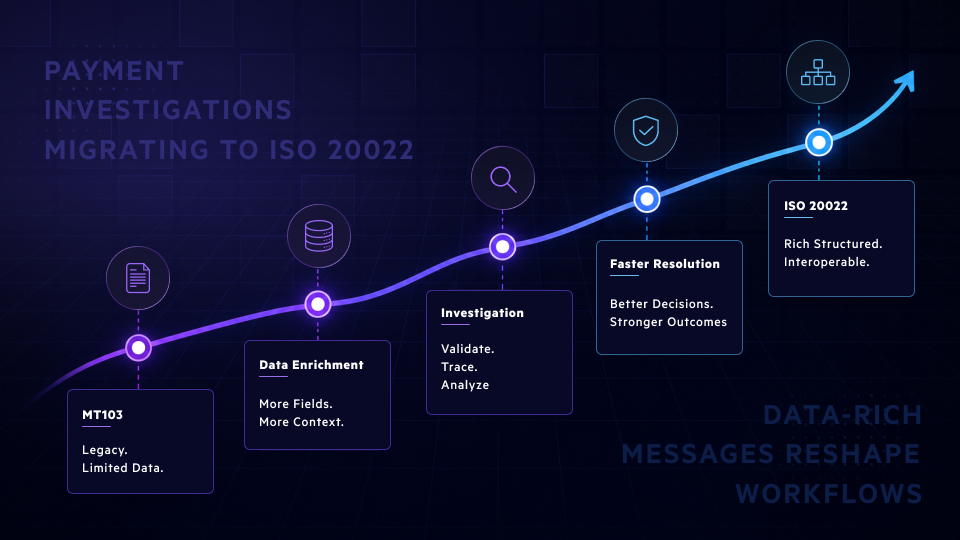
ISO 20022 is no longer just a messaging upgrade. It is redefining how payment investigations are initiated, tracked, and resolved across global payment ecosystems.
Banks that continue using legacy investigation workflows often struggle to fully utilize structured payment data, leading to slower resolutions, inconsistent handling, and increased operational effort.
When evaluating a platform, look for capabilities such as:
The right payment investigations software should help operations teams move from manual investigation handling to structured, data-driven workflows.
2. SWIFT Case Manager and Stop & Recall Readiness
As SWIFT modernization accelerates, investigation workflows are becoming more standardized, traceable, and collaborative.
Platforms that still depend on emails, spreadsheets, or disconnected systems introduce operational delays, audit gaps, and inconsistent communication between institutions.
A modern investigation platform should support:
With cross-border payment volumes continuing to grow, banks need investigation workflows that support faster coordination and improved transparency across the payment lifecycle.
3. Unified Case Management Across Payment Rails
Many financial institutions still manage investigations across siloed systems and operational teams.
Domestic payment investigations, cross-border inquiries, RFIs, exceptions, recalls, and fraud-linked cases are often handled separately, creating duplicate effort and fragmented visibility.
A modern platform should centralize:
A unified case management layer improves investigator productivity, strengthens governance, and creates more consistent investigation handling across payment rails.
4. Automation That Reduces Manual Investigation Effort
Manual investigations continue to place significant pressure on payment operations teams.
According to industry benchmarks, automation can reduce investigation resolution times by up to 80%, making workflow automation a critical capability for banks evaluating investigation platforms in 2026.
The right platform should automate:
5. Real-Time Operational Visibility
Without real-time visibility, banks struggle to identify bottlenecks, monitor SLA risks, and prevent investigation backlogs from escalating.
As payment volumes and compliance expectations continue to rise, operations teams need centralized visibility into investigation performance and workload distribution.
A strong investigation platform should provide:
Real-time operational insights help banks improve turnaround times, optimize resource allocation, and maintain stronger control over investigation workflows.
6. Faster Deployment Without Enterprise Complexity
Traditional investigation systems typically involve long deployment cycles, heavy customization, and high operational overhead.
Banks today are increasingly prioritizing platforms that can modernize investigation operations without requiring large-scale transformation programs.
When evaluating deployment readiness, look for platforms that offer:
The faster a platform can integrate into existing payment environments, the sooner operations teams can reduce investigation delays, improve efficiency, and streamline payment exception handling at scale.
As banks evaluate the next generation of payment investigation platforms, the challenge is no longer finding a tool that can simply manage cases. The real priority is identifying a platform that can modernize investigation operations without adding more complexity to existing payment environments.
This is where TracEI differentiates itself.
Instead of functioning as another disconnected investigation application, TracEI is designed as a centralized investigation orchestration platform built specifically for modern payment ecosystems. It brings together automation, real-time visibility, ISO 20022 readiness, and standardized workflows into a single operational layer.
TracEI is an intelligent payment investigation platform built on the Pega Launchpad and developed by EvonSys, a global leader in low-code solutions with decades of enterprise exceptions and investigations experience. It is designed to replace fragmented, native investigation workflows with a unified, automated investigation layer that can handle the complexity modern banks face, without the overhead of a full enterprise build.
TracEI helps financial institutions move away from:
And transition toward:
What also makes TracEI stand out is its ability to support modernization without forcing banks into large-scale transformation programs.
With API-first architecture, modular deployment flexibility, and faster implementation timelines, institutions can modernize investigation workflows incrementally while integrating with existing payment ecosystems.
As investigation complexity continues to grow alongside instant payments, ISO 20022 adoption, and SWIFT standardization, banks need platforms that are built not just for current operational requirements, but for the future of payment investigations.
TracEI positions itself as that next-generation exceptions & investigations (E&I) layer, helping banks improve operational efficiency, strengthen compliance readiness, and deliver faster, more transparent investigation experiences to customers.
Automation is no longer just about efficiency. It plays a critical role in reducing operational backlog, improving response consistency, and helping teams scale investigation handling without increasing manual workload.
This is the question every bank's decision-making team will confront. Here's an honest, structured view of why TracEI consistently comes out ahead among all the other in-house systems.
TracEI vs. In-House Systems
TracEI vs. Large Enterprise Platforms (with Enterprise Price Tags)
While some enterprise-grade investigation platforms offer strong functionality, they often come with high costs, extended implementation timelines, and significant operational complexity, making them difficult for mid-sized banks and regional institutions to adopt efficiently. TracEI was specifically designed to deliver enterprise-grade capabilities without the enterprise price tag, with a 6-week deployment path and a cost model built for institutions that need predictability.
Live in 6 Weeks
Low-code rollout with seamless integration and testing means you see operational benefits in weeks, not years. Early adopters gain a measurable first-mover advantage.
Built for Evolving Standards
TracEI is natively aligned with ISO 20022, SWIFT Case Manager, CBPR+, and Stop & Recall, with ongoing compliance managed by EvonSys, so your IT team doesn't bear that burden.
Eliminates Hidden Operational Costs
Annual SWIFT standards updates alone consume 2 FTE for 6 months at many banks. TracEI absorbs that overhead while converting a recurring variable cost into predictable, manageable licensing.
Unified Platform
TracEI unifies all investigation workflows in one system, including domestic, cross-border, sanctions, fraud, and customer service by eliminating the maintenance and training overhead of multiple tools.
ISO 27001 & ISO 27701 Certified
Enterprise-grade information security and privacy management certification, meeting the non-negotiable compliance requirements of regulated financial institutions globally.
Better Customer Outcomes Drive Revenue
Faster resolution directly improves customer satisfaction, supports client retention, reduces complaints, and creates a reputation advantage in competitive payment corridors.
Choosing a payment investigation platform is a decision with long-term operational and regulatory impact. Legacy MT199 and MT299-based investigation processes are already on a defined retirement path, and SWIFT release timelines such as SR2026 and SR2027 leave little room for delay or rework.
At the same time, payment volumes continue to rise, and cross-border investigations are becoming more complex and time-sensitive. Banks that continue to rely on fragmented in-house systems or manual workflows into 2027 risk higher operational costs, increased compliance pressure, and a widening gap between customer expectations and actual resolution capabilities.
The checklist outlined above provides a structured way to evaluate platforms based on what truly matters in 2026 and beyond. TracEI is built to align with these requirements, and the ROI Calculator can help quantify the potential operational and financial impact for your institution.
Transform Your Payment Investigations Process
Explore how TracEI handles your specific investigation workflows and quantify the impact on your financial institution.
.png)
.png)

.png)


.png)