

.png)

.png)
Every payment exception triggers a cascade of operational activities. An analyst opens a case. Teams sift through payment messages and transaction records. Correspondent banks exchange emails, and customers begin seeking updates.
While these activities are necessary, they also create high operational costs that often remain hidden from traditional budgeting and performance metrics.
Manual payment investigations have become one of the most overlooked sources of inefficiency in banking operations. As cross-border payment volumes continue to grow and regulatory scrutiny intensifies, the financial and operational impact of these investigations is becoming increasingly difficult to ignore.

The global market for cross-border payment services was valued at $212.5 billion and continues to grow steadily at 7.1% anually. As payment volumes increase, payment exceptions and inquiries rise as well. Industry data indicates that approximately 2%–10% of payments generate an investigation request, often resulting in lengthy resolution times, limited transparency, and poor customer experiences.
On the surface, these figures may appear manageable. However, when applied across millions of annual transactions, the operational burden becomes substantial.
Approximately 5% of cross-border payments encounter friction before reaching their destination, creating a need for manual intervention and contributing to more than $2 billion in annual industry costs. Individual investigations into delayed or failed payments typically cost payment providers between $30 and $50 per case. When multiplied across thousands of daily exceptions, the financial impact quickly becomes significant.

A typical manual payment investigation often follows a fragmented process:
An analyst receives an exception alert or inquiry.
Transaction details are manually cross-referenced across MT/MX messages, internal systems, and historical correspondence.
Teams reach out to correspondent banks via email or bilateral messaging channels.
Responses may take days, with little visibility into the investigation status.
Multiple stakeholders request and exchange the same information repeatedly.
Delays frequently occur when payment instructions contain incomplete or inaccurate information. Resolving such issues can take five to ten business days, depending on the number of parties involved and the complexity of the investigation.
During this period, customers are left waiting for answers, operations teams are diverted from higher-value work, and service-level commitments come under increasing pressure.
The impact of manual payment investigations reaches well beyond employee hours. It affects operational efficiency, compliance, customer trust, and regulatory readiness.
Operational Inefficiency
Many financial institutions continue to operate with straight-through processing (STP) rates that leave a significant percentage of transactions requiring manual intervention. Every manual touchpoint introduces delays, increases operational overhead, and creates opportunities for human error.
As payment volumes rise, manual investigation processes become increasingly difficult to scale without expanding headcount and operational costs.
Compliance Exposure
Manual workflows make it challenging to maintain consistent documentation and audit trails across investigations.
Financial crime compliance costs exceed $60 billion annually across the United States and Canada alone. At the same time, organizations facing compliance violations incur average annual costs that are nearly three times higher than the cost of maintaining effective compliance programs.
Without standardized investigation processes, maintaining regulatory readiness becomes increasingly difficult.
Customer Trust and Experience
Corporate clients expect payment transparency and timely resolution when issues arise.
When high-value transactions remain unresolved for days, customer confidence erodes. Delayed investigations often result in increased inquiry volumes, strained client relationships, and potential customer attrition.
In an increasingly competitive payments landscape, responsiveness and transparency are becoming key differentiators.
Regulatory Risk
Regulatory scrutiny around payment operations, AML monitoring, and transaction transparency continues to intensify.
Global regulators imposed billions of dollars in fines related to financial crime compliance failures in recent years. Investigation processes that lack structure, consistency, or auditability expose institutions to unnecessary operational and regulatory risk.
The payments industry is entering a new era of standardization and transparency.
ISO 20022 and SWIFT Case Manager are fundamentally changing how payment investigations are managed. Institutions that continue to rely on fragmented, manual workflows risk falling behind both operationally and competitively.
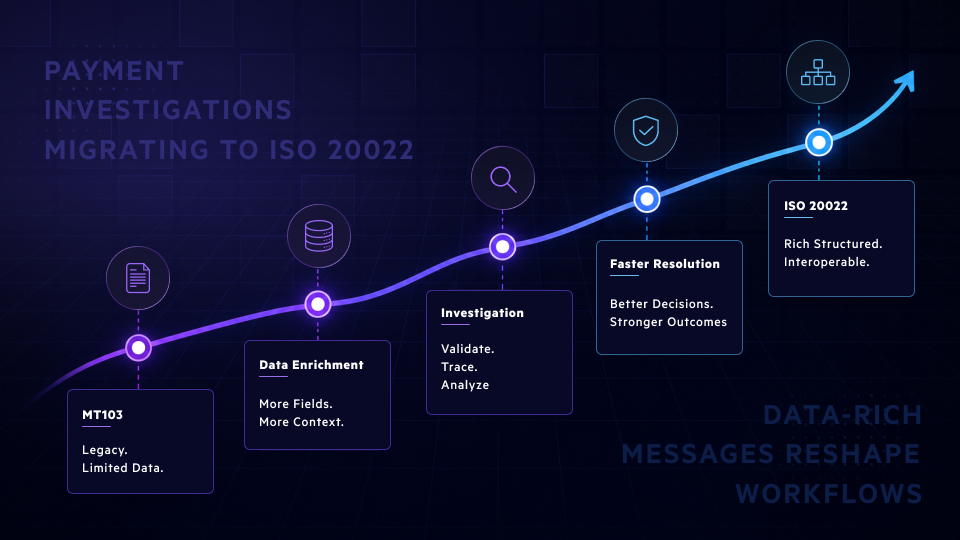
Rich, structured ISO 20022 data enables greater payment operations automation throughout the investigations lifecycle. Industry estimates suggest that up to 84% of exception messages can become eligible for straight-through processing when supported by structured data and banking workflow automation.
Financial institutions that have embraced ISO 20022 have already reported significant reductions in manual reconciliation efforts, improving both efficiency and accuracy.
SWIFT's enhanced Case Management capabilities further advance this transformation by standardizing investigation processes and leveraging ISO 20022 data and Universal End-to-End Transaction Reference (UETR) standards. The result is a more collaborative, transparent, and automated investigation environment between sending and receiving institutions.
The industry's direction is clear: payment investigations are moving toward standardized, automated, and fully auditable workflows.
The question is whether your bank's internal investigation capabilities are prepared to keep pace.
Financial institutions that replace fragmented manual processes with structured banking workflow automation consistently report measurable improvements across operations, compliance, and customer service.
Faster Resolution
Investigations that once required days of back-and-forth communication can often be resolved within hours or even minutes through automated workflows and intelligent case routing.
Consistent Processes
Every case follows a standardized workflow, reducing variability, eliminating unnecessary steps, and minimizing the risk of human error.
Complete Auditability
Every action, message, escalation, and resolution step is automatically recorded, creating a comprehensive audit trail for compliance and regulatory reviews.
Real-Time Visibility
Operations teams gain instant visibility into case status, investigator workloads, aging investigations, and SLA performance.
Scalability
As payment volumes grow, institutions can handle larger investigation workloads without proportional increases in staffing requirements. This is no longer a future-state vision. It is the operational reality for financial institutions that have modernized their investigations framework.
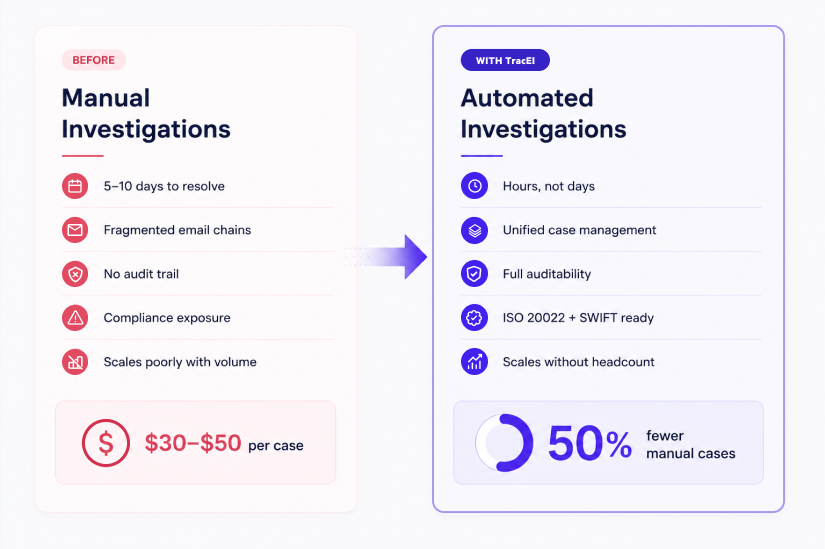
TracEI by EvonSys is a purpose-built payment investigations platform designed to eliminate the inefficiencies associated with fragmented, manual investigation processes.
Built on the Pega Launchpad platform and designed to be SWIFT Case Manager-ready, TracEI enables banks to manage the entire investigation lifecycle through a unified, automated workflow.
Key capabilities include:
TracEI helps financial institutions reduce manual payment investigations by up to 50% through intelligent payment operations automation and streamlined workflows. Resolution times are significantly shortened, transforming investigations that once took days into processes completed within hours.
At the same time, comprehensive audit trails ensure compliance teams have immediate access to the information they need during reviews and regulatory examinations.
Where traditional systems often create fragmented workflows, siloed processes, and limited visibility, TracEI delivers centralized case management, multi-scheme support, real-time dashboards, SLA monitoring, and workload management from a single platform.
Financial institutions can be operational in as little as six weeks, accelerating time-to-value without the complexity typically associated with enterprise transformation initiatives.
Manual payment investigations are no longer just an operational inconvenience. They represent a growing source of cost, risk, and inefficiency that compounds over time.
As payment volumes increase and industry standards evolve, the limitations of manual investigation processes become increasingly difficult to sustain. Labor costs rise, compliance pressures intensify, customer expectations grow, and operational bottlenecks become more visible.
At the same time, the industry is rapidly moving toward ISO 20022, SWIFT Case Manager, and banking workflow automation.
The upcoming 2026 industry milestones are approaching quickly. Financial institutions that act now will be better positioned to manage the transition efficiently, while those that delay may find themselves modernizing under significantly greater operational pressure.
The conversation is no longer about whether payment investigations should be modernized. The focus has shifted to how quickly institutions can transition to a more efficient operating model and how much operational cost and risk can be avoided by acting sooner rather than later.
Ready to Modernize Your Payment Investigations Process?
Discover how TracEI helps banks reduce manual effort, accelerate resolution times, improve compliance readiness, and build a future-ready investigations framework.
.png)
.png)

.png)


.png)