.png)

.png)
In the not-too-distant future, the Head of Digital Operations at a multinational bank is racing against a tight quarterly deadline. The bank's AI agents are finally live. One analyzes real-time market data and credit profiles for instant loan pre-approvals, another automates KYC and global compliance checks, a third personalizes customer onboarding offers, and another monitors fraud in high-volume payment streams. The central orchestration agent receives the command: "Process 10,000 high-value loan applications this week. Ensure full regulatory compliance, minimize risk, and deliver decisions in under 5 minutes per case."
The agent activates, promising seamless execution. But minutes turn to hours. The dashboard soon stalls with updates like “Fetching compliance data” and “Awaiting fraud confirmation.” Behind the scenes, isolated agents rely on fragile APIs and patched middleware. One vendor update breaks the chain, audit trails fragment, and automation gives way to delays, manual fixes, and operational friction.
This challenge is one of the biggest bottlenecks holding back agentic AI in banking and financial services. As we move from AI assistants to ecosystems of autonomous agents that plan, delegate, and adapt in real time, what’s missing is a secure, universal protocol that allows agents across platforms and vendors to discover, communicate, and collaborate safely.
Google’s Agent2Agent (A2A) Protocol aims to solve this challenge by introducing an open, vendor-neutral communication standard designed specifically for agentic AI systems. A2A enables agents built using different frameworks, models, or platforms to collaborate without sharing internal memory, tools, or proprietary logic. Instead, they communicate through a structured, secure, and extensible protocol based on JSON-RPC, HTTP, and Server-Sent Events (SSE).
But what makes A2A such a critical piece of infrastructure for the future of AI systems? To answer that, we first need to understand the challenges shaping the agentic AI era.
Traditional generative AI systems are great at producing responses, but they stop there. Agentic AI systems go further, they act on goals, plan multi-step strategies, delegate subtasks, execute actions, monitor progress, and adapt when things change.
Yet without a standardized way for these agents to interact, the potential quickly unravels:
Agents from any framework or platform communicate seamlessly, eliminating custom glue code and silos
Built-in support for long-running workflows with real-time updates ideal for compliance reviews, fraud checks, and processes needing human-in-the-loop or external calls.
Agents advertise and discover each other’s strengths via Agent Cards, enabling dynamic, code-free selection of the best specialist.
Strict trust lines prevent sharing of internal logic, tools, or sensitive data—essential for banking’s privacy, audit, and compliance requirements.
A2A is built around a straightforward yet powerful client agent-remote agent interaction pattern. The diagram below captures the end-to-end sequence, highlighting how standard protocols enable this without tight coupling or internal exposure.
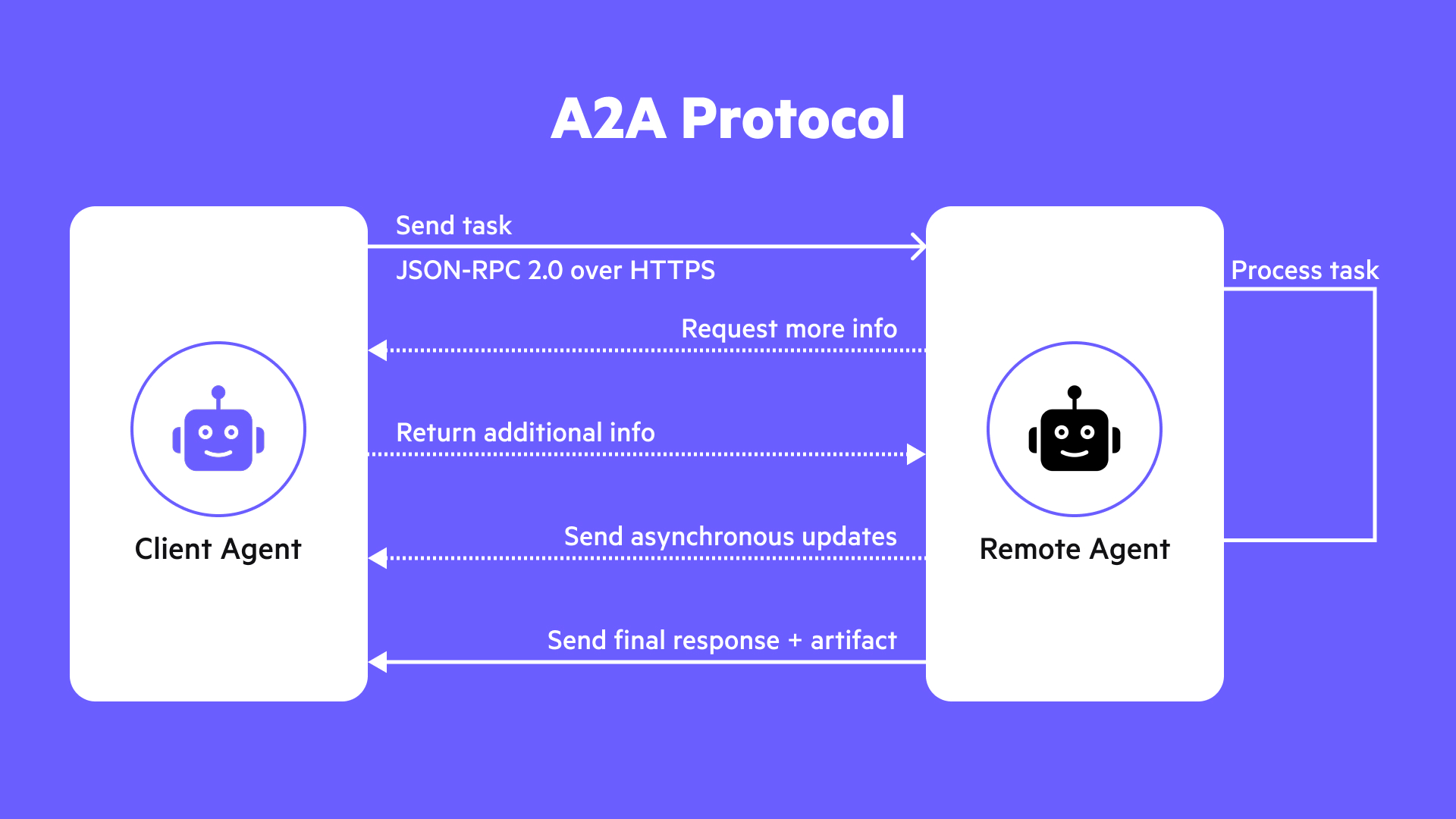
The client agent initiates a task using JSON-RPC 2.0 over HTTPS, with structured messages and content parts defining the request.
The remote agent executes the task through its Agent Executor, while keeping its internal logic hidden from the client.
If needed, the remote agent can request additional inputs, and the client agent responds with incremental information.
The remote agent streams status updates, intermediate messages, and partial results using Server-Sent Events.
Once completed, the agent returns structured outputs and artifacts as the result.
This interaction model makes A2A well suited for enterprise workflows, data pipelines, and multi-agent orchestration.
Within every Remote Agent is the Agent Executor, the component responsible for executing incoming A2A tasks. It interprets requests from the client agent and orchestrates the internal resources required to complete them.
Think of the Agent Executor as the domain brain of the agent, while the A2A protocol serves as the communication contract that enables interaction between agents. This separation provides several advantages:
While the Agent Executor manages how tasks are executed internally, A2A also ensures that long-running tasks can be handled efficiently through asynchronous communication mechanisms.
One of A2A’s most powerful capabilities is its support for long-running and asynchronous workflows, enabled through Server-Sent Events (SSE) for real-time task updates.
This asynchronous design allows agents to handle complex enterprise workflows without blocking execution or losing visibility into progress.
Before agents can collaborate, they must first discover each other’s capabilities. A2A achieves this through Agent Cards, which describe what an agent can do and how it can be accessed. The diagram below shows how this discovery process works.
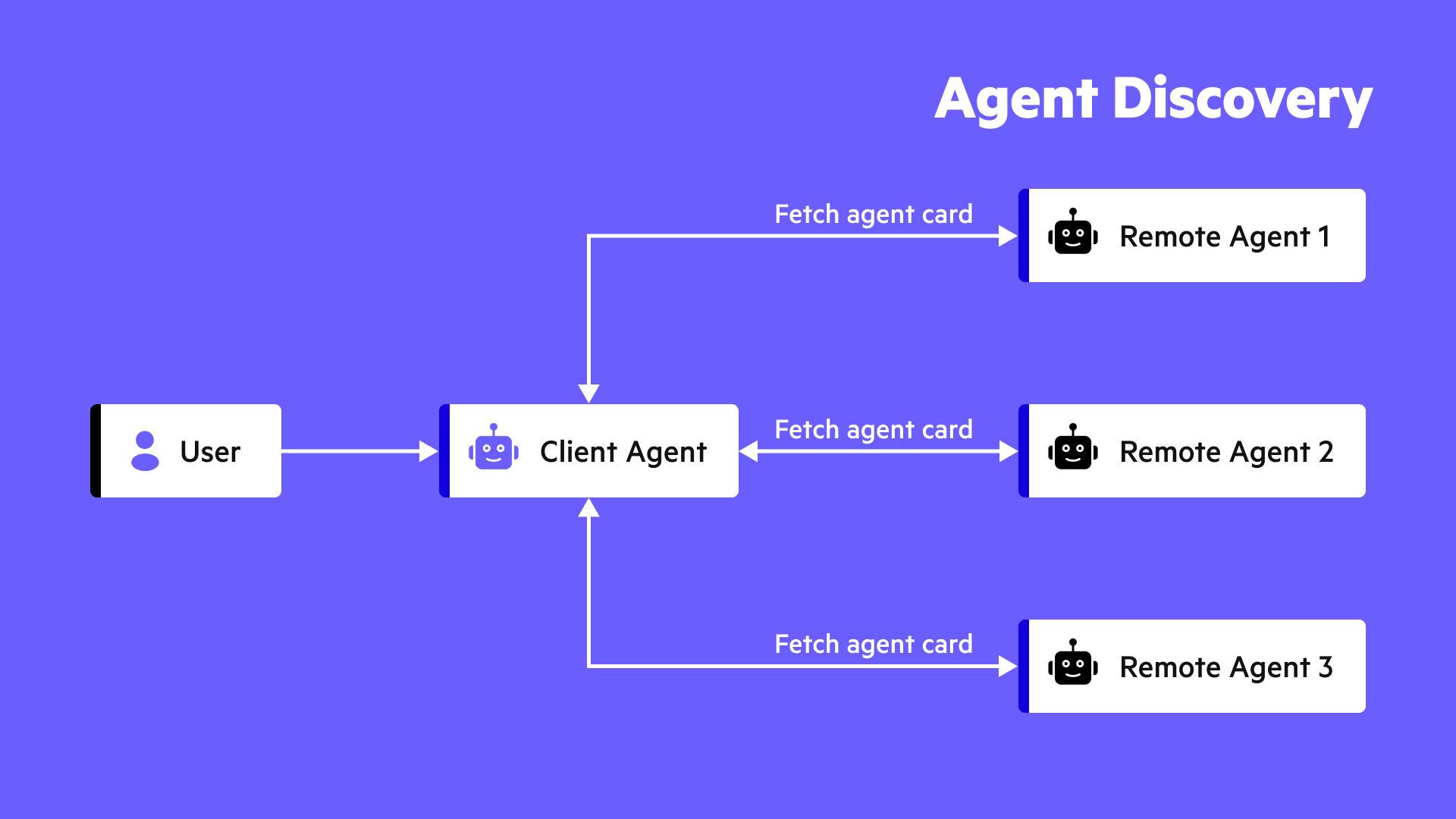
1. A user interacts with a Client Agent.
2. The Client Agent retrieves Agent Cards from available Remote Agents.
3. Each Agent Card describes the agent’s identity, supported tasks, endpoints, and authentication requirements.
4. Based on these capabilities, the Client Agent selects the most suitable agent(s) to execute the task.
Agent Cards act like machine-readable resumes for agents, enabling dynamic discovery and runtime composition of multi-agent workflows.
Security is a core design principle of the A2A protocol. When agents interact across teams, platforms, or organizations, it is essential to ensure that communication happens within clearly defined trust boundaries.
A2A addresses this through a structured authentication and authorization model, allowing agents to verify identities and enforce access controls without exposing internal systems. The diagram below illustrates how authentication and authorization are handled between client and remote agents.
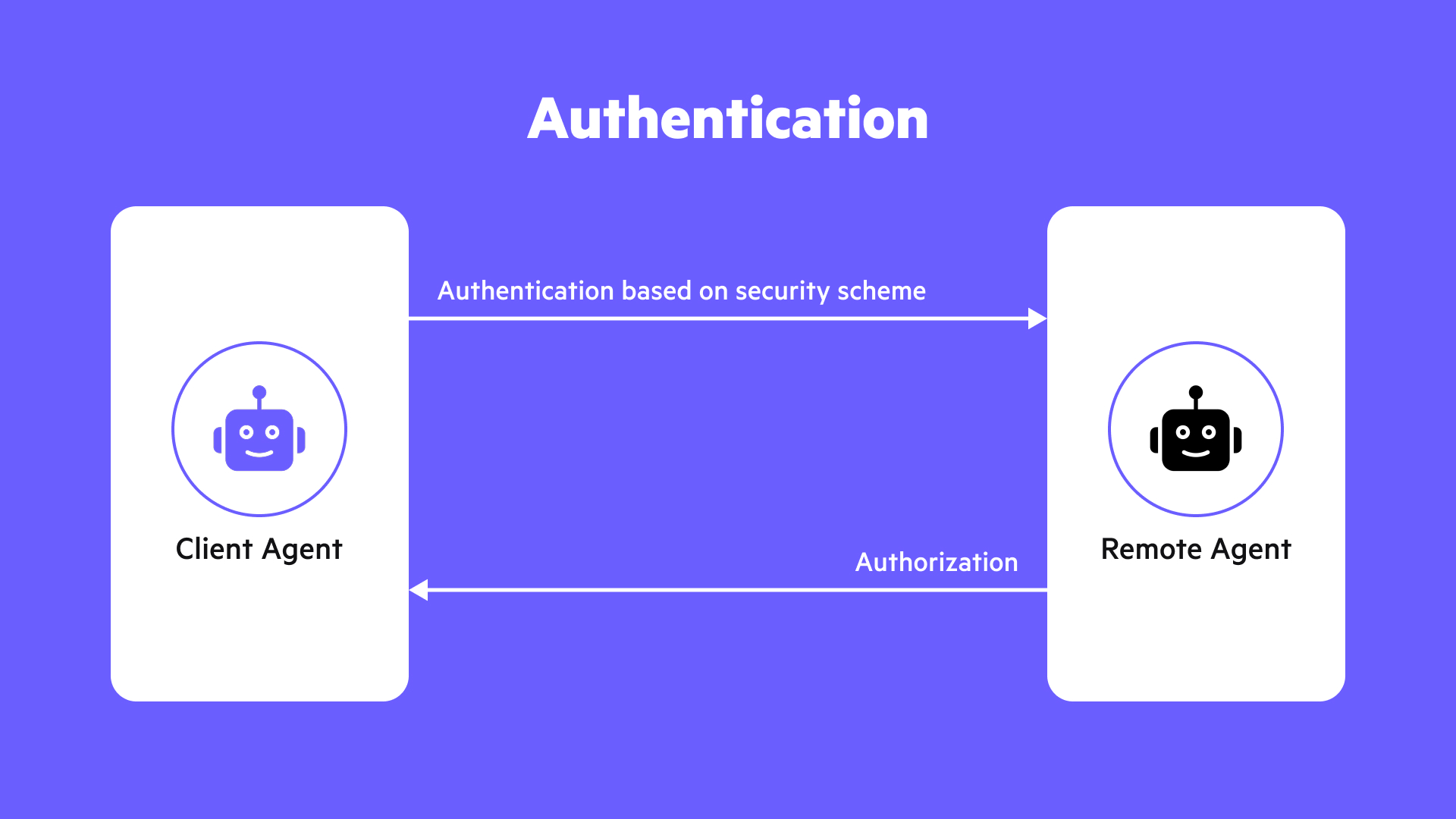
This design enables secure collaboration between agents across teams, vendors, and organizations, making A2A suitable for enterprise-scale multi-agent systems.
At the heart of the A2A protocol are a set of core primitives that define how agents structure tasks, exchange information, and deliver results.
Task – A stateful unit of work with a defined lifecycle (submitted, working, completed, or failed).
Message – A single communication exchange between agents during task execution.
Part – The smallest content unit within a message, such as text, structured data, or files.
Artifact – Structured outputs generated during task execution, representing intermediate or final results.
Agent Card – A JSON-based metadata document describing an agent’s identity, capabilities, endpoints, and security requirements.
Together, these primitives allow agents to communicate predictably and safely, regardless of their internal implementation.
To better understand how A2A enables agent collaboration, consider a multi-agent travel planning system.
In this scenario, several specialized agents work together:
The result is a system with no hardcoded integrations and no tight coupling, just agents discovering, communicating, and collaborating seamlessly.
The A2A protocol represents a major step toward scalable multi-agent ecosystems. By standardizing how agents discover, communicate, and collaborate, it addresses many of the limitations that currently slow down enterprise adoption of agentic AI.
In many ways, A2A signals a shift from isolated AI assistants to interoperable networks of intelligent agents, much like how microservices transformed traditional backend architectures.
The Rise of Agentic AI
As intelligent agents evolve, new protocols and architectures will shape how AI systems collaborate at scale.

.png)


.png)