.png)

.png)
Successful RPA adoption in banking is no longer about whether automation works, but it's about how reliably it delivers results. Banks that implement RPA effectively see measurable outcomes: faster processing cycles, lower operational costs, improved compliance, and teams freed from repetitive work.
However, achieving these outcomes consistently across functions, systems, and regions requires more than simply deploying bots.
This is where experienced RPA implementation services make the difference. With the right strategy, framework, and execution partner, banks can move from isolated automation wins to enterprise-wide impact.
Recognizing operational inefficiencies is only the starting point. Real value comes from identifying the right RPA use cases and implementing audit-ready automation. This blog explores how banks can apply RPA effectively across core operations
Scaling automation is not a technology practice, but an operational discipline. Implementing well-embedded RPA into the operating model requires critical practice and strategy. This is where structured RPA implementation services come into play. Key factors to consider while scaling enterprise RPA:
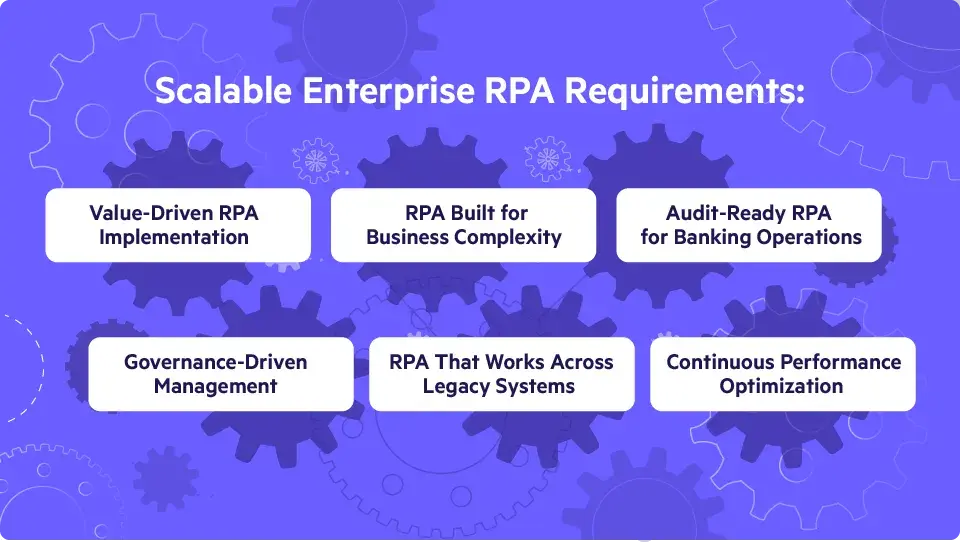
Successful RPA implementation in banking should start with clear business outcomes. One should predefine the target: cycle-time reduction, cost efficiency, and consistency in banking RPA compliance. This focus prevents fragmented automation and ensures RPA implementation services scale as expected.
Enterprise RPA must operate across multiple systems, geographies, and business units without creating silos. The bots should be designed for resilience and high-volume execution, ensuring stability as automation expands.
Successful RPA implementations must meet banking RPA compliance requirements from day one. This includes audit trails, exception logging, access controls, and traceability for regulatory reviews.
Centralized governance ensures consistency across bot design, deployment, and performance monitoring. This prevents uncontrolled automation sprawl and reduces long-term operational risk.
RPA must complement core banking platforms rather than disrupt them. Scalable implementations integrate securely with legacy systems, APIs, and workflows to protect the existing technology investments.
Automation performance should be continuously monitored against SLAs and business KPIs.
Choosing the right RPA implementation partner determines whether automation delivers enterprise impact or remains a series of disconnected wins. Banks should evaluate partners based on the following factors:
Look for RPA implementation services with direct experience in banking operations, core systems, and regulatory environments. A partner should understand transaction lifecycles without needing extensive handholding.
Enterprise RPA demands more than bot development. The right partner designs scalable architectures, reusable automation components, and centralized orchestration models that support growth across business units.
Effective partners align RPA initiatives with measurable business outcomes, reduced cycle times, cost efficiency, service consistency, and operational predictability. They stay accountable beyond go-live.
RPA delivers maximum value when combined with workflow orchestration, low-code platforms like Pega, and system integration. Partners who operate across these layers help banks modernize without disrupting existing technology investments.
Every successful RPA implementation service starts by defining critical business control points. It includes transaction validation, reconciliations, regulatory reporting, and exception handling. Bots should be designed around these checkpoints to ensure consistent execution.
Compliance is engineered into the automation itself. Role-based access, audit logs, exception traceability, and approval checkpoints ensure every automated action remains transparent and defensible during audits.
As automation grows, manual monitoring fails. RPA implementation services establish governance models that centrally manage bot performance, change control, and compliance, without slowing execution.
Each expansion phase links directly to outcomes such as cycle time reduction, cost efficiency, service consistency, and risk reduction. This ensures RPA remains aligned with business priorities as scale increases.
RPA has moved beyond efficiency gains. In banking, it has become a core execution layer that determines how predictably operations run, how well compliance holds under pressure, and how confidently organizations scale.
The difference lies in execution. EvonSys helps banks implement RPA as a sustainable enterprise capability. Our approach combines enterprise RPA delivery with strong banking RPA compliance, ensuring automation scales without introducing risk. Beyond RPA, we support broader digital transformation through low-code development, workflow automation, and system integration, allowing banks to modernize incrementally while protecting existing technology investments.
Build a Scalable, Compliant RPA Strategy with EvonSys
With the right RPA implementation services and execution partner, banks can bring enterprise-wide outcomes.

.png)


.png)