.png)

.png)
On paper, operations appear well-defined, with workflows documented and responsibilities clearly assigned. However, in everyday work, execution delays often occur during the process. During customer onboarding, the relationship manager needs to collect multiple documents. The operations team should then validate the details, and compliance teams perform KYC checks across various systems. Much of this work involves extracting data from forms and IDs, verifying it against sources, and re-entering the same information into onboarding, core banking, and compliance platforms.
A minor data mismatch due to manual entry triggers rework. Incomplete submissions sit in queues waiting for follow-up. KYC checks that follow predefined rules still require human review, which slows approvals and extends account opening timelines. When work piles up, banks often hire temporary staff, which increases costs without generating business profits.
These issues create delays in customer service and increase pressure on internal teams. Although onboarding and KYC processes are structured and rule-driven, progress ultimately depends on human availability. For banks, this turns onboarding into a serious challenge instead of a value opportunity.
In this blog, we uncover the challenges organizations face with manual processing and why RPA is mandatory in the banking sector.
Today's banking operations must simultaneously:
Banks increase customer counts, handle high transaction volumes, expand digital services, and face increased regulatory obligations. But many operational models still depend on adding more employees to handle increasing workloads. This creates a scalability challenge. When every increase in business volume requires a proportional increase in manual effort, operational costs continue to rise while efficiency gains remain limited. Teams spend more time processing routine activities, managing queues, and coordinating handoffs instead of improving processes or focusing on complex business decisions.
Banking operations rely on experienced professionals with expertise in risk assessment, compliance, customer service, and financial analysis. However, many of these employees spend significant time performing activities that do not require their expertise:
These activities are necessary, but they prevent employees from focusing on work where human judgment creates the most value.
Regulatory compliance has always been a priority for banks. Many compliance-related activities still depend on manual reviews, validations, and information gathering. As transaction volumes increase, maintaining consistency across these processes becomes more difficult.
Manual execution introduces operational challenges such as:
Banks need operational models that can deliver consistency and traceability while allowing compliance teams to focus on higher-value risk decisions.
Many banks operate with a combination of modern digital platforms and decades-old core systems.
While these systems continue to support critical operations, they often create gaps across applications, requiring employees to manually transfer information between systems.
Employees become the connection layer between:
This hidden dependency increases operational complexity and makes even simple processes harder to scale.
For years, banks have managed increasing operational demands by expanding teams, adding review layers, and increasing manual capacity. While this approach can provide short-term relief, it does not address the underlying challenge, the growing dependency on human effort for processes that must scale with business growth. It only increases the number of people required to manage the same operational challenges.
This also limits how organizations use their skilled workforce. Experienced employees continue spending valuable time coordinating information, performing routine checks, and managing process steps instead of focusing on activities that require judgment, analysis, and customer expertise. As teams expand, maintaining consistency across processes becomes more challenging, increasing the risk of variations, delays, and operational inefficiencies.
The challenge for banks is building an operating model that can support future growth without continuously increasing costs and complexity. This requires moving from people-driven scaling to a more intelligent approach in which technology handles predictable, repetitive tasks while employees focus on decisions that create greater business value.
Robotic Process Automation (RPA) enables banks to rethink how routine operational work is executed. Instead of relying on employees to manually complete predictable, repetitive activities across multiple systems, RPA uses software bots to perform rule-based tasks with speed, consistency, and reliability. The market size of RPA in the banking sector was valued at USD 842.7 million in 2022 and is projected to reach USD 4,044.1 million by 2033.
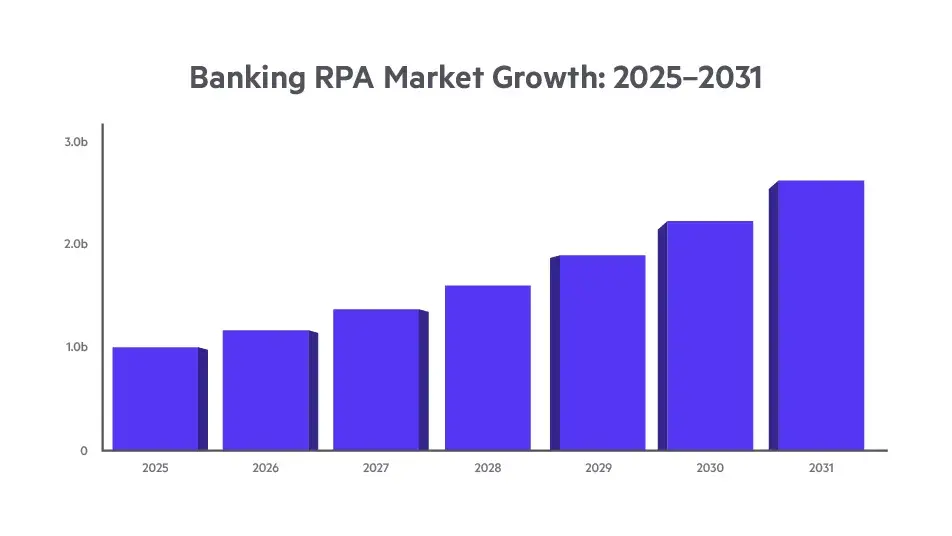
The value of RPA extends beyond automating individual tasks. It is reducing the operational dependency on manual effort for activities that do not require human judgment.
Consider a customer onboarding process. Employees may need to collect information, validate documents, check data across multiple systems, update records, and initiate downstream workflows. While each step may appear manageable, the cumulative effort becomes significant when performed across thousands of customer requests.
RPA can handle these repetitive operational steps by interacting with existing applications, moving information between systems, performing validations, and triggering predefined actions.
Manual work remains one of the most underestimated cost drivers in banking operations. While business operations may appear structured, execution still depends on repetitive, rule-based tasks spread across fragmented systems. This gap between process design and day-to-day execution is exactly where many RPA use cases in banking deliver the most value. When applied with the proper process insight, technical resilience, and governance, RPA moves beyond task automation.
Read our next blog to know more about how RPA helps in the banking sector and how to build an audit-ready implementation.



.png)


.png)