.png)

.png)
In today’s digital transformation landscape, cloud computing has become an essential platform for delivering on-demand, scalable, and cost-effective IT resources. Whether responding to regulatory requirements or launching new digital services, organizations need environments that can support change without extensive infrastructure rework. Seasonal demand, new markets, and increasing transaction volumes all require systems that can scale without impacting performance.
This blog explores how to approach cloud adoption more strategically and how enterprise-ready platforms can help build a more resilient, scalable cloud-based workflow management system that supports continuous security.
Cloud has become a strategic requirement for any organization as it provides better security, scalability, and disaster recovery than traditional data centers. Traditional on-premises workflow environments often struggle with:
Infrastructure maintenance – Organizations must manually manage servers, security updates, and on-premises environment monitoring, which increases operational workload and IT team dependency.
Security and compliance complexity – Companies that manage highly sensitive information, such as customer data in banking and protected health information in healthcare, require consistent security controls and regulatory compliance across on-premises environments.
Scalability limitations – Scaling depends on additional hardware procurement and environment expansion, making it challenging to respond quickly when the workload increases.
Innovation lag – The current on-premises infrastructure could lack the native cloud capabilities and the “always on” environment that cloud offers due to high availability and disaster recovery.
While cloud adoption has accelerated across industries, moving to the cloud without a proper strategy can introduce additional challenges:
Legacy system dependencies - Many enterprises still operate mission-critical systems that were not originally designed for cloud environments. Migrating or integrating these systems without disrupting business operations can become a significant challenge.
System updates and modernization - Teams may need new operating processes, governance models, and skill sets to manage cloud-driven workflows effectively. For many organizations, cloud adoption succeeds technically but struggles operationally. The challenge is creating an environment that supports enterprise agility without increasing complexity.
When organizations manage workflow-intensive applications, generic cloud infrastructure alone may not meet operational requirements. Enterprise workflow platforms often require consistent performance, governance controls, scalability, and continuous availability.
Pega offers a cloud operating model designed to support workflow automation, case management, customer engagement, and decisioning applications.
Pega offers multiple cloud deployment approaches depending on business, regulatory, and operational requirements. Organizations can choose between Pega Cloud, Pega Cloud for Government, and client-managed cloud environments based on the level of control, compliance, and operational ownership they require.
For most enterprises, Pega Cloud provides a fully managed cloud model where Pega handles infrastructure operations, updates, monitoring, and platform maintenance. Organizations with a government agency mission may adopt Pega Cloud for Government, which aligns with security and regulatory requirements. Pega Cloud for Government is intended exclusively for U.S. federal, state, local, and tribal government organizations and is not offered outside the United States.
Meanwhile, enterprises seeking greater infrastructure ownership can opt for client-managed cloud, deploying Pega in their preferred cloud ecosystem while managing orchestration and operations internally.
At its core, Pega Cloud operates through a cluster-based deployment model, where workloads are distributed across specialized node types rather than relying on a single environment to handle everything. This separation allows applications to remain responsive even as operational demands change.
For example, Pega Cloud typically separates workloads into:
This architectural separation helps ensure that spikes in one workload area do not disrupt the performance of others. For instance, a sudden increase in background processing demand does not necessarily slow down user interactions.
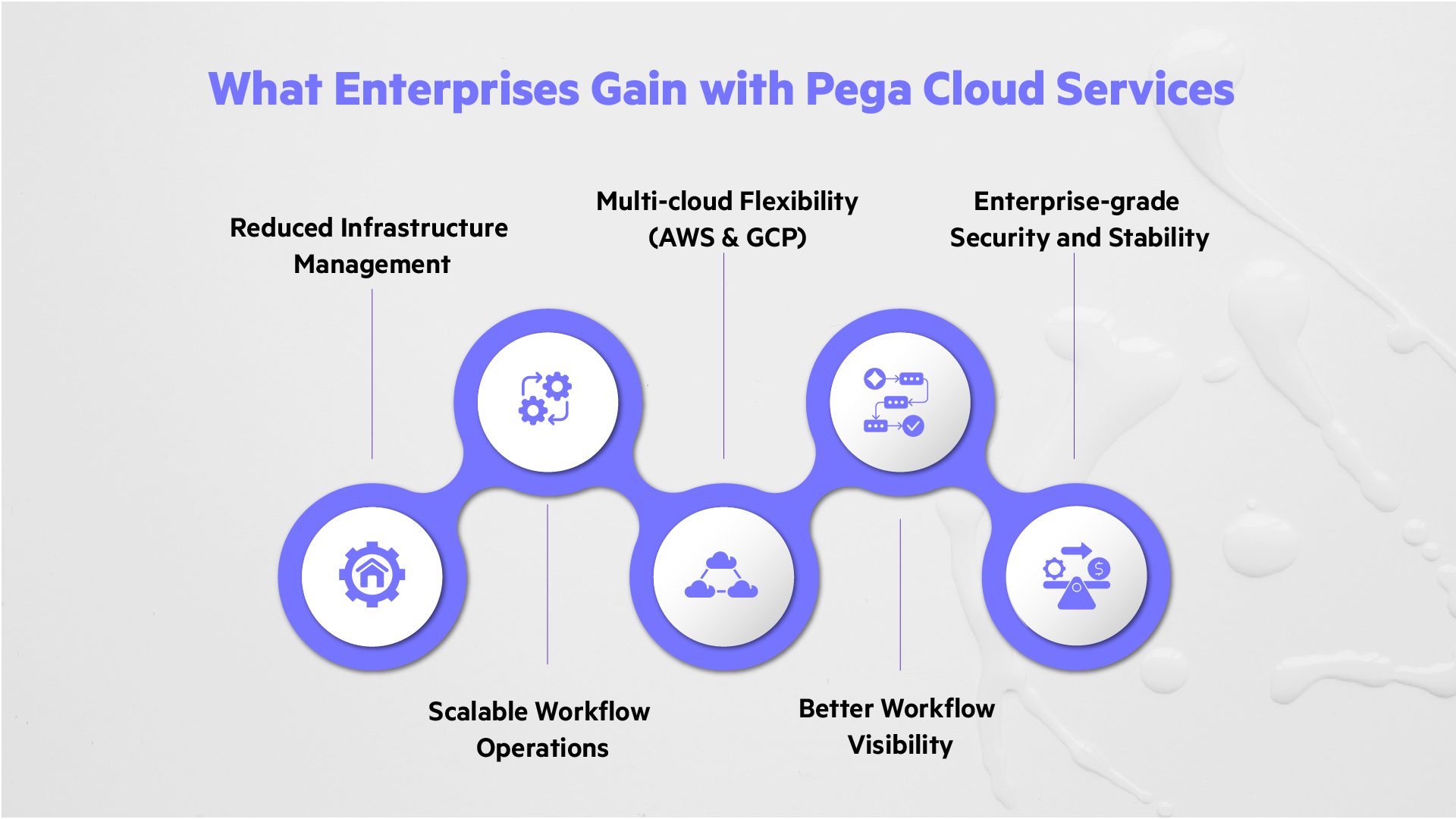
Reduced operational burden without losing control
One of the key advantages of Pega Cloud services is reduced infrastructure management effort. Pega handles platform maintenance, monitoring, and updates, while enterprises retain visibility into application performance and operational activities.
Cloud environment designed for complex workflow
Unlike generic cloud environments, Pega Cloud is built for cloud-based workflow management. It supports complex case processing, decisioning, integrations, and high-volume workflows without affecting operational continuity.
Multi-cloud adoption
Pega Cloud supports both AWS and GCP, helping organizations align with existing cloud strategies. This flexibility enables enterprises to modernize their cloud-based workflow management system without being tied to a single cloud provider.
Better operational visibility across enterprise environments
Pega Cloud provides stronger monitoring and diagnostic capabilities, helping enterprises gain better visibility into workflow performance, system health, and operational issues across environments.
Enterprise-grade security for operational stability
For organizations using a cloud-based workflow management system, security and stability are critical. Pega Cloud supports isolated environments, encryption, continuous monitoring, and compliance-focused operations to help maintain business continuity.
Enterprises need the right strategy to modernize workflows and minimize disruption during the transition. At EvonSys, we help organizations implement and optimize cloud-based workflow management through deep Pega expertise and enterprise-focused delivery approaches. From cloud-readiness assessments and migration planning to workflow modernization and post-implementation support, our teams help businesses build scalable, resilient Pega environments aligned with operational goals.
Reference:
https://academy.pega.com/topic/cloud-deployment-architecture/v1
Transform complex workflows with a cloud strategy designed for enterprise scale.

.png)


.png)