For most banks, the cost of running dispute operations rises and falls with how many disputes come in. More disputed transactions in a quarter means more cases for analysts to open, review, and close, so the bank spends proportionally more on staff and time as volume grows. This tight link between case volume and cost has held for years because each dispute needed a person from start to finish.
Agentic AI in banking is breaking that link, and the industry has already put a name to the change behind it. Several 2026 industry outlooks describe a model where one person leads a team of AI agents and output grows without added headcount; a model researchers call the "10x bank" Growth in this model depends on how well an organization reinvents work, with people still expected to guide how these agents get deployed.
Adoption numbers point the same way. A Citizens survey of finance leaders found that 82% of midsize companies and 95% of private equity firms have begun or plan to implement agentic AI in their operations in 2026. Private equity firms list collections outreach among their use cases. Dispute operations rarely come up in that conversation, yet they run on the same case-by-case work.
Inside a dispute operation, the old link shows up as escalation queues that pile up and documentation scattered across systems that don't share data. A growing share of these cases no longer need a person to touch them.
This blog explores the specific mechanics that break the old cost-per-case math, why that counts as a capacity change rather than an efficiency gain, and where a person still has to stay in the loop even as agents take on more of the resolution work.
Three mechanics explain how agentic AI in banking changes cost-per-case.
In a manual process, an analyst pulls transaction records, checks CRM account history, then checks a card network portal for chargeback status, one step at a time, whenever time allows. An agent runs these same lookups in parallel the moment a case opens. What takes a human analyst 25 minutes takes an agent under 90 seconds.
A $150 duplicate charge dispute with clear transaction records on both sides doesn't need three days behind higher-priority cases. An agent checks it against network rules and account history right away and closes it if the case meets set criteria.
Two analysts reviewing the same dispute can reach different outcomes based on experience, caseload, or how carefully they read the documentation. AI in dispute resolution applies the same rules to the same facts every time.
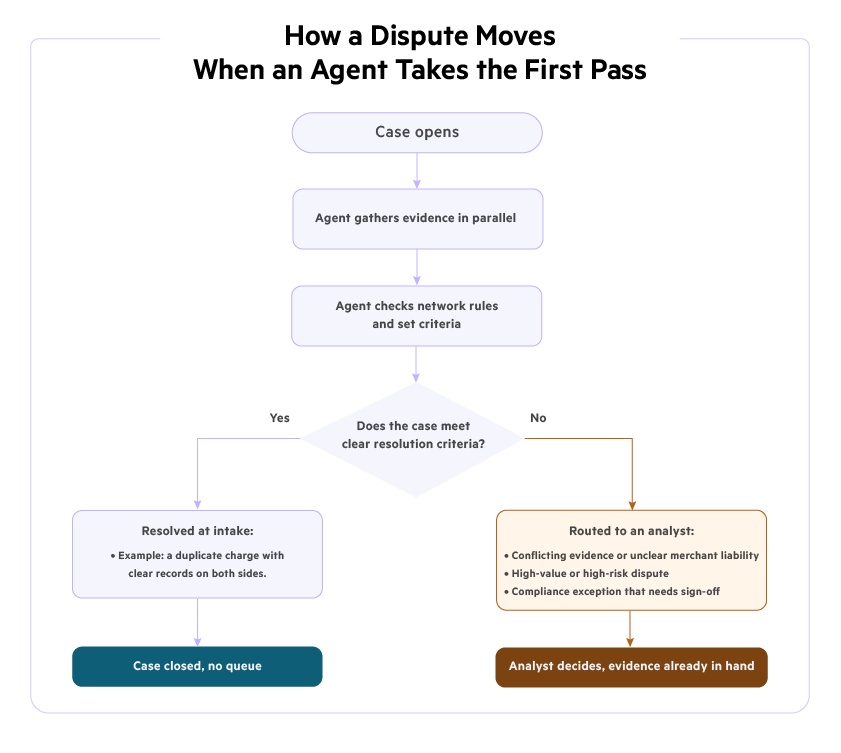
Together, these three mechanics remove the queue itself for a meaningful share of cases. Once a case exits the queue, it no longer needs an analyst's hour to close.
Efficiency gains save time on the volume a bank already handles. This is different.
A 20% rise in dispute volume used to mean a 20% rise in analyst hours needed. When a growing share of cases resolve without a person, analyst hours stop rising in step with volume.
Most institutions still budget and staff against a ratio that assumes every case needs a person. Agentic AI in banking makes that ratio the wrong number to plan against.
Instead of asking how many analysts a rising case volume requires, the more useful question becomes how many cases need a person versus how many meet clear resolution criteria on their own.
This distinction matters for anyone building next year's budget. A tool that makes analysts 20% faster still assumes the old ratio. A capacity change means the ratio itself needs rebuilding.
Gartner projects agentic AI will autonomously resolve 80% of common customer service issues without human intervention by 2029, cutting operational costs by 30%. That's a broader prediction than disputes alone, but it describes the same change. Cases close without a person, at a scale most institutions haven't planned for yet.
Pega Smart Dispute applies the same model today. It resolves straightforward disputes through straight-through processing and routes what needs judgment to a person. Dispute operations are running this model now, years ahead of Gartner's 2029 marker for the broader category.
Not every case fits a rule.
Disputes involving conflicting evidence, unclear merchant liability, or first-party fraud suspicion need a person to weigh context an agent can't resolve on rules alone.
A $150 duplicate charge and a $50,000 wire dispute don't carry the same risk profile, and the threshold for automatic resolution should reflect that.
Cases touching regulatory reporting, litigation holds, or unusual account activity need a documented human decision.
AI in dispute resolution works by narrowing what reaches a person. The cases that do reach an analyst come with the evidence already gathered and the routine questions already answered, so the person spends their time on judgment.
Cost per case stopped being a fixed ratio. Institutions that plan next year's budget on the old math risk overstaffing for the volume they will see.
Most institutions still plan headcount and budget against the assumption that dispute volume and analyst hours rise together. Agentic AI in banking breaks that assumption for a share of cases, and that share keeps growing.
The question for BFSI leaders is whether next year's budget still assumes every case needs a person, and what changes once that assumption stops holding.
Plan Next Year’s Dispute Budget on the New Math