.png)

.png)
When a customer notices an unfamiliar transaction in their bank account, they open the mobile banking app, only to be redirected through multiple menu options and a self-service agent that may fail to address their issue. Frustrated, the customer initiates a chat session, only to repeat the same information to a Customer Service Representative.
One of the core reasons for this poor experience is data silos and the disconnect between customer information and interaction history. As a result, both self-service agents and CSRs struggle to access a unified, real-time view of the customer's situation.
This has accelerated the adoption of Conversational AI, which helps transform fragmented customer journeys into more natural, contextual, and seamless experiences. Rather than forcing customers to navigate complex processes, Conversational AI enables them to communicate their needs in their own words and receive relevant assistance in real time.
Customer expectations have evolved significantly. Whether they are shopping online, booking travel, or managing their finances, customers expect instant, personalized experiences.
Today's customers no longer view service channels as independent touchpoints. Instead, they expect organizations to recognize them across channels, understand their intent, and continue interactions without requiring them to start over. They want a consistent experience regardless of whether they engage through a mobile app, website, chatbot, contact center, or branch.
Consider a customer who initiates a loan application through a banking mobile app but needs additional assistance to complete the process. When they contact a CSR the following day, they expect the representative to have complete visibility into the application details, previous interactions, and the application's current stage.
In short, customers expect to continue their conversations across channels without having to repeat information from the beginning.
Despite years of investment in automation, many organizations continue to struggle with delivering better customer experiences. Traditional automation is designed to execute predefined tasks and follow business rules. It struggles when interactions become dynamic, contextual, or customer-specific. As a result, many organizations have automated individual processes without necessarily improving the overall customer experience.
For example, a customer may be able to initiate a request digitally, receive automated updates, and even interact with a chatbot. Yet when the situation falls outside predefined scenarios, the experience often becomes fragmented. Customers may be transferred between channels, asked to repeat information, or forced to navigate multiple systems before reaching a resolution. As organizations rethink their customer engagement strategies, the focus is shifting from simply automating tasks to creating connected, intelligent experiences that make interactions easier for both customers and employees.
Many organizations have invested heavily in self-service capabilities such as FAQs, knowledge portals, IVR systems, and chatbots. These solutions were designed to help customers find answers independently while reducing reliance on customer service representatives.
Self-service has made customer support available anytime, but many organizations continue to struggle with delivering seamless experiences. While effective for basic inquiries, many self-service solutions lack the capabilities needed to support modern customer journeys. The limitations of traditional self-service agents include:
For instance, when a customer reports a lost debit card through the bank's self-service portal, it explains the replacement process. However, it cannot block the card or initiate a replacement request. The customer must contact an agent to complete the process. The self-service channel can only offer guidance but cannot execute the required action. A recent Gartner study highlights that 60% of agents miss opportunities to promote self-service during customer interactions.
The challenges that customers and CSRs face while dealing with traditional self-service agents include:
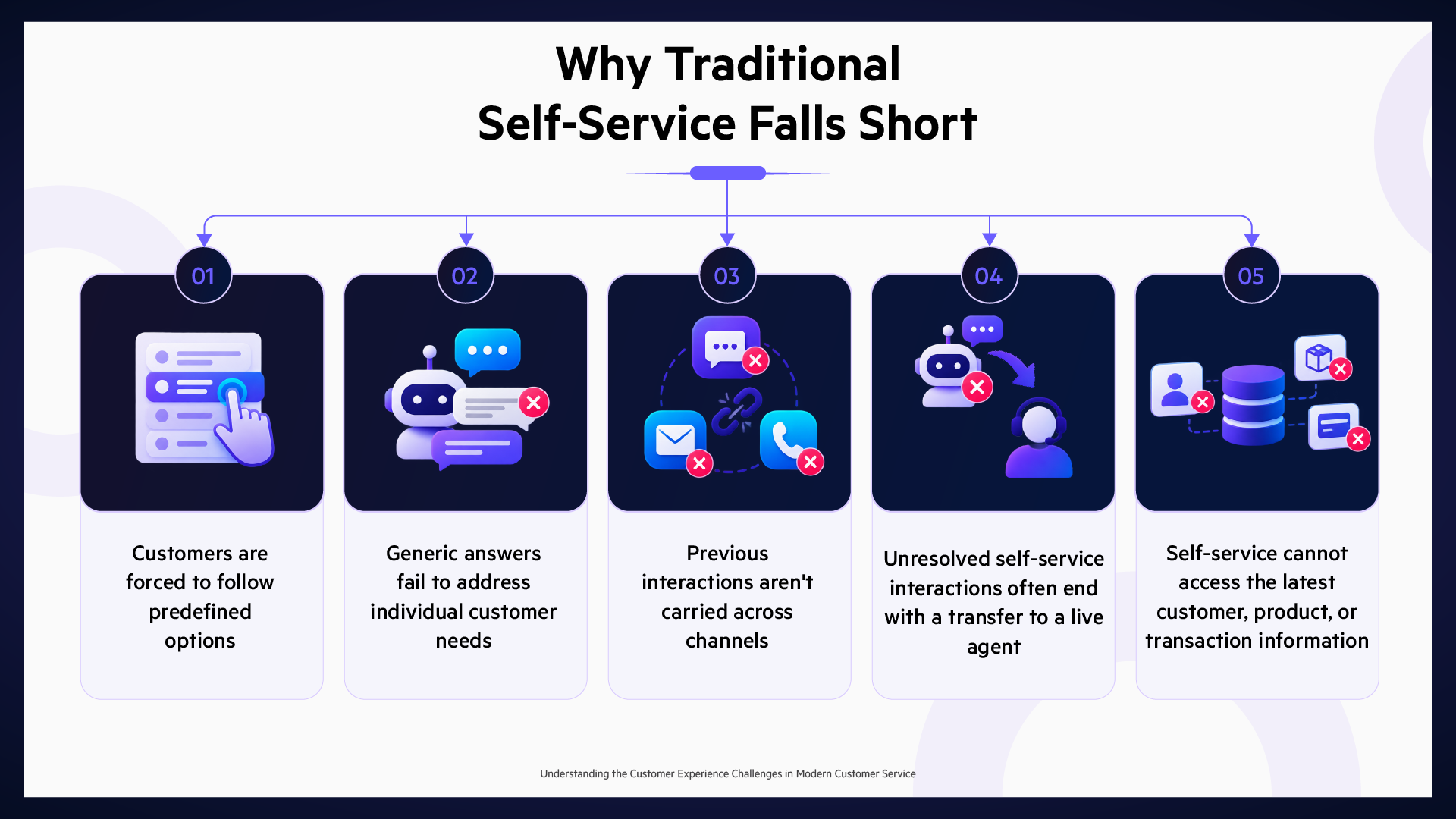
Meeting today's customer expectations requires an approach that simplifies the customer experience. This is where Conversational AI is emerging as a powerful alternative.
Unlike traditional automation, Conversational AI enables systems to understand natural language, recognize customer intent, and maintain context throughout an interaction. Rather than forcing customers to navigate predefined menus or adapt to rigid workflows, it allows them to communicate in their own words and receive relevant assistance in real time. By connecting customer interactions, preserving context, and orchestrating responses across systems, it enables customers to continue the conversation rather than restarting their journey each time they switch channels.
As organizations navigate increasing customer expectations and growing service complexity, the focus is shifting from simply automating tasks to enabling intelligent conversations. Conversational AI is becoming a critical capability for organizations seeking to deliver seamless customer experiences, improve operational efficiency, and strengthen customer relationships.

.png)


.png)