.png)

.png)
A bank may have a defined workflow for loan processing, payment investigations, dispute handling, or account opening. The documented process covers the standard steps that teams are expected to follow. But during actual banking operations, a case may trigger additional steps and exceptions.
Case exceptions, additional checks, missing information, and cross-team dependencies can introduce steps outside the standard workflow. Consider a typical card payment dispute.
The dispute management process may follow a defined sequence:
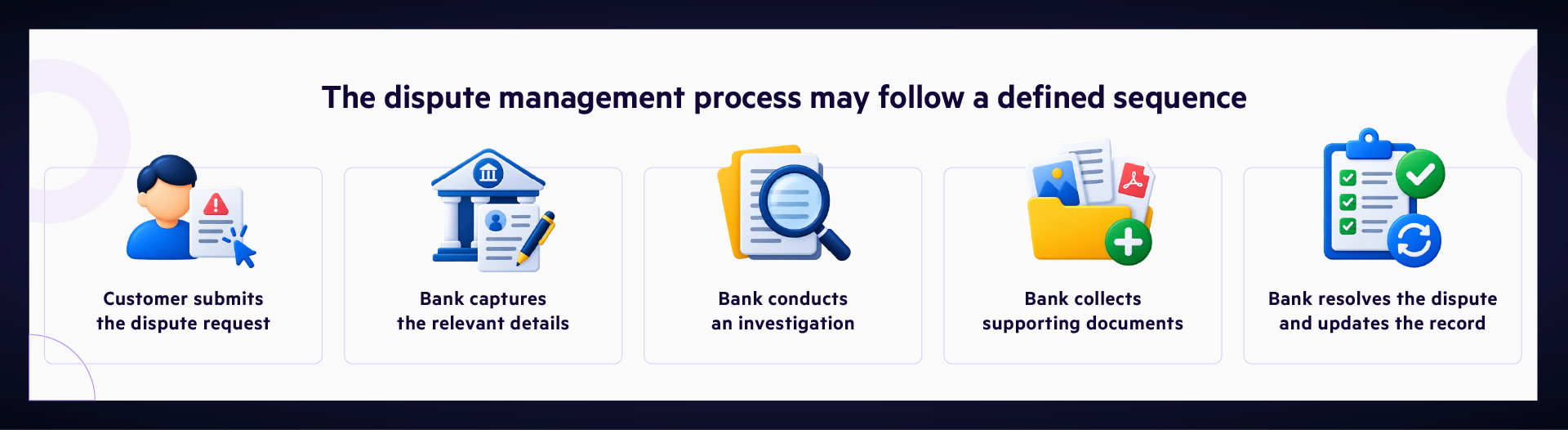
The process seems straightforward, but individual cases don't always follow the same path. Additional delays may result from:
In this dispute scenario, traditional process analysis can help the bank identify these process deviations:
Traditional process analysis can identify these exceptions in business operations. But when a bank handles thousands of disputes across multiple payment networks, dispute types, teams, systems, and exception scenarios, the number of possible process paths can increase rapidly.
The analysis can provide useful metrics such as average resolution time, SLA compliance, case volumes, and the number of disputes handled by each team. These metrics can indicate that something is wrong, but they don't always provide enough context to explain what is driving the problem.
Traditional process analysis can help a bank reconstruct how cases move through a workflow, identify bottlenecks, compare process paths, and investigate why some cases take longer than others. The challenge is that the analysis becomes harder when the process has a high number of cases, exceptions, dependencies, and variations. This is where business process complexity starts to affect the analysis itself. The problem may not originate from a single process or event.
As case volumes and process variations increase, these investigations become more difficult to perform consistently and quickly. This is one of the key limitations of process analysis in complex banking operations. It can reveal where performance is changing, but determining why can require substantial manual investigation.
For banking leaders, the issue is not simply finding another bottleneck. It is about distinguishing the process conditions that are actually driving the outcome from the variations that merely occur along the way.
Finding the delay is the starting point, but understanding why it occurs in a particular case is crucial.
In banking, the same process can have very different implications depending on what happens before and after it. A dispute awaiting additional information, for example, is not necessarily a problem in itself. The reason for the request, the type of transaction, the team handling the case, and the previous steps in the investigation can all change how that event should be interpreted. This is where context becomes important.
Consider two dispute cases that both spent three days waiting for information. On the surface, they look similar. But one may be waiting for a merchant response, while the other is waiting for additional customer documentation. One may be resolved within the SLA, while the other may require further investigation and breach it.
Looking at the waiting period alone doesn't explain the difference. A context-aware approach considers the surrounding information.
For a bank, knowing that a process is underperforming is only the starting point. The bigger opportunity is to turn operational signals into insights that teams can use to make better decisions.
This is where the shift from process visibility to process intelligence becomes important.
Process visibility helps operations leaders see what is happening across their workflows. Process intelligence connects these signals to the way cases actually move through the operation, helping teams identify patterns that may not be obvious from individual reports or metrics.
For example, instead of simply seeing that card dispute resolution time has increased, a bank could examine which combinations of case characteristics, process events, and outcomes are associated with the increase. That can help teams focus their improvement efforts on the parts of the operation that have the greatest impact.
This is where AI can take process intelligence further by helping organizations analyze large volumes of process information, recognize patterns, and identify potential issues without relying entirely on manual investigation.
Traditional process analysis remains useful for understanding how a banking process performs. The challenge is keeping that analysis effective when case volumes are high, and process conditions keep changing.
By applying AI to process information, Process AI can analyze large volumes of cases, identify patterns across process paths, and surface relationships that may be difficult to detect through periodic analysis or manual investigation. It can analyze large volumes of process information, identify patterns across cases, and surface relationships that may be difficult to detect through periodic analysis or manual investigation.

.png)


.png)