.png)

.png)
Digital payments have become the keystone of modern financial services. As customers have come to rely on cards, online transfers, and digital wallets, the number of transaction disputes has also grown significantly. Payment disputes arise when a customer questions an online transaction, and the common reasons are:
This creates increasing pressure on dispute management in banking, as it involves customer service, regulatory compliance, and operational efficiency. Moreover, manual workflows with fragmented systems make the management a slow, resource-intensive process.
To address these challenges, banks are turning towards intelligent technologies that streamline investigations and automate repetitive tasks. This is where automated dispute management plays a crucial role. One of the most advanced solutions is Pega Smart Dispute Agentic Automation, an AI-driven approach that combines agentic decisioning, intelligent case management, and modern platforms to reduce manual intervention and accelerate the dispute lifecycle.
In this blog, let’s explore Pega Smart Dispute Agentic Automation in detail and how it automates dispute management.
Pega Smart Dispute Agentic Automation is a comprehensive, AI-driven platform that manages the entire lifecycle of payment disputes and fraud claims across networks, including Visa, Mastercard, Amex, Zelle, ACH, and others.
The platform is complemented with Pega Customer Service for Financial Services and is built on Pega Constellation. It uses GenAI and automated, agentic workflows to reduce dispute resolution times, increase straight-through processing (STP), and ensure compliance with complex regulations.
When banks use traditional dispute management, the entire process is manual, adding additional challenges such as integration, compliance, and chargeback maintenance.
Tracking disputes manually can be difficult because it involves multiple back-and-forth interactions, and each stage must strictly follow the rules set by payment networks. If these rules are not followed correctly, the dispute may be deemed invalid, resulting in financial liability for the issuing bank. When there is no separate case-tracking system, investigators often need to log in to the card network portals to monitor case status, submit responses, and review updates. These interfaces are typically complex and not designed for ease of use, making dispute tracking difficult and increasing the chances of errors.
Another challenge in traditional dispute management is the time required to train employees to handle disputes effectively. Back-office investigators must understand complex chargeback rules, documentation requirements, and investigation procedures before they can independently manage cases. The platform simplifies this process through intuitive interfaces and built-in pass/fail logic that guides users through each step of the dispute workflow. As a result, training timelines can be significantly reduced, enabling employees to become productive in weeks instead of months.
Transaction data, customer information, dispute records, and communication history may reside across multiple platforms, including core banking systems, case management tools, and email channels. Because these systems operate in silos, employees are forced to manually retrieve and transfer data between platforms to continue the investigation. This fragmented approach slows down the entire dispute lifecycle.
Manual dispute handling also makes it difficult for banks to consistently comply with the strict guidelines set by card networks. These networks enforce specific timelines, reason codes, and documentation requirements for each stage of the dispute process, including chargeback submission, representment, and arbitration.
When disputes are processed manually, teams must track these deadlines and documentation requirements themselves. Missing a submission window or providing incomplete evidence can result in automatic case rejection or financial liability for the issuing bank.
These challenges highlight the growing need for automated dispute management solutions that can streamline workflows, integrate systems, and reduce manual intervention.
The growing complexity requires an automated dispute management system. Financial institutions need systems that can intelligently analyze disputes, coordinate workflows, and make contextual decisions across multiple systems. This is where Agentic Automation plays a crucial role in modernizing dispute management in banking.
The dispute lifecycle involves multiple stakeholders, including the cardholder, the issuing and acquiring bank, the merchant, and the card network. The workflow below illustrates how a dispute progresses from investigation to arbitration across these parties.
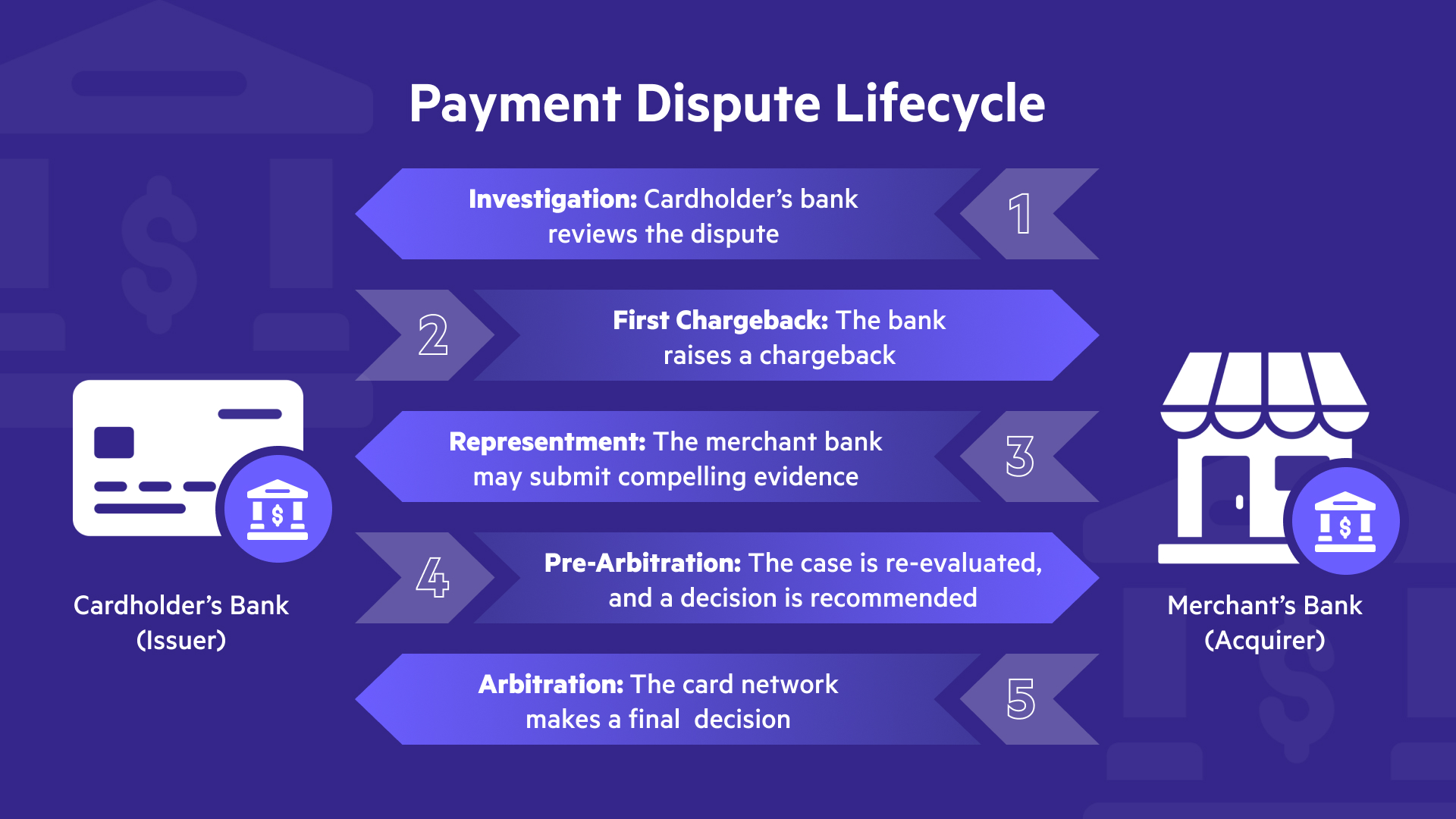
Investigation Stage: The issuer (Cardholder’s bank) reviews the cardholder’s dispute request.
First Chargeback: The issuer submits the chargeback through the card network to the acquirer (merchant’s bank).
Representment: The merchant may challenge the chargeback by providing supporting evidence.
Pre-Arbitration: If the dispute continues, the issuer and acquirer attempt another resolution.
Arbitration: The card network makes the final decision on liability.
Agentic Automation enhances the investigation stage by intelligently identifying opportunities for early dispute resolution before a chargeback is initiated. Pega Smart Dispute analyzes historical cases, reviews potential merchant credits, and dynamically presents dispute questionnaires to guide agents through the investigation process. The system can also automatically validate network rules to identify scenarios where chargebacks are not eligible, eliminating the need for agents to manually review complex chargeback manuals. Additionally, it integrates with third-party resolution providers such as Ethoca and Verifi, enabling collaboration between issuers, acquirers, and merchants to resolve disputes before they escalate. By validating dispute rules and predicting the likelihood of success, the platform helps banks avoid unnecessary chargebacks, reducing operational costs and processing time.
Let’s understand how the complemented features in Agentic Automation accelerate dispute management in banking.
A key component of modernizing dispute management in banking is the user experience Pega Constellation provides. Constellation is Pega’s modern UI architecture that delivers consistent, intuitive interfaces for applications built on the Pega Platform.
Within Pega Smart Dispute Agentic Automation, Constellation enhances the experience for both service agents and investigators by:
Key GenAI Features:
Process AI: The pre-trained prediction model analyzes historical dispute cases to estimate the likelihood of merchant acceptance and gives a prediction score. Based on it, the platform can automatically determine the next step in the dispute workflow.
Doc AI: Supports the dispute investigations by identifying and verifying the type of documents submitted. The capability can be extended through additional training to reduce manual review effort and improve the accuracy of case documentation.
Gen AI: The model can also be extended with additional prompts or questionnaires to support broader dispute scenarios and provide more accurate responses during investigations.
Pega Knowledge Buddy: Utilizes Retrieval Augmented Generation (RAG) to provide instant, accurate answers to complex dispute processing questions by referencing internal bank documentation.
Case Summarization: An automated field that displays a concise, AI-generated summary of the client's claim and entire dispute history.
One of the most complex aspects of dispute management in banking is complying with the strict chargeback guidelines imposed by global payment networks. Card networks such as Visa and Mastercard define detailed rules that banks must follow when processing dispute cases. These guidelines govern how disputes are categorized, the evidence required, and the timelines for submitting and responding to chargebacks.
The platform is designed to support regulatory frameworks commonly used in dispute management. These regulations define how banks must investigate disputes, communicate with customers, and resolve claims involving credit cards or electronic transactions.
United States Regulations
Regulation Z
This regulation implements the Truth in Lending Act, ensuring transparency in credit transactions and protecting consumers from unfair practices.
Regulation E
Regulation E implements the Electronic Fund Transfer Act, protecting customers against unauthorized electronic transactions.
Canada Regulation
Bill C‑86
This legislation strengthens the financial consumer protection framework for Canadian banks, including rules for handling customer disputes involving credit card transactions.
United Kingdom Regulation
Section 75
Section 75 protects consumers for credit card purchases between £100 and £30,000 by making credit card providers jointly liable if goods or services are not delivered or are misrepresented.
By embedding network guidelines and regulations into its workflows and integrating with payment ecosystems, the platform enables financial institutions to handle disputes at scale while maintaining regulatory and operational accuracy.
Disputes are inevitable, and the way banks handle them plays a critical role in maintaining customer trust. When dispute resolution takes too long or issues remain unresolved, customers can quickly lose confidence and patience. By adopting Pega Smart Dispute on the Pega Platform, banks can modernize their dispute operations, reduce operational costs, and deliver faster, more transparent outcomes for customers.
Implementing an intelligent dispute management solution requires deep expertise in both banking workflows and the Pega ecosystem. This is where EvonSys plays a crucial role.
EvonSys brings extensive experience in implementing and optimizing Pega-based solutions for financial institutions worldwide. With a strong focus on innovation and domain expertise, EvonSys helps banks successfully deploy Pega smart dispute agentic automation and achieve faster time-to-value.
Looking to modernize your dispute management process?
Explore how Pega Smart Dispute Agentic Automation can help your organization resolve disputes faster.

.png)


.png)