.png)

.png)
Organizations running applications on the Pega Platform often depend on solutions that have evolved over many years. These applications power critical operations, support complex workflows, and have been enhanced repeatedly to meet changing business needs. While this evolution brings valuable capabilities, it can also make the internal structure of an application increasingly difficult to understand.
When the time comes to modernize or upgrade these applications, many teams face the same challenge. They lack a clear picture of how the application actually works today. Business logic may be spread across multiple rules, workflows may have changed over time, and documentation may no longer reflect the current state of the system.
The result is a discovery phase that can take weeks or even months. Teams must manually analyze rules, workflows, and integrations just to understand where to begin. This effort slows modernization initiatives and increases uncertainty around scope, cost, and risk.
Pegasystems’ Application Signature Tool breaks this modernization bottleneck. It is designed to quickly reveal the structure of existing Pega applications and lay the groundwork for modernization. By automating application discovery and generating actionable insights, it helps teams move from uncertainty to clarity and begin their modernization journey with confidence.
In this blog, we explore what the Application Signature Tool is, why it matters, and how it helps organizations modernize heritage Pega applications with confidence.
Many organizations rely on what are commonly referred to as heritage applications within the Pega Platform ecosystem. These are solutions originally built on earlier platform versions and continuously enhanced over time to support evolving business needs. While these applications often remain business-critical, their architecture may reflect older implementation patterns, customizations, and integrations accumulated over years of development. As a result, understanding their current structure becomes an important first step before any modernization effort can begin.
While heritage Pega applications continue to support critical business operations, modernizing them can be challenging. Over time, these applications accumulate layers of enhancements, integrations, and custom logic that make their internal structure harder to interpret. In many cases, knowledge about workflows and rules is scattered across teams or outdated documentation, making it difficult for organizations to fully understand how the application functions today.
Organizations may face challenges such as:
Before any modernization initiative begins, teams must answer a fundamental question: What does the current application actually look like?
Traditionally, answering this question required weeks or even months of manual analysis. Teams would review rules, workflows, and integrations to understand how the application operates. This approach is not only slow but can also introduce uncertainty if documentation is outdated or institutional knowledge has changed.
The Application Signature Tool transforms this first and most critical step of modernization, application discovery.
The Application Signature Tool is designed to automate the discovery and analysis of existing Pega applications. Instead of relying on manual investigation, the tool extracts application metadata and generates a standardized output that represents the application's architecture and structure.
In practical terms, the tool scans an application and produces a signature file that captures essential elements such as:
The signature file can then be uploaded directly into Pega Blueprint to visualize the current application structure and begin the modernization process.
By automating discovery and producing a consistent representation of the application, the Application Signature Tool removes one of the biggest barriers organizations face when modernizing complex enterprise solutions.
One of the most powerful aspects of the Application Signature Tool is its ability to replace manual discovery processes with automated analysis.
Traditionally, understanding a complex application required extensive involvement from architects and consultants. Teams needed to review configurations, analyze workflows, and reconstruct the application's structure piece by piece.
The Application Signature Tool changes this.
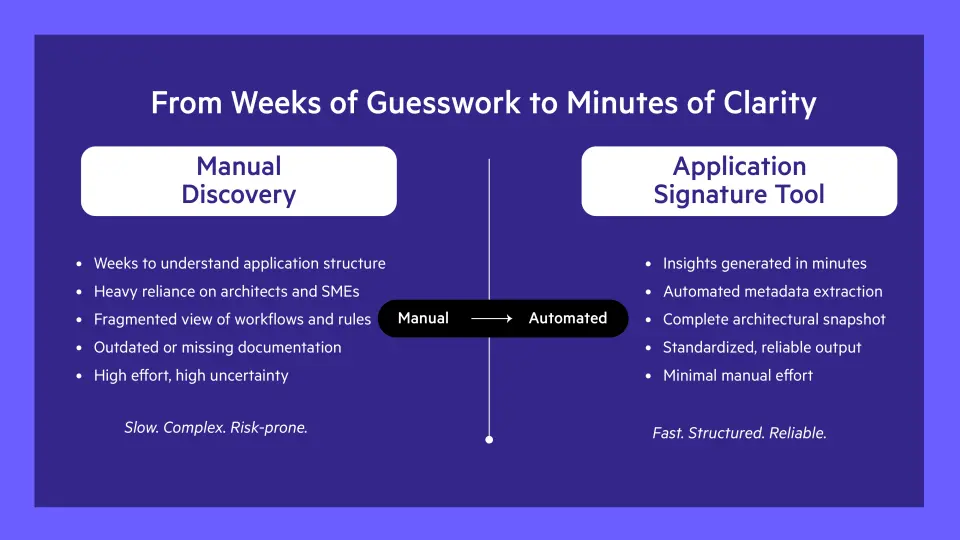
For organizations planning modernization initiatives, the Application Signature Tool delivers several practical benefits.
Manual discovery can take weeks or months. The Application Signature Tool dramatically accelerates this process by generating automated outputs in minutes. This allows teams to move quickly from understanding the application to planning modernization strategies.
Modernization decisions should be based on facts rather than assumptions. The tool provides objective insights derived directly from the application itself, helping teams understand:
This evidence-based approach supports more informed and confident decision-making.
Because discovery is automated, organizations can reduce the need for long, consulting-intensive discovery phases. This lowers the costs and reduces the risks associated with incomplete or inaccurate manual analysis.
One of the most powerful advantages of this tool is its seamless integration with Pega Blueprint. The output generated by the tool can be directly uploaded into Blueprint to visualize the application's current state and begin reimagining workflows using AI-assisted capabilities.
Modernizing heritage applications allows organizations to take advantage of the latest innovations within the Pega ecosystem, including AI-powered workflows and improved automation. By removing barriers to modernization, the Application Signature Tool helps organizations unlock the full potential of the modern Pega Platform.
Who Should Use This Tool
The Application Signature Tool is valuable for multiple roles involved in modernization initiatives across the Pega Platform ecosystem.
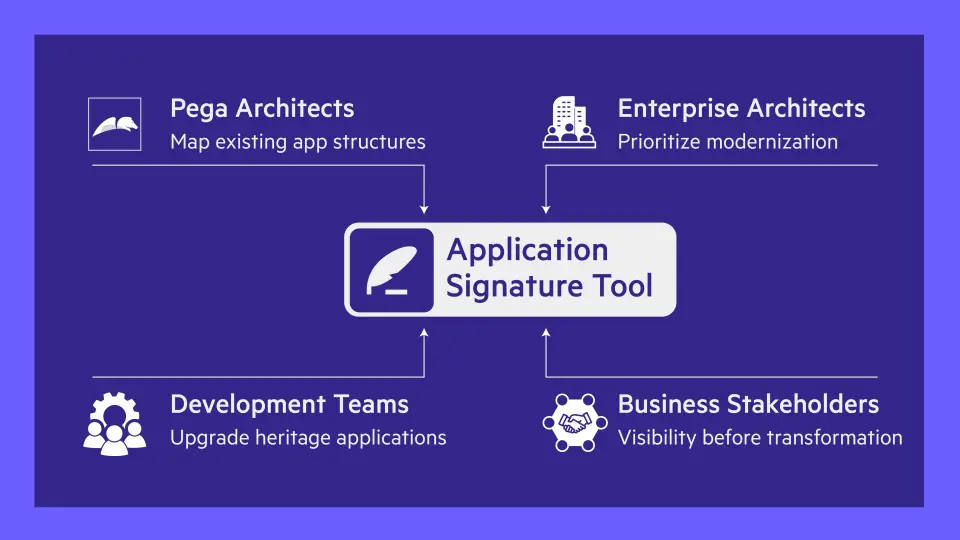
By providing an objective view of the application’s current state, the tool enables both technical and business teams to make modernization decisions with greater confidence.
Once the Application Signature Tool generates the application signature file, the next step in the modernization journey happens within Pega Blueprint.
Blueprint performs two critical functions:
When the signature file is uploaded into Blueprint, it generates an initial Blueprint representing the current structure of the application. This visualization provides teams with a clear understanding of existing workflows and processes.
This step transforms complex application logic into an accessible, visual representation.
Blueprint also includes a reimagine capability that enables organizations to redesign workflows based on modern best practices.
Using the application signature as the foundation, Blueprint can:
This AI-assisted approach allows teams to evolve applications while maintaining continuity with existing business processes.
Another key advantage of the Application Signature Tool is that it supports incremental modernization strategies.
Instead of attempting to modernize an entire application at once, organizations can focus on specific workflows or case types that deliver the greatest business value.
A typical modernization cycle might include:
Organizations can repeat this cycle for additional workflows, gradually transforming their applications while maintaining operational stability.
This iterative approach allows teams to modernize at a pace that aligns with business priorities and resource availability.
Beyond individual modernization initiatives, the tool also provides strategic value for organizations managing multiple heritage applications.
Because the tool generates consistent and repeatable assessments, enterprises can:
This consistency improves resource allocation and ensures modernization efforts focus on areas with the highest potential return.
For organizations running heritage Pega applications, modernization has often been a complex and resource-intensive undertaking. The lack of visibility into existing architectures made discovery difficult and planning uncertain.
The Application Signature Tool represents a turning point.
By automating application discovery and generating Blueprint-ready insights, the tool enables teams to quickly understand how their applications are structured today and confidently plan the next phase of modernization.
As organizations increasingly adopt AI capabilities within the Pega Platform ecosystem, having a clear understanding of existing applications becomes even more critical. The Application Signature Tool provides that clarity, helping teams transform complex heritage systems into modern, scalable, and future-ready applications.

.png)


.png)