.png)

.png)
ISO 20022 has moved from migration planning to day-to-day payment operations. Since November 2025, ISO 20022 MX messages have been the standard for cross-border payment instructions over Swift, replacing legacy MT formats for financial institutions and non-bank financial institutions.
On November 14, 2026, Swift will require financial institutions to receive Enquiry and Investigation messages in MX format, including camt.110 and camt.111. The same milestone will also remove support for unstructured addresses in CBPR+ payment messages, increasing the need for structured payment data across the payment process.
For investigation teams, these changes have a direct operational impact. Payment cases can involve information from ISO 20022 messages, existing MT messages, and translated message content. Investigators need to connect that information, understand the payment history, and resolve cases within a consistent workflow.
This is where Pega Smart Investigate becomes relevant. By supporting payment investigation workflows across message formats, it can help financial institutions manage the information involved in investigations as ISO 20022 adoption continues.
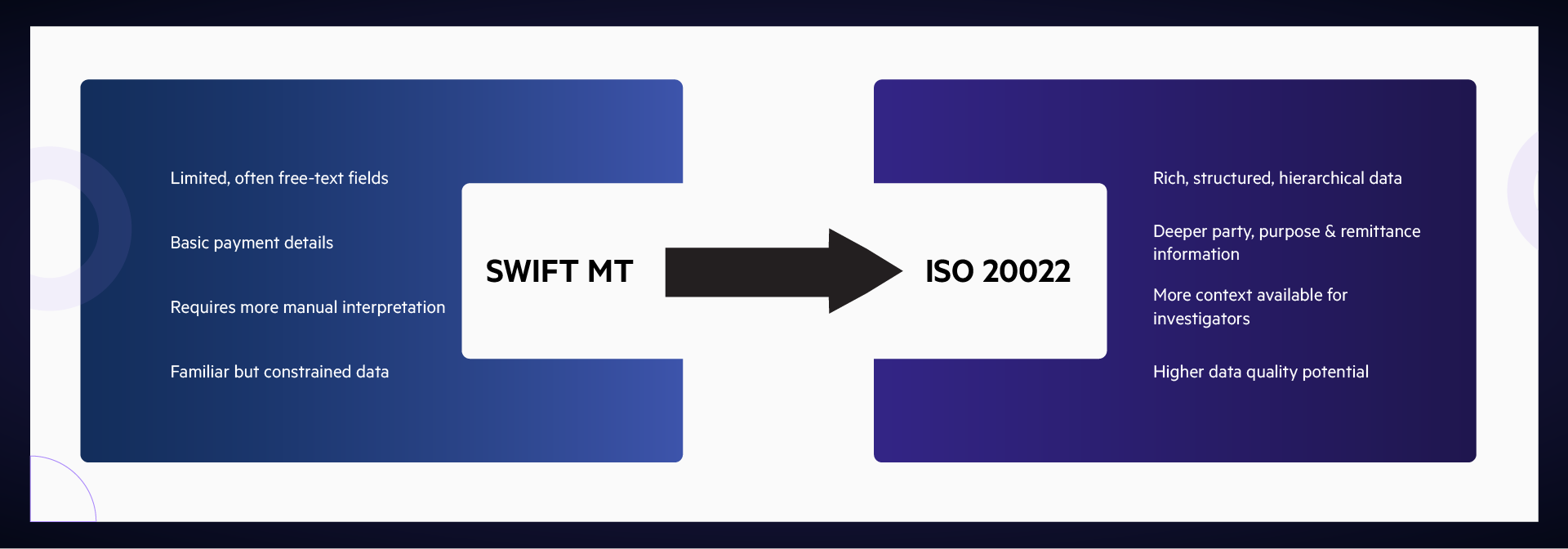
ISO 20022 provides payment information in defined data elements, giving banks more structured information to process and use. Swift links this structured data to better data quality, more effective compliance screening, greater transparency, and higher levels of automation.
For payment investigation teams, that creates several considerations:
More structured payment information: Investigators can work with payment details captured in defined data fields.
More information to review: Richer payment messages can provide additional context when a case requires investigation.
Greater focus on data quality: Incorrect or incomplete information can affect downstream processing and investigation activities.
More opportunities for automation: Structured data can support rules, routing, validation, and other automated steps.
New investigation requirements: As ISO 20022 adoption expands into exception and investigation processes, investigation platforms need to handle the new message types and data structures.
The quality and availability of payment data therefore have a direct effect on how investigation teams work. The investigation workflow needs to make that information usable within the case.C
Pega Smart Investigate gives financial institutions a common case-management environment for payment investigations. Investigators can work through defined processes while the payment information associated with a case can come from different message formats.
For investigations involving SWIFT MT and ISO 20022, Pega Smart Investigate can support:
Case creation and routing: Payment events can trigger investigation cases and route them according to defined business rules.
Payment information within the case: Relevant transaction information can be associated with the investigation, giving investigators the context needed to review the case.
Consistent investigation processes: Teams can follow defined steps for investigation and resolution across different payment scenarios.
Workflow consistency: Investigation steps, assignments, and actions can follow defined processes across payment types.
This approach allows teams to manage investigations through a common workflow while supporting payment information from both established MT processes and newer ISO 20022 flows.
Pega Smart Investigate can bring relevant payment information into the investigation case, allowing investigators to:
For banks operating with both formats, this gives teams a consistent payment investigation process while the underlying message structures continue to differ.
The coexistence of SWIFT MT and ISO 20022 can affect how investigation teams access and work with payment information. Pega Smart Investigate can give teams a common case workflow for handling investigations across both formats.
One investigation process: Teams can follow defined investigation procedures across MT and ISO 20022 cases.
Consistent case context: Relevant payment information can remain available within the investigation case as the work progresses.
Less format-specific handling: Investigators can work within the same case process even when the underlying payment messages have different structures.
Support for the transition period: Teams can continue handling existing MT-based investigations while adding ISO 20022 payment flows.
Better use of structured payment data: ISO 20022 provides richer structured information that can be used within the investigation process when available.
For organizations modernizing their payment investigation operations, this creates a more consistent way to manage cases while payment messaging continues to evolve.
As banks continue adopting ISO 20022, investigation teams need to account for both current MT-based processes and newer ISO 20022 payment flows. A few questions can help assess whether the existing payment investigation setup is ready:
These considerations can help banks identify where their current investigation processes need to evolve and where Pega Smart Investigate can support the transition.
ISO 20022 adoption will continue alongside existing SWIFT MT processes for many organizations. Investigation teams therefore need to work with both message formats while maintaining consistent case-handling processes.
Pega Smart Investigate can support this model by bringing payment information into a common investigation workflow and giving teams a consistent way to manage cases across different message formats.
For banks reviewing their ISO 20022 payment investigations, the next step is to assess how existing investigation processes handle both formats and where Pega Smart Investigate can support modernization.
EvonSys can help you assess and modernize your payment investigation operations with Pega Smart Investigate.

.png)


.png)