.png)

.png)
Customers expect quick answers, personalized service, and the freedom to interact with businesses on the channel they prefer. Voice remains one of the most widely used channels, especially for situations that require immediate attention or involve complex issues. Yet many organizations still rely on traditional IVR systems that route callers through long menus, transfer them between departments, or require customers to repeat the same information multiple times.
Voice AI advances in speech recognition, natural language processing (NLP), and AI-driven decisioning now allow businesses to understand spoken requests, identify customer intent, and complete tasks through natural conversations. Customers can activate a card, report fraud, check a claim status, or update personal information without navigating complicated menus or waiting for an available agent.
For enterprises already using Pega, these conversations become even more valuable. Voice AI in Pega connects every customer interaction to business rules, case management, and real-time decisioning. Instead of treating a voice conversation as an isolated event, Pega uses it to trigger workflows, retrieve customer context, recommend the next best action, and complete business processes from start to finish.
The result is a faster experience for customers, lower operational effort for service teams, and more consistent decisions across every interaction.
What is Voice AI in Pega?
Voice AI combines several AI technologies that allow computers to understand and respond to spoken language. These technologies work together to convert speech into actionable business requests. A typical Voice AI solution includes:
These capabilities allow systems to conduct conversations. Enterprise applications, however, require more than understanding language. Every customer request must follow business rules, trigger the correct workflow, access multiple systems, and maintain compliance.
Pega Voice AI transforms voice interactions into enterprise actions. It evaluates customer information, business policies, and case data before deciding what happens next. Whether a customer wants to dispute a payment, report a lost card, schedule a medical appointment, or check the status of an insurance claim, Pega coordinates the entire process while keeping every interaction within a single case.
Because the same business rules are applied across voice, web, chat, and mobile channels, organizations can deliver consistent service regardless of how customers choose to interact.
A conversation with Voice AI may sound simple from the customer's perspective, but several technologies work together behind the scenes. The interaction usually follows this sequence:
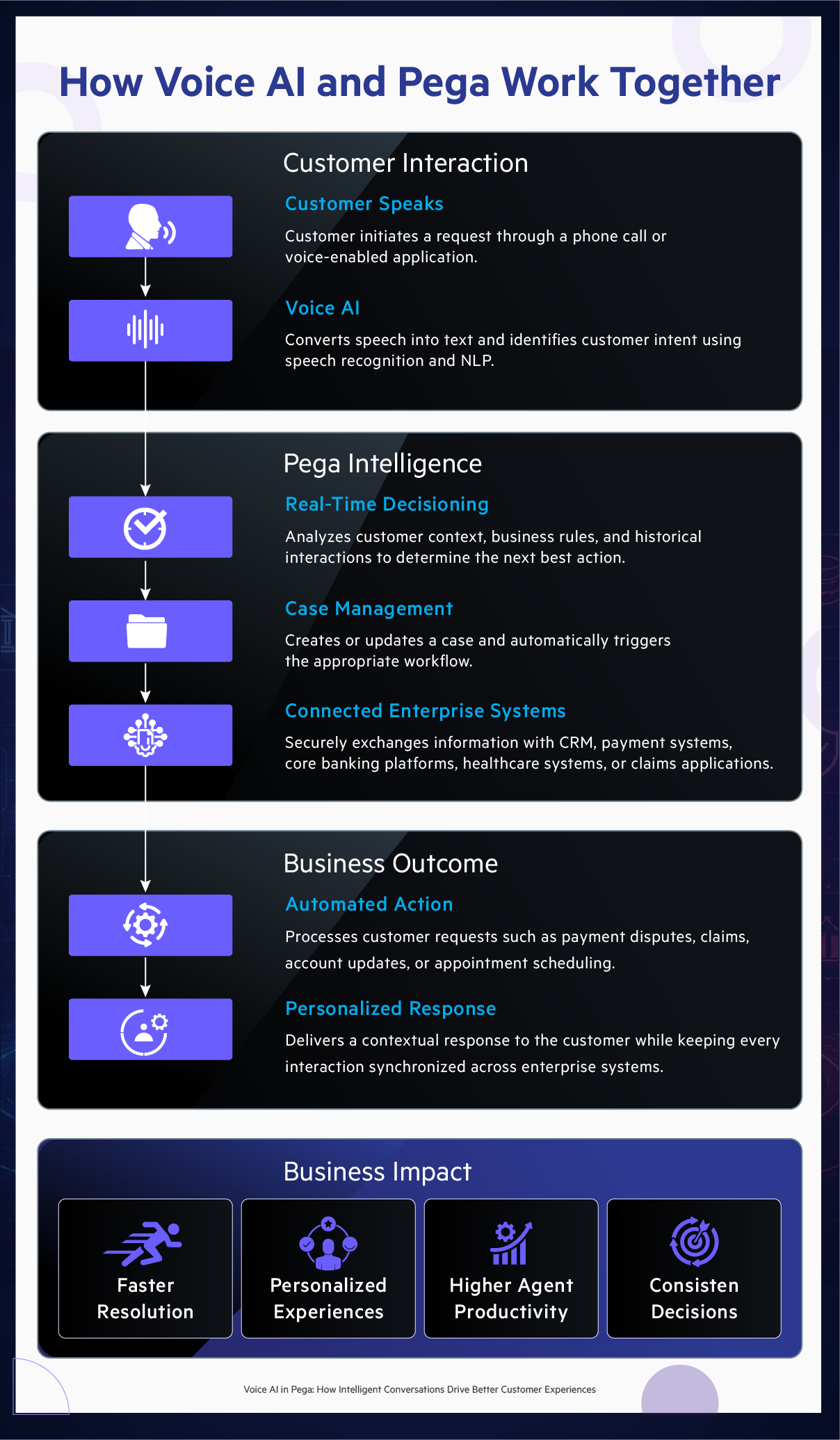
Consider a customer who calls a bank to report a fraudulent credit card transaction. Voice AI captures the customer's request and authenticates their identity. Pega immediately retrieves account information, creates a fraud investigation case, blocks the compromised card, orders a replacement card if required, and provides the customer with a reference number before the call ends. If additional verification is needed, the case moves to the appropriate team with the conversation history attached, eliminating the need for the customer to repeat information.
This ability to combine conversational AI with workflow automation reduces manual effort and shortens resolution times for both customers and service teams.
High call volumes, repetitive requests, long handling times, and increasing customer expectations continue to put pressure on contact centers. Voice AI automates routine interactions while giving human agents more time to focus on complex cases.
Organizations adopting Voice AI in Pega commonly pursue outcomes such as:
Voice AI can also automate internal processes, assist employees during live conversations, capture call summaries, recommend knowledge articles, and reduce post-call administrative work.
When combined with Pega's decisioning capabilities, every conversation becomes an opportunity to deliver more relevant service based on the customer's history, preferences, and current needs.
The impact of Voice AI in Pega goes beyond automating conversations. By connecting voice interactions with case management and decisioning, organizations improve customer service while reducing operational effort.
Better customer experiences
Customers expect quick, natural conversations without repeating information. Voice AI identifies intent early, while Pega retrieves customer history and ongoing cases to continue the conversation from where it left off. This creates faster and more personalized interactions across every touchpoint.
Faster case resolution
Routine requests such as reporting a lost card, updating personal information, or checking payment status follow predefined workflows. Once Voice AI understands the request, Pega can trigger the appropriate process automatically, reducing handling time, manual data entry, and unnecessary transfers.
Consistent decisions across channels
Customers move between voice, chat, web, and mobile channels. Pega applies the same business rules and workflows across each one, giving customers a consistent experience while improving governance and compliance.
Higher agent productivity
Voice AI assists service representatives by capturing conversation details, recommending knowledge articles and suggesting the next best action. Agents spend more time solving customer problems instead of completing administrative tasks.
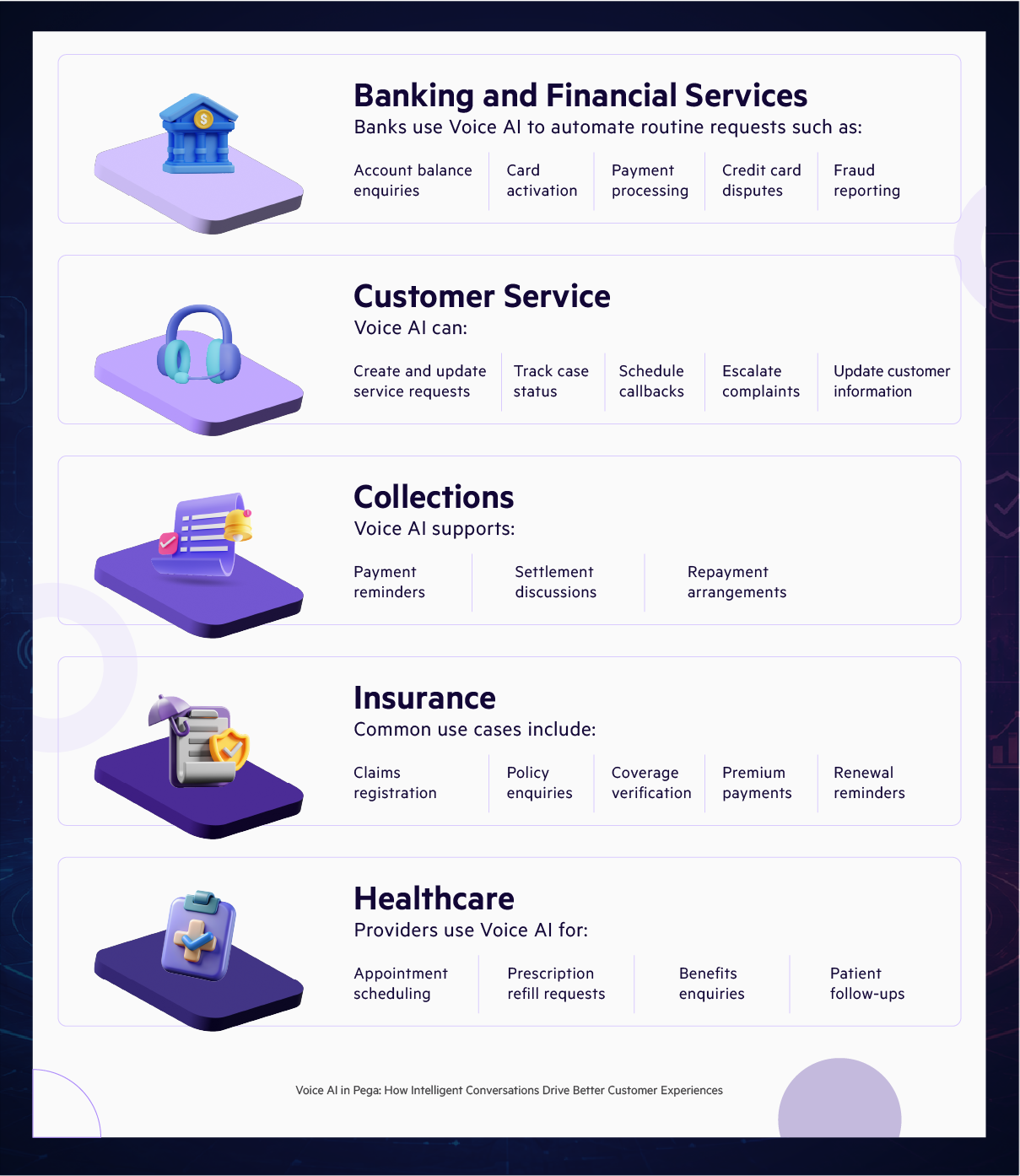
Voice AI in Pega supports a wide range of enterprise processes. Here are some common applications across industries.
Customer Decisioning
Personalizing Conversations with Pega Customer Decision Hub
Pega Customer Decision Hub evaluates customer profiles, previous interactions, products, current cases, and business policies in real time to recommend the next best action.
A customer checking the status of a mortgage application receives relevant updates based on the current stage of the process. Someone reporting a payment issue receives assistance based on their account history and existing cases. These recommendations happen during the conversation, allowing organizations to deliver more relevant and consistent customer experiences across every channel.
Implementation Considerations
A successful Voice AI implementation depends on more than speech recognition. Organizations should focus on three areas:
Integration: Voice platforms, authentication services, enterprise applications, and Pega workflows should exchange data reliably to maintain a consistent customer experience.
Security and compliance: Voice interactions often involve sensitive customer information. Strong authentication, encryption, audit trails, and regulatory compliance should be built into every workflow.
Continuous improvement: Monitoring intent recognition, call resolution rates, customer satisfaction, and conversation transcripts helps refine AI models and improve performance over time.
Pega Customer Decision Hub evaluates customer profiles, previous interactions, products, current cases, and business policies in real time to recommend the next best action.
A customer checking the status of a mortgage application receives relevant updates based on the current stage of the process. Someone reporting a payment issue receives assistance based on their account history and existing cases. These recommendations happen during the conversation, allowing organizations to deliver more relevant and consistent customer experiences across every channel.
Implementation Considerations
A successful Voice AI implementation depends on more than speech recognition. Organizations should focus on three areas:
Integration: Voice platforms, authentication services, enterprise applications, and Pega workflows should exchange data reliably to maintain a consistent customer experience.
Security and compliance: Voice interactions often involve sensitive customer information. Strong authentication, encryption, audit trails, and regulatory compliance should be built into every workflow.
Continuous improvement: Monitoring intent recognition, call resolution rates, customer satisfaction, and conversation transcripts helps refine AI models and improve performance over time.
Voice interactions are becoming more intelligent as AI continues to evolve. Advances in generative AI, large language models, and real-time decisioning are enabling systems to understand context more accurately, manage complex conversations, and resolve requests with minimal human intervention.
For organizations using Pega, this means voice will become more than a service channel. Voice AI in Pega will support conversational case management, AI-assisted agents, multilingual customer interactions, sentiment-aware responses, and increasingly personalized experiences driven by real-time data and business policies.
As customer expectations grow, organizations will need platforms that can combine conversational AI with workflow automation and enterprise decisioning. Pega already brings these capabilities together, giving businesses a strong foundation to build customer experiences that are faster, consistent, and ready to adapt as Voice AI continues to evolve.
Want to see where Voice AI fits into your Pega roadmap?

.png)


.png)