.png)

.png)
Every year, Swift introduces a Standards Release to keep the global financial ecosystem aligned with evolving payment requirements. With Swift SR2026 going live in November 2026, financial institutions are preparing for changes that extend beyond compliance.
The release marks a significant milestone in the industry's transition to ISO 20022 cross-border payments, introducing stricter data quality requirements, standardized payment investigations, and stronger validation rules.
While many financial institutions are focused on meeting the Swift SR2026 deadline, the broader objective is to build a more efficient, transparent, and interoperable payments ecosystem.
From introducing ISO 20022 structured alternatives for legacy free-format communications to enhancing investigation workflows, the Swift Standards Release 2026 introduces significant changes that will shape the future of cross-border payments.
SR2026, or Swift Standards Release 2026, is a major update to global financial messaging standards. Effective November 14, 2026, it introduces mandatory structured and hybrid postal addresses, begins the transition from legacy free-format messages to ISO 20022 structured alternatives, and strengthens ISO 20022 validation requirements for cross-border payments.
Here are some of the key changes in Swift SR2026 and what they mean for financial institutions preparing for the next phase of ISO 20022.
Structured and Hybrid Postal Addresses Become Mandatory
One of the most impactful changes in Swift SR2026 is the removal of fully unstructured postal addresses. For CBPR+ ISO 20022 messages, only structured and hybrid postal addresses will be accepted, bringing greater consistency to payment data across the global financial network.
Structured address data improves sanctions screening, anti-money laundering (AML) checks, and payment routing while reducing manual repairs caused by incomplete or inconsistent address information. Banks should begin reviewing customer records, payment channels, and onboarding processes to eliminate unstructured address formats before the Swift SR2026 deadline.
The Transition to Structured E&I Messaging:
As part of the continued ISO 20022 migration journey, Swift is introducing structured ISO 20022 alternatives for legacy E&I message types. While November 2026 marks an important transition milestone, certain free-format messages, including MT199 and MT299, will continue during the transition period before being fully phased out in November 2027.
Moving to structured ISO20022 messaging format reduces dependence on legacy MT messages, enables better interoperability between payment systems, and supports more efficient processing across cross-border payments.
Banks Must Receive admi.024 Notifications
Another important update in the Swift standards release 2026 is the requirement for banks to receive admi.024 notifications. These administrative messages communicate processing outcomes and validation results between financial institutions.
Standardized notifications improve operational visibility by allowing banks to identify validation issues earlier, automate internal workflows, and reduce manual follow-up when payment processing exceptions occur.
Getting Ready for camt.110 Case Management
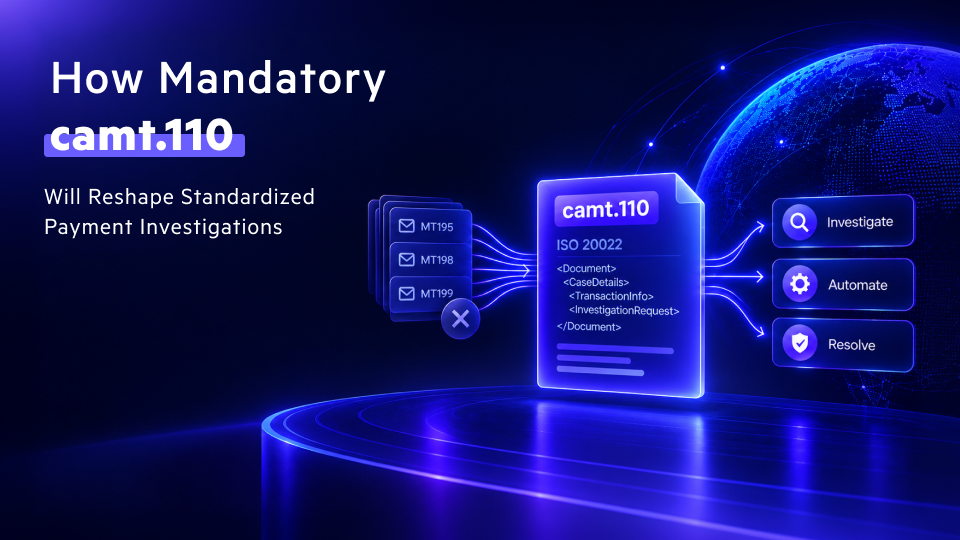
Banks must also be ready to receive camt.110 messages as part of the ISO 20022 Case Management framework. This represents an important step toward standardized payment investigations.
Instead of relying on emails or unstructured communication, banks can exchange investigation requests using structured ISO 20022 messages. This improves collaboration between correspondent banks, accelerates investigation timelines, and strengthens payment exception management through greater automation and traceability.
Meeting Enhanced Validation Requirements
Swift SR2026 introduces enhanced validation rules and updates its business rule engine to align with the latest Swift Usage Guidelines. These improvements validate payment messages more rigorously before processing, helping institutions identify errors earlier in the payment lifecycle.
The result is improved straight-through processing (STP), better data quality, fewer rejected or repaired payments, and stronger compliance across ISO 20022 cross-border payments.
Supporting the New OTHR Investigation Category
To support a wider range of investigation scenarios, Swift SR2026 introduces the new OTHR (Other Investigation) category. This enhancement allows banks to process payment investigations that do not fit within existing predefined investigation types.
By expanding investigation coverage while maintaining standardized messaging, financial institutions gain greater flexibility to manage evolving business scenarios, improve reporting, and automate more investigation workflows across the CBPR+ ISO 20022 framework.
Keeping Pace with Updated Swift Usage Guidelines
Beyond new message capabilities, Swift SR2026 updates message validation rules, investigation reason classifications, and business service definitions to align with the latest Swift Usage Guidelines.
These refinements improve consistency between financial institutions, reduce implementation risk, and ensure investigation messages remain compatible with the latest Swift infrastructure. For banks preparing for cross-border payments 2026, adopting these updated business rules will be essential to maintaining seamless payment processing and investigation workflows.
The impact of Swift SR2026 extends beyond meeting a standards requirement. The release introduces changes that help financial institutions improve data quality, strengthen compliance, enhance automation, and prepare for the future of ISO 20022 cross-border payments.
Better Data Quality and Compliance
The transition to structured and hybrid postal addresses improves the quality and consistency of payment data. By reducing ambiguity in address information, banks can strengthen downstream processes such as sanctions screening, KYC, and trade-based money laundering (TBML) checks.
Standardized data also reduces payment delays caused by incomplete or inconsistent information and helps eliminate workarounds previously used to fit unstructured address data into legacy formats.
Improved Automation and Interoperability
ISO 20022-compliant messages provide richer and more structured data compared to legacy formats. This enables greater automation across reconciliation, reporting, analytics, and integration with internal systems such as ERP platforms, treasury management systems, and payment hubs.
For banks managing high volumes of cross-border payments, improved data quality and machine-readable messages can reduce manual intervention and improve operational efficiency.
Future-Proofing Against Legacy Limitations
As legacy MT formats and unstructured data fields continue to be phased out, institutions that rely on outdated processes risk payment delays, message rejection, and operational disruption.
The ISO 20022 migration 2026 journey requires banks to modernize their payment infrastructure, adopt structured data standards, and ensure readiness for future Swift requirements.
Stronger Cross-Border and Regulatory Resilience
Consistent data standards help financial institutions meet evolving regulatory, compliance, and sanctions requirements across global payment networks. This is particularly important for correspondent banking, international trade, and supply chain finance, where accurate and transparent payment information is critical.
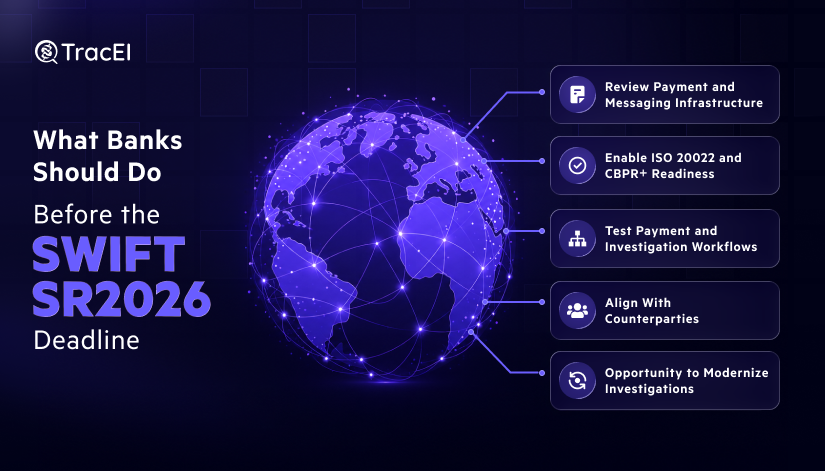
Start preparing now. As the Swift SR2026 deadline approaches, banks and financial institutions need to ensure their payment infrastructure, messaging flows, and investigation processes are ready for the upcoming changes. Waiting until the final stages could leave limited time for testing, remediation, and system updates.
Here’s what banks should focus on now:
Review Payment and Messaging Infrastructure
Audit existing payment flows to identify dependencies on legacy MT formats, unstructured postal addresses, and manual investigation processes. Understanding these gaps early will help banks prioritize upgrades and avoid disruption when SR2026 requirements take effect.
Enable ISO 20022 and CBPR+ Readiness
Update payment systems to support ISO 20022 cross-border payments, structured address formats, and the latest CBPR+ ISO 20022 requirements. This ensures smoother message processing, improved data quality, and better interoperability across the payment ecosystem.
Test Payment and Investigation Workflows
Conduct thorough testing of message flows, validation rules, integrations, and exception scenarios before migration. Banks should ensure their systems can process new requirements, such as camt.110, admi.024 notifications, and updated investigation workflows to avoid payment delays or rejected messages.
Align With Counterparties
SR2026 readiness requires coordination across banks, corporates, and technology providers. All participants need to support structured and hybrid address formats along with ISO 20022-compliant messages to prevent processing failures.
Use SR2026 as an Opportunity to Modernize Investigations
Beyond compliance, SR2026 provides an opportunity to improve how banks manage payment exceptions and investigations. Modern investigation platforms can help automate workflows, improve case visibility, and reduce resolution times.
TracEI by EvonSys helps financial institutions modernize payment investigations with a unified platform designed for Swift, CBPR+, and ISO 20022 environments. It enables banks to manage evolving investigation requirements while improving automation, transparency, and operational efficiency.
Swift SR2026 is more than a compliance milestone. It strengthens ISO 20022 cross-border payments through richer data, standardized investigations, enhanced validation, and improved interoperability. Financial institutions that prepare early by modernizing payment data, investigation workflows, and validation processes will be better positioned to reduce payment exceptions, improve operational efficiency, and deliver faster, more reliable cross-border payment experiences.
If you need support preparing for Swift SR2026 compliance and modernizing payment investigation workflows, contact us today to discuss how TracEI can help your organization achieve ISO 20022 and CBPR+ readiness.
Prepare Your Bank for Swift SR2026
Don’t wait until the deadline. Modernize your payment investigation workflows and ensure readiness for ISO 20022 and CBPR+ requirements with TracEI by EvonSys.


.png)


.png)