.png)

.png)
Global payments have become faster, more complex, and more interconnected than ever before. Banks today process millions of transactions across domestic and international payment networks, multiple currencies, and diverse regulatory environments. While payment execution has become increasingly automated, resolving payment exceptions remains a significant operational challenge.
A delayed, failed, or incomplete payment is no longer just an operational issue. It directly impacts customer trust, liquidity management, regulatory compliance, and the overall banking experience. Yet many financial institutions still rely on fragmented systems, manual investigations, and disconnected communication channels to resolve payment issues.
According to Swift’s Exception and Investigation Transformation Report, unstructured free-form messages continue to account for more than 72% of exception and investigation communications. This highlights a persistent gap between modern payment processing capabilities and investigation workflows.
As global payments continue to evolve, visibility across the payment lifecycle is no longer an added capability. It is a foundation for improving operational efficiency, strengthening customer trust, and building resilient payment operations.
Traditionally, banks measured payment success through transaction completion rates and system availability. While these metrics remain important, they do not provide a complete view of the customer experience.
A payment can be technically processed but still create challenges when it gets delayed at an intermediary bank, requires additional information, or triggers compliance checks. Without complete visibility, operations teams often spend significant time searching across multiple systems, reviewing messages, and coordinating manually with counterparties.
This lack of transparency creates operational bottlenecks and increases resolution times.
The growth of cross-border payments has made this challenge even more complex. International transactions involve multiple participants, including originating banks, correspondent banks, payment networks, and beneficiary institutions. Each additional participant introduces potential points of failure.
Effective cross-border payment tracking enables banks to monitor transactions throughout their lifecycle. It provides operational teams with the information needed to identify delays, understand payment status, and proactively address exceptions before they impact customers.
With global payment volumes continuing to increase, visibility is becoming a fundamental capability for financial institutions. According to the Bank for International Settlements, global payment systems continue to experience significant growth as digital payment adoption accelerates across markets.
Banks that lack centralized visibility risk higher operational costs, longer investigation cycles, and reduced customer confidence.
Manual investigation processes are struggling to keep pace with today’s complex payment environment. As transaction volumes increase and payment networks become more interconnected, banks need faster, more transparent, and automated ways to manage exceptions.
.png)
Lack of Visibility
Traditional investigation processes often rely on fragmented systems, emails, spreadsheets, and multiple banking applications. This makes it difficult for teams to access a complete view of payment status, resulting in inconsistent information, delayed decisions, and unnecessary escalations.
Manual Effort
Operations teams spend significant time collecting payment details, coordinating with internal teams, and following up with external parties. These repetitive tasks slow down resolution cycles and prevent investigators from focusing on higher-value activities.
Compliance Challenges
Limited transparency across payment journeys makes it challenging for banks to meet service-level agreements and evolving regulatory expectations. Without accurate, real-time information, teams may struggle to provide timely updates and maintain audit readiness.
Rising Operational Costs
Manual exception handling creates significant operational expenses for financial institutions. Delayed investigations can also impact liquidity management, as funds remain unavailable while teams work to identify and resolve payment issues.
Need for Modernization
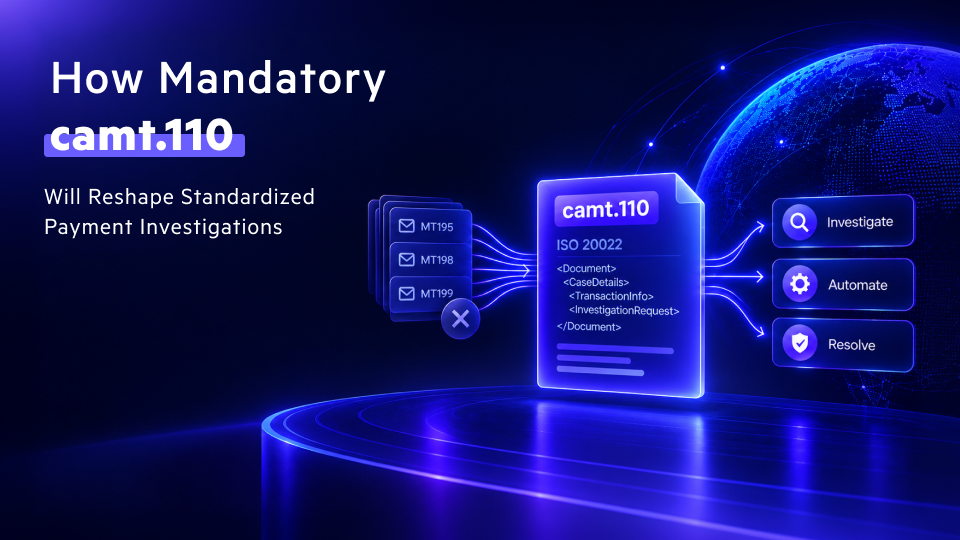
With evolving payment standards like ISO 20022, banks have access to richer payment data that can improve investigation accuracy and automation. However, they need modern infrastructure that can connect data sources, automate workflows, and deliver actionable insights.
The introduction of Swift’s Global Payments Innovation initiative has significantly improved transparency in international payments. Swift gpi tracking allows banks to track payment status, improve transaction traceability, and provide better updates to customers.
However, payment tracking alone does not solve the entire investigation challenge.
Knowing where a payment is located is only one part of the resolution process. Banks also need to understand why an exception occurred, determine the required action, communicate with relevant parties, and complete the investigation efficiently.
This is where advanced investigation platforms become essential.
A modern approach combines payment tracking capabilities with automated case management, workflow orchestration, and intelligent decision support. Instead of manually searching for payment information, investigators can access a consolidated view of the transaction journey and associated exception details.
This creates stronger banking operations visibility by connecting payment data, investigation workflows, and operational teams through a unified platform.
For customers, this means fewer delays and more accurate updates. For banks, it means improved operational efficiency, reduced investigation costs, and better compliance management.
As payment ecosystems become more complex, automation is becoming a critical component of operational transformation.
Payment operations automation enables banks to streamline investigation workflows, reduce manual intervention, and accelerate resolution times. Automated routing ensures cases reach the right teams, while intelligent workflows help prioritize high-impact exceptions.
Automation also enables banks to move from reactive investigation management to proactive exception prevention.
For example, instead of waiting for a customer to report a delayed payment, banks can identify potential issues earlier through real-time monitoring and automated alerts. Operations teams can take corrective action before delays affect customer experience.
A modern payment investigation framework should include capabilities such as:
These capabilities allow banks to create a more resilient payment infrastructure while improving operational performance.
Research from McKinsey highlights that automation and digital transformation initiatives can significantly improve productivity across financial services operations. By reducing repetitive manual tasks, banks can redirect resources toward higher-value activities and customer-focused initiatives.
The future of banking depends on the ability to combine speed, transparency, and operational intelligence.
Payment modernization cannot stop at faster transaction processing. Banks must also modernize the processes that support exception handling and investigation management.
A future-ready payment investigation framework should provide complete payment visibility across the entire transaction lifecycle. It should allow operations teams to quickly answer critical questions:
By creating this level of transparency, banks can improve customer experiences while reducing operational complexity.
Solutions like TracEI help financial institutions modernize payment investigations by combining automated workflows, AI-driven capabilities, and real-time tracking. Built for today’s complex payment environment, platforms like these enable banks to manage exceptions more efficiently while supporting evolving standards such as ISO 20022 and Swift requirements.
Payment visibility is no longer a differentiator. It is a necessity.
As payment volumes grow and cross-border transactions become more complex, banks need faster, more transparent ways to monitor, investigate, and resolve payment issues. Traditional manual processes cannot deliver the efficiency and control required in a modern payment environment.
TracEI helps banks transform payment investigations with intelligent workflows, centralized case management, and end-to-end visibility, enabling faster resolution, improved operational efficiency, and stronger customer trust.
The future of payments will be defined not only by speed, but by how effectively banks understand, manage, and resolve every transaction journey.
Bring Greater Visibility and Automation to Every Payment Journey
With TracEI, financial institutions can move beyond manual investigations by connecting payment data, workflows, and AI-driven insights to resolve exceptions faster and more efficiently.


.png)


.png)