.png)

.png)
The payments industry is moving toward a more structured, transparent, and automated future. As financial institutions continue their transition toward Swift ISO 20022, the focus is expanding beyond transaction processing to include every stage of the payment lifecycle, including payment exceptions, investigations, and resolution workflows.
While modern payment systems have improved speed and connectivity, payment investigations have not evolved at the same pace. Many banks still rely on manual reviews, email-based communication, fragmented systems, and unstructured messages to resolve payment issues. These legacy approaches create payment investigation delays, increase operational costs, and make it difficult to provide customers with timely updates.
The introduction of camt.110 represents a major step forward in modernizing payment investigations. Designed as part of the ISO 20022 investigations messaging framework, camt.110 enables financial institutions to exchange structured investigation requests, replacing traditional free-format communication methods.
The need for modernization is becoming more urgent as payment ecosystems continue to evolve. The shift toward structured payment messaging is already accelerating across the financial ecosystem. According to Swift Annual Review 2025, 97% of payment instructions were being sent in ISO 20022 format, demonstrating strong industry adoption of richer, structured payment data.
As transaction volumes grow, banks need scalable processes to manage investigations and exceptions efficiently while maintaining compliance, visibility, and operational control.
For financial institutions, camt.110 is not simply another messaging update. It represents a broader shift toward automated investigation workflows, improved collaboration between institutions, and better customer experiences.
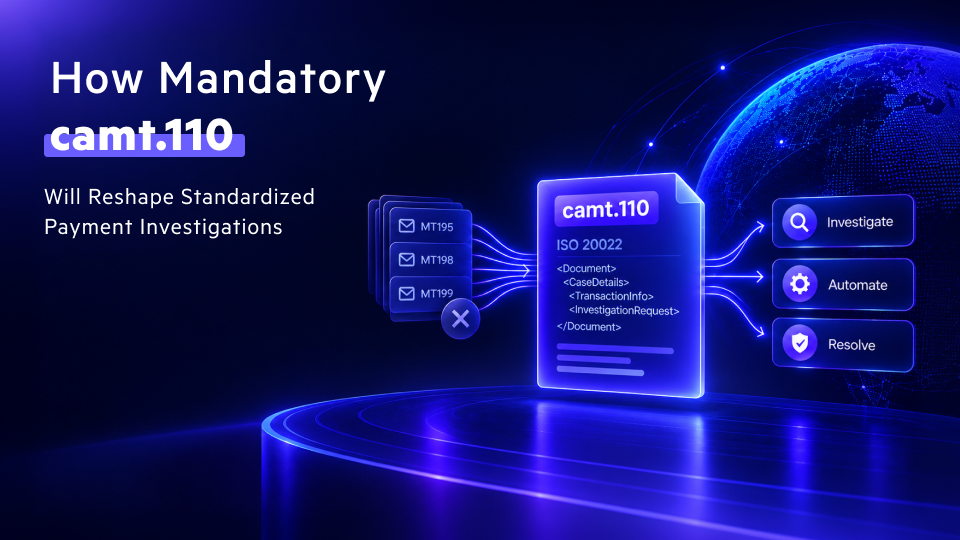
Camt.110 is an ISO 20022 financial message type used for payment and account investigation request workflows. It replaces legacy free-format text messages like the MT199 to handle payment exceptions, missing funds, and claims through automated routing.
In simple terms, camt.110 provides a standardized method for banks and financial institutions to initiate payment investigation requests using structured data. Instead of relying on free-format messages that require manual interpretation, banks can exchange consistent and machine-readable information.
Historically, financial institutions used messages such as MT199 to communicate investigation requests. While these messages supported operational requirements, their unstructured nature limited automation and created additional manual effort.
Investigation teams often needed to:
This fragmented approach increased resolution times and created operational challenges, especially as cross-border payment volumes expanded.
camt.110 changes this model by introducing structured investigation workflows. The message provides predefined data elements that help banks communicate investigation details more effectively, enabling automated routing and improved case management.
The message supports investigation scenarios including:
As part of ISO 20022 investigations, camt.110 works alongside related investigation messages, such as camt.111, which supports responses to investigation requests. Together, these messages create a standardized request and response framework for managing payment investigations.
The adoption of Swift ISO 20022 is transforming how financial institutions exchange payment information. While much of the industry discussion has focused on payment initiation and transaction processing, investigations and exceptions are becoming equally important areas of modernization.
Traditional investigation workflows were designed for a less connected payment environment. Today, banks manage increasing payment volumes across multiple channels, currencies, counterparties, and regulatory environments.
This complexity creates several operational challenges:
The McKinsey Global Payments Report highlights that while payment experiences are becoming simpler for customers, the underlying ecosystem is becoming more complex due to increasing participants, infrastructure layers, and payment channels.
For banks, this means investigation capabilities must evolve alongside payment capabilities.
camt.110 enables financial institutions to improve investigation handling by providing structured communication that can support automation and better workflow management.
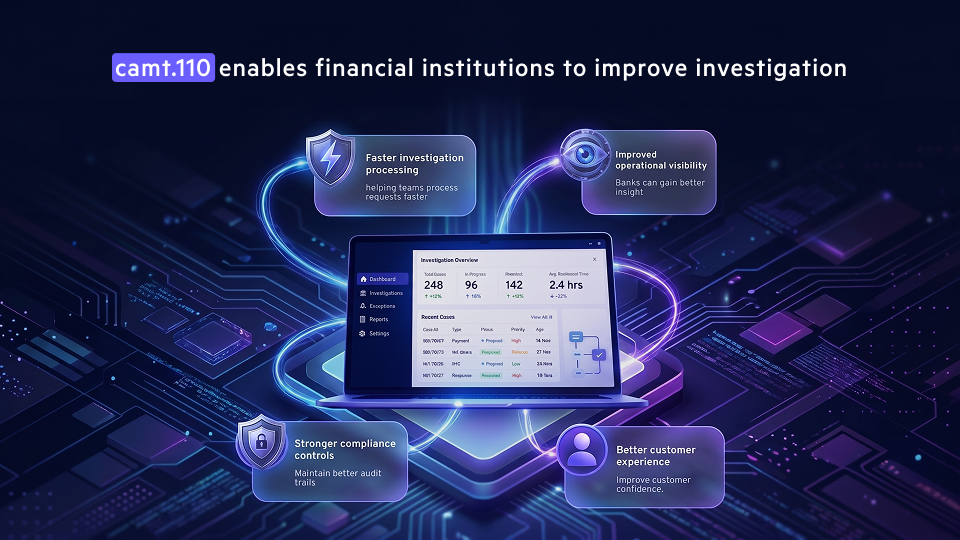
Key benefits include:
Faster investigation processing
Structured data reduces the need for manual interpretation, helping teams process requests faster and route cases more accurately.
Improved operational visibility
Banks can gain better insight into investigation ownership, status, and resolution progress.
Stronger compliance controls
Standardized workflows help financial institutions maintain better audit trails and demonstrate operational governance.
Better customer experience
Faster investigation resolution enables banks to provide more accurate updates and improve customer confidence.
As banking compliance changes continue to evolve, financial institutions need investigation platforms that can support structured messaging, automation, and complete case visibility.
Successfully adopting camt.110 requires more than supporting a new message format. Banks need to evaluate their existing investigation processes and determine how technology can improve efficiency and scalability.
Many financial institutions continue to operate with disconnected systems where payment processing, customer service, compliance reviews, and investigations are managed separately.
This creates data silos and makes it difficult for teams to gain a complete view of investigation activity.
A modern investigation strategy should focus on four key areas.
Unified case management
Banks need centralized platforms that allow teams to create, assign, track, and resolve investigations through a single workflow.
A unified approach improves collaboration between operations teams, compliance teams, and relationship managers while reducing manual coordination.
ISO 20022 readiness
As camt.110 adoption increases, banks need platforms that can process structured ISO 20022 investigations data while supporting existing payment environments during the transition period.
This flexibility allows institutions to modernize without disrupting ongoing operations.
Automation and integration
Manual investigation processes cannot scale with growing payment complexity.
Banks need solutions that automate repetitive activities such as case creation, routing, notifications, and status tracking.
API-first integration also enables investigation platforms to connect with existing payment infrastructure.
Compliance and auditability
With increasing regulatory expectations, banks require complete visibility into investigation activities.
Audit trails, standardized workflows, and reporting capabilities help financial institutions strengthen governance and reduce operational risk.
Banks that prepare early will be better positioned to meet camt.110 requirements while improving overall payment operations.
The introduction of camt.110 creates an opportunity for banks to rethink how they manage payment investigations. However, adopting structured messaging alone is not enough.
Financial institutions need a technology foundation that can connect payment data, automate workflows, and provide complete visibility throughout the investigation lifecycle.
TracEI helps banks modernize payment investigations through unified case management capabilities designed for the evolving payments landscape.
Built for the Swift ISO 20022 era, TracEI enables banks to manage investigations across Swift FIN, ISO 20022 messages, and domestic payment rails through a centralized platform.
With TracEI, banks can:
TracEI also supports banks preparing for Swift case manager capabilities by providing a flexible framework for managing structured investigation workflows.
By replacing fragmented processes with connected workflows, TracEI helps financial institutions improve investigation speed, operational efficiency, and customer outcomes.
As payment ecosystems continue to evolve, banks that combine ISO 20022 readiness with intelligent case management will be better prepared to manage increasing complexity.
camt.110 marks a significant milestone in the modernization of payment investigations. As financial institutions continue their transition toward Swift ISO 20022, structured investigation communication will become essential for improving transparency, automation, and operational efficiency.
By replacing legacy free-format messages such as MT199 with structured investigation requests, camt.110 enables automated routing, better collaboration, and improved visibility into payment exceptions.
However, successful adoption requires more than implementing a new message type. Banks need modern investigation platforms that connect systems, automate workflows, and provide end-to-end case visibility.
TracEI enables financial institutions to navigate this transformation with unified case management, ISO 20022 readiness, and intelligent investigation workflows.
As camt.110 becomes a core component of modern investigations and exceptions management, banks that prepare today will be better positioned to deliver faster, more transparent, and more reliable payment experiences in the future.
Turn camt.110 readiness into an operational advantage
Streamline payment investigations with automation, unified case management, and end-to-end visibility.


.png)


.png)