Payment investigations have become a growing operational challenge for financial institutions. While payments are moving faster across increasingly connected networks, resolving exceptions can still involve manual investigation, fragmented systems, inconsistent information, and repeated communication between banks. According to Swift, resolving payment exceptions costs the industry an estimated $1.6 billion annually.
ISO 20022 is changing this landscape by introducing richer and more structured payment data. The next important step is extending this standardization to payment exceptions and investigations through messages such as camt.110.
As the industry moves toward mandatory ISO 20022 adoption, camt.110 will change more than how investigation requests are exchanged. It will create an opportunity for banks to rethink how investigations are initiated, routed, investigated, and resolved.
Adopting new message standards is just the first step. To unlock true operational efficiency, financial institutions must build intelligent investigation operations that actively leverage structured data to drive end-to-end automation and faster outcomes.
camt.110 is an ISO 20022 XML message used by banks and financial institutions to initiate a payment or account-related investigation or request a status update on an existing investigation.
It forms part of the ISO 20022 exceptions and investigations framework and replaces older, less structured investigation messaging approaches, including legacy MT messages such as MT 195, MT 198, and MT 199.
This represents a significant change in how financial institutions communicate around payment exceptions. Instead of relying heavily on free-text messages and manual interpretation, camt.110 provides structured, machine-readable information that can be processed more consistently.
What is camt.110 Used for?
camt.110 can support a range of payment investigation scenarios, including:
It works within the broader exceptions and investigations ecosystem, including Swift Case Management, helping institutions move toward more standardized case handling and communication.
What Does a camt.110 Message Contain?
A camt.110 message contains two key components:
Business Application Header (AppHdr)
This contains message-level information such as sender and receiver details, routing information, and timestamps.
Document (Document)
This contains the investigation-specific information, including case details and references to the original payment or transaction.
The structured nature of this information is important because it allows downstream systems to interpret and process investigation data more effectively.
The biggest impact of camt.110 will not be the message itself. It will be what financial institutions can do with the structured information it provides.
Today, an investigation may require an operations analyst to interpret an incoming message, locate the original payment, search across multiple applications, gather additional information, create a case, and determine which team should handle it.
Structured investigation messaging creates an opportunity to automate many of these steps.
From Manual Investigation to Structured Workflow
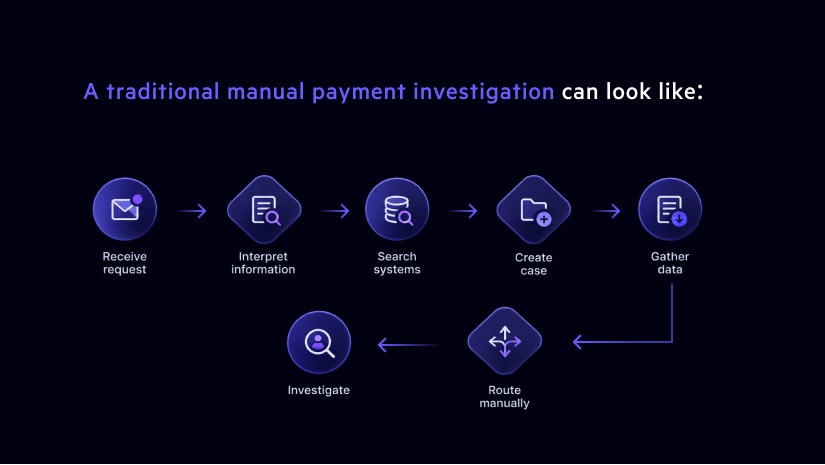
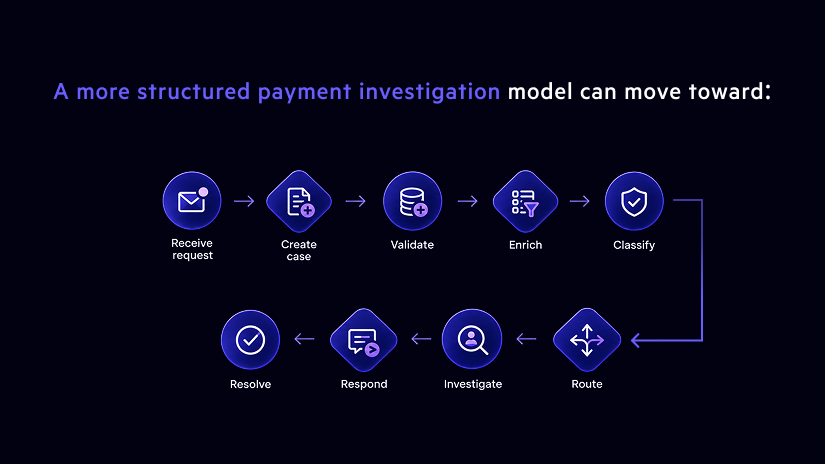
The difference is significant.
Instead of spending time preparing a case for investigation, operations teams can focus on analyzing the exception and determining the appropriate resolution.
Greater Automation Across the Investigation Lifecycle
Structured investigation data can support automation across several activities:
This can reduce repetitive work, minimize manual handoffs, and improve consistency across investigation teams.
Supporting camt.110 requires more than updating message interfaces.
Financial institutions need to evaluate whether their existing investigation environment can actually use structured ISO 20022 data throughout the investigation lifecycle.
Connecting Messaging With Case Management
A bank may be able to receive a camt.110 message, but if investigators still have to manually copy information into another application, the operational benefits of standardization are limited.
Banks should consider how investigation messages flow from their payment environment into case management and workflow systems.
The objective should be to create a connected process where structured information can automatically trigger the appropriate investigation workflow.
Aligning With Swift Case Management
The evolution of ISO 20022 exceptions and investigations also increases the importance of standardized case management.
Swift case management provides a centralized environment for managing payment exceptions and investigations. Banks need to consider how their internal investigation workflows interact with this broader ecosystem.
This includes assessing whether they can:
Questions Banks Should Ask
Financial institutions should evaluate:
These questions shift the focus from message compliance to operational readiness.
For financial institutions looking to modernize the operational side of payment investigations, TracEI provides a structured environment for managing the investigation lifecycle.
Built on Pega Launchpad, TracEI supports ISO 20022 and Swift Case Manager-aligned processes while helping banks to operationalize camt.110 data across domestic and cross-border payment operations
Its role is to help financial institutions move from fragmented investigation processes toward more structured, workflow-driven operations.
Direct camt.110 Intake and Ingestion
TracEI automatically ingests incoming camt.110 messages, parsing header and document layers to generate complete investigation cases instantly. Key attributes such as UETR, settlement details, and investigation reason codes are captured straight into the workflow, removing manual data entry and indexing delays.
Guided Investigation Workflows
Once a camt.110 request is ingested, TracEI applies intelligent business rules to validate message contents, classify the inquiry, and route it to the appropriate resolution path. Investigators are guided through standardized resolution steps, ensuring consistent decision-making across teams.
Centralized Case Workspace
TracEI aggregates incoming camt.110 details with core transaction records and account histories in a single, unified view. Investigators get complete context on the payment exception without toggling between disparate legacy systems.
Automated Case Updates and Response Generation
TracEI orchestrates outbound messaging throughout the case lifecycle. As investigations progress or conclude, TracEI maps structured case findings directly into standard response formats, including camt.111 and Swift Case Manager updates, eliminating manual handoffs and fragmented email exchanges.
Complete Lifecycle Auditability
Every stage of the camt.110 investigation, from initial message intake to counterparty exchange and final settlement, is captured in a unified audit trail, ensuring complete regulatory compliance and transparent SLA tracking
The move to mandatory camt.110 is an important milestone in the standardization of payment investigations.
But the value of ISO 20022 will not come from message standardization alone.
The real opportunity lies in what financial institutions do with the structured information once it enters their environment.
Banks that continue to rely on manual case creation, disconnected systems, and fragmented investigation processes may achieve messaging compliance without addressing the operational friction that slows investigations.
Those that connect standardized messaging with structured case management, workflow automation, centralized investigation visibility, and consistent processes can take a different approach.
camt.110 provides the structured foundation. Modern investigation platforms can turn that foundation into operational efficiency.
With TracEI, financial institutions can modernize payment exception and investigation workflows, support ISO 20022 and Swift Case Manager requirements, reduce manual effort, and gain greater visibility across the investigation lifecycle.
As payments continue to move faster, investigations need to keep pace.
The next phase of payment investigations is not just about standardized messages. It is about using standardized information to create faster, more connected, and more intelligent investigation operations.
Transform ISO 20022 Data into Actionable Workflows
Make camt.110 work harder with automated case handling, intelligent routing, and end-to-end investigation visibility.