Live webinar | Seconds to Settle, Weeks to Resolve: The Payment Investigations Paradox
Register Now


Global transaction banking has reached a decisive turning point. The broad adoption of the MX messaging standard and the steady retirement of legacy MT messaging across cross-border networks have permanently altered how payment data travels internationally. Yet behind this modern front-office speed lies an operational disconnect. While payment processing now takes seconds, back-office investigation teams regularly require days to resolve straightforward settlement discrepancies.
This friction carries measurable costs. Cross-border exception rates consistently hover between two and five percent of overall transaction volume, but these few stalled payments account for up to seventy percent of total payment processing expenses and an estimated 1.6 billion dollars in annual industry overhead.
The primary cause of this overhead is legacy architecture. Traditional operations relied on free-text fields in messages such as MT103, MT199, and MT299. Operations staff had to manually parse narrative entries, contact intermediaries over unstructured bilateral emails, and navigate decentralized clearing chains.
To overcome these limitations, an ISO 20022 migration cannot stop at translation middleware. Forward-looking institutions realize that true banking modernization demands native architectures capable of ingesting rich XML data, automating back-office interventions, and resolving inquiries in real time.
Many institutions initially approached the standard by implementing translation layers that mapped incoming MX messages into existing internal MT formats. While this approach provided immediate tactical compliance, it stripped out nested party attributes, purpose codes, and remittance records.
Modern payment investigations software operates directly on native ISO 20022 data models. Granular identifiers such as specific street lines, postal codes, and Legal Entity Identifiers eliminate the ambiguity that previously caused false positives during automated checks.
When an issue occurs, a modern platform automatically ingests and contextualizes messages such as pacs.008 customer credit transfers, pacs.009 financial institution transfers, and camt.056 cancellation requests, preserving the complete data lineage within a single operational case file.
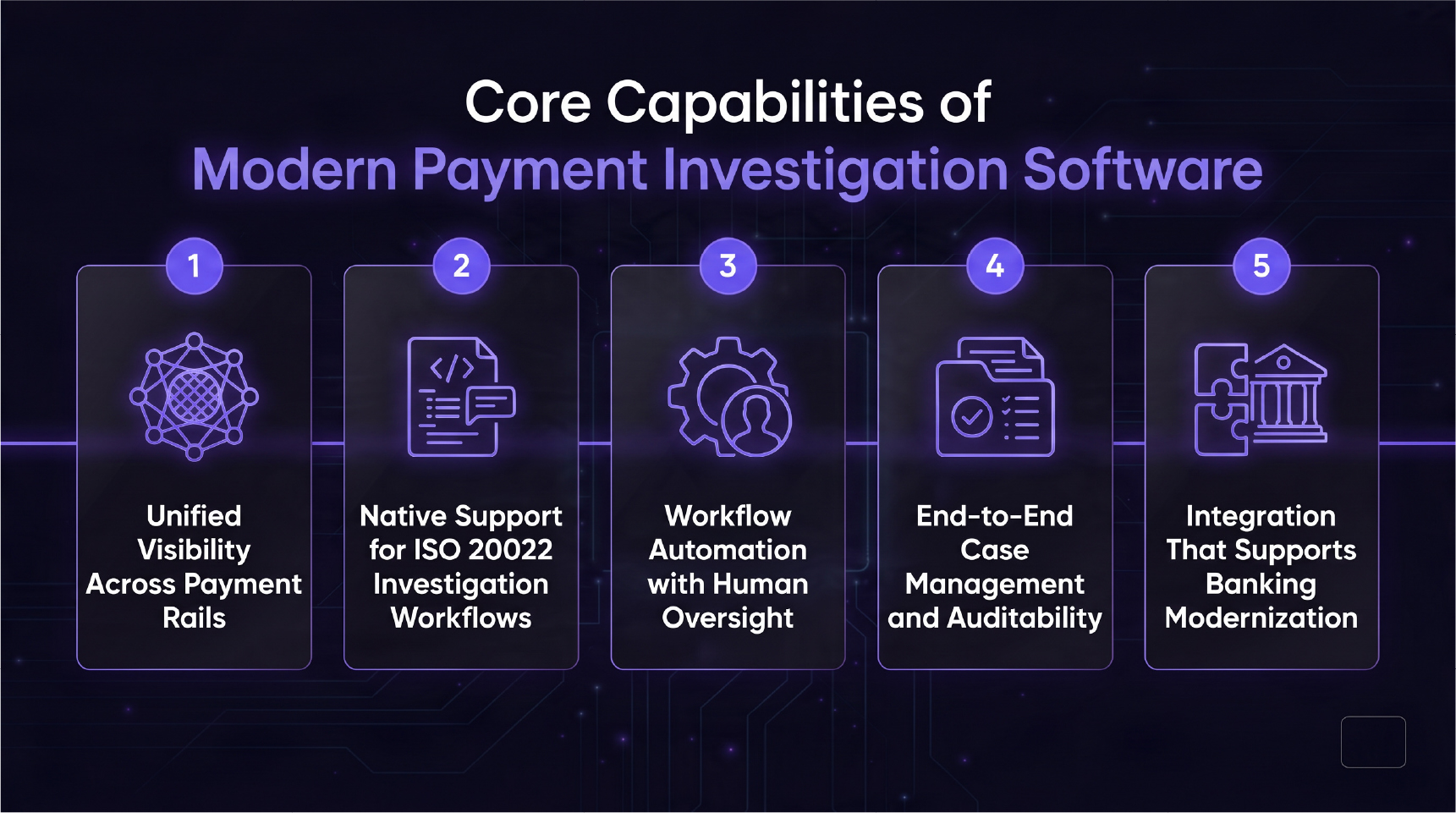
Managing payment investigations across disparate networks creates friction, delays resolution, and drives up operational costs. Modern software solves this by unifying cross-border and domestic payment rails into a streamlined digital workspace. By transforming manual exception handling into automated, intelligent workflows, financial institutions accelerate case resolution while protecting customer trust.
1. Unified Visibility Across Payment Rails
A unified workspace serves as the single source of truth for managing domestic and cross-border exceptions. Instead of forcing investigators to log into multiple disconnected portals, the platform aggregates relevant transaction details, historical communications, and current case status into one screen. This comprehensive visibility seamlessly extends across traditional Swift messages, newer ISO 20022 formats, domestic payment schemes, APIs, and even manual email-based inquiries.
As a result, operations teams can trace a payment's journey without repeatedly searching separate ledgers. For operations leaders, this centralized perspective provides the aggregate data needed to spot recurring systemic failures, balance employee workloads, and pinpoint exactly where cases face processing delays.
2. Native Support for ISO 20022 Investigation Workflows
True modernization requires software that goes beyond merely reading ISO 20022 messages, it must actively leverage structured data to guide investigation decisions and automate interbank dialogue. Depending on the specific payment scheme, an effective platform natively handles specialized structured messages like camt.110 for investigation requests, camt.111 for formal responses, camt.056 for cancellation requests, and camt.029 for resolution or status updates.
Throughout this entire lifecycle, the system preserves critical transaction identifiers and exact message histories without truncation. This capability is increasingly urgent as market infrastructure evolves, such as the Federal Reserve Financial Services aligning with harmonized data requirements by incorporating structured payment investigation models into its Fedwire Funds Service releases. Transitioning to native ISO 20022 processing allows banks to turn rich financial data into an operational tool rather than treating it purely as a regulatory checkbox.
3. Workflow Automation with Human Oversight
Repetitive manual tasks like routing cases, entering redundant data, and checking status updates drain hours that investigators should spend on complex, high-risk exceptions. Modern payment investigation platforms reduce this administrative burden through configurable business rules that automatically route cases based on payment rail, error type, or urgency.
For instance, a transaction flagged for missing beneficiary details can immediately find the right regional team while automated triggers send follow-up reminders to correspondent banks. Artificial intelligence further assists the team by predicting the intent of incoming inquiries and detecting duplicate claims early. Crucially, these systems maintain a strict boundary for risk management, ensuring that final approvals, sensitive data corrections, and altered payment instructions always require human review and explicit validation.
4. End-to-End Case Management and Auditability
Maintaining an unalterable record of actions is vital for institutional governance, especially since payment investigations routinely cross multiple internal departments and external banking partners. Modern exception management software logs the entire timeline of a case, capturing the initial customer inquiry, associated ledger data, assigned internal owners, external correspondence, and final manager sign-offs.
This immutable audit trail works alongside strict maker-checker controls and role-based permissions to ensure compliance with internal risk policies. Backed by live operational dashboards, managers gain immediate insight into aging cases, SLA performance metrics, and team capacity. This structured approach helps operations leaders eliminate dependencies on individual institutional knowledge and standardizes resolution quality across global offices.
5. Integration That Supports Banking Modernization
Improving payment investigations does not require an expensive, high-risk overhaul of a bank's core processing infrastructure. A well-engineered payment investigation platform features a flexible, API-driven architecture designed to complement existing engines, customer service applications, and messaging systems. It easily handles legacy MT message formats alongside modern XML standards, giving institutions a practical tool to manage varying levels of digital maturity across different business units.
Low-code configuration options allow operations teams to update rules and adapt to shifting scheme requirements without waiting for extensive IT development cycles. This allows financial institutions to modernize their exception workflows incrementally while fully preserving their existing technology investments.
To accelerate the journey from basic transaction compliance to operational maturity, platforms like TracEI offer a blueprint for modern automated exception and investigation execution. Built to align with rigorous global network criteria, the platform provides fully integrated compliance for Swift Case Ready milestones, FinPlus migration requirements, and Swift gpi Stop and Recall protocols.
By deploying an architecture driven by intelligent rulebooks and generative AI intent extraction, the software automatically triages incoming inquiries, flags duplicate entries, and matches unstructured data fields without manual screening. TracEI routes investigations based on customer tiers, transaction values, or regulatory risks, shifting routine tasks away from core personnel to optimize team resource allocation.
This native alignment with both Fedwire and international ISO standards drastically compresses the investigation cycle. Moving away from traditional swivel-chair applications to integrated exception layers allows financial institutions to cut manual investigation volumes in half while maintaining comprehensive data lineage and immutable audit controls across interoperable payment channels.
The shift toward global instant payments demands instantaneous back-office resolution. Upgrading to an investigation framework built natively for structured data helps financial institutions eliminate traditional processing friction, protect core margins, and deliver the real-time transparency modern commercial clients expect.
Deploying a specialized payment investigation software like TracEI allows banks to fully capitalize on this architectural evolution, accelerating the ISO 20022 transition by turning historical operational liabilities into sustainable competitive advantages.
Turn ISO 20022 Data into Faster Investigation Outcomes
Move beyond message translation. See how TracEI automates case triage, routing, and resolution with full data lineage and audit control.