Live webinar | Seconds to Settle, Weeks to Resolve: The Payment Investigations Paradox
Register Now


The modern payment ecosystem promises instant execution, but real-time payments are only as reliable as the back-office systems built to support them. Payments flow seamlessly through real-time networks, automated clearing house batch systems, high-value wire transfers, and cross-border corridors. Corporate clients and consumers expect transfers to clear in seconds, with complete transparency and continuous availability.
Yet behind this modern digital experience lies an escalating operational challenge. When a transaction stalls, that effortless experience breaks down immediately. Operations teams find themselves trapped in manual backlogs, deciphering network error codes and assembling fragmented records across disparate platforms.
As transaction volumes surge and payment networks multiply, traditional manual triaging cannot keep pace. Protecting client trust and operating margins demands a decisive shift toward intelligent, automated payment exception routing that resolves transaction failures the moment they occur.
Financial institutions no longer rely on a single domestic settlement system. Today, teams manage instant real-time clearing networks, automated clearing house batch files, high-value wire networks, and international corridors at the same time.
While multi-rail payments give commercial clients greater speed and flexibility, they create heavy operational friction behind the scenes. Every network runs on its own distinct messaging standards, strict cut-off windows, operational rules, and failure codes.
Because of this diversity, every payment failure requires a unique fix. Resolving a missing domestic routing code involves completely different steps than tracking a delayed cross-border transfer or resolving a data format error. When networks operate on fundamentally separate standards, operations teams cannot sort exceptions accurately or hit service deadlines without a unified technology platform.
Traditional approaches to resolving payment errors rely heavily on human judgment, disconnected queues, and legacy ticketing systems. When an exception occurs, an analyst must manually pull the raw message log, read the error code, search core banking records to find transaction details, decide which department handles the issue, and manually send the case forward.
This legacy approach creates clear operational hurdles that hold back institutions:
Inconsistent Handling and Uneven Results
Manual triage depends on individual analyst experience and memory. When identical payment errors happen across different shifts or regional offices, they often get resolved in completely different ways. One analyst might fix a mistyped account number directly, while another cancels the payment or sends it back to the client. This inconsistency creates unpredictable outcomes for customers and makes quality checks difficult to enforce.
Siloed Communication Across Different Networks
Operations teams are historically split by network, separating wire groups, clearing house operators, and instant payment desks. Important details stay trapped within these separate groups, blocking visibility across the bank. When an international transfer moves onto a domestic network and fails, the original team is left completely in the dark. Employees spend hours sending emails back and forth just to ask for transaction details that another department already has.
Rising Overhead and Higher Costs
Under a manual model, banks must hire more staff every time transaction counts increase. As payment activity grows, payroll and back-office expenses climb fast. Instead of working on high-priority disputes, skilled staff spend most of their day doing basic data entry and moving files between systems. This hands-on process eats away at profit margins on transaction fees.
Slow Department Handoffs and Missed Deadlines
Every handoff between operations, treasury, customer service, and fraud teams adds friction and delay. A payment error that takes five minutes to resolve often sits for days inside shared inboxes or backlogged queues waiting for someone to review it. Clients expect instant updates, so a multi-day delay hurts customer trust and causes banks to miss agreed service deadlines.
Audit Blindspots and Regulatory Risks
When investigation work is spread across spreadsheets, chat tools, and untracked emails, building a clean audit trail is nearly impossible. Regulators and network authorities require clear records of why payments failed, how quickly funds were returned, and how complaints were handled. Tracking these steps by hand takes significant effort and leaves the institution open to regulatory penalties and compliance errors.
Relying on manual triage for payment exception routing leads to deep backlogs, rising expenses, and frustrated customers. As modern payment networks demand faster turnaround times, institutions must replace manual handoffs with automated systems that sort, assign, and resolve exceptions without delay.
To break free from manual bottlenecks, forward-thinking institutions are adopting rule-based workflow automation. Instead of leaving incoming errors to human guesswork, organizations set up clear, policy-driven engines that instantly review payment issues, check them against pre-set business rules, and apply payment operations automation.
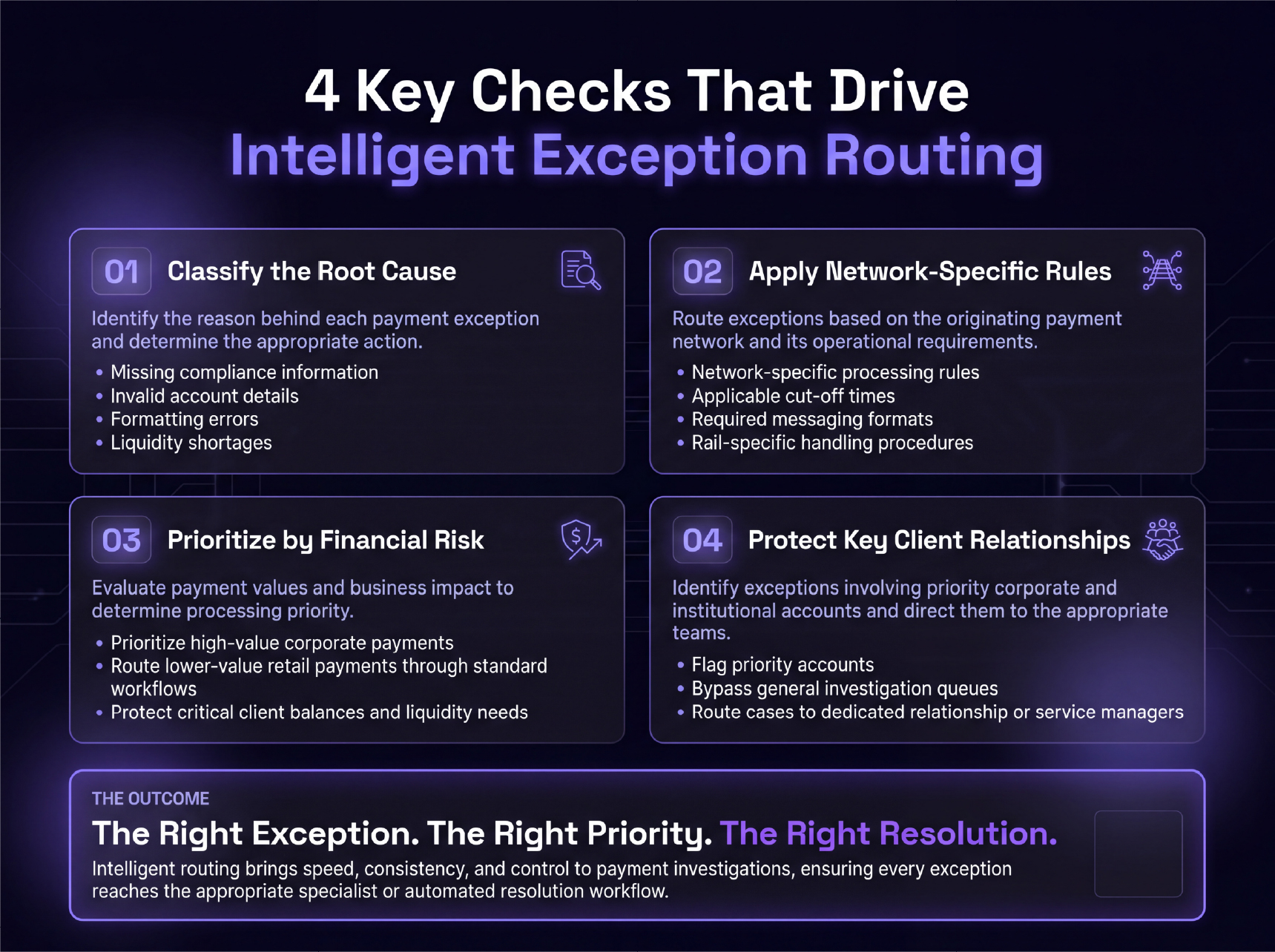
4 Key Checks That Drive Intelligent Exception Routing
01. Classify the Root Cause
Identify the reason behind each payment exception and determine the appropriate action.
02. Apply Network-Specific Rules
Route exceptions based on the originating payment network and its operational requirements.
03. Prioritize by Financial Risk
Evaluate payment values and business impact to determine processing priority.
04. Protect Key Client Relationships
Identify exceptions involving priority corporate and institutional accounts and direct them to the appropriate teams.
The Outcome
The Right Exception. The Right Priority. The Right Resolution.
Intelligent routing brings speed, consistency, and control to payment investigations, ensuring every exception reaches the appropriate specialist or automated resolution workflow.
True operational resilience demands end-to-end banking workflow orchestration that unifies back-office engines, messaging gateways, compliance platforms, and multi-rail payment workflows into a single glass panel. This is where purpose-built orchestration solutions like TracEI transform payment operations.
TracEI eliminates fragmented workflows by providing a unified case management layer across all domestic and cross-border rails. With native ISO 20022 and Swift scheme support, TracEI automates exception intake, enriches data context, and intelligently routes complex cases to the right teams. By streamlining case resolution and enforcing standardized rulebooks, TracEI reduces resolution times while creating a fully audit-ready investigation trail.
Payment operations can no longer solely depend on manual handoffs, shared inboxes, and fragmented legacy tools. As global clearing networks accelerate toward continuous settlement and strict messaging standards, relying on human intervention leaves institutions exposed to escalating overhead, slow turnaround times, and compromised client trust.
Adopting rule-driven routing delivers the operational clarity banking teams need to scale without friction. By pairing automated business logic with purpose-built platforms like TracEI, financial institutions turn unpredictable payment exceptions into scalable, trackable, and automated resolutions that protect operating margins and safeguard customer relationships.
Modernize Your Payment Operations from Exception to Resolution
Eliminate manual queues across ACH, wires, and instant payments. TracEI delivers intelligent, rule-driven triage to resolve exceptions faster and protect operating margins.