Live webinar | Seconds to Settle, Weeks to Resolve: The Payment Investigations Paradox
Register Now


Banks have spent years adapting legacy banking systems to keep pace with a changing payments landscape. New payment rails, richer payment data, regulatory requirements, and rising customer expectations have introduced new operational demands. In response, many banks have extended existing platforms with additional workflows, integrations, interfaces, and manual workarounds.
Each change can address an immediate requirement. But over time, these incremental fixes can create a more complicated environment for managing payment exceptions and investigations.
An investigation may now require information from payment processing platforms, messaging systems, customer-service applications, case management tools, and communication channels. Investigators may need to move between applications, reconcile information, and coordinate with multiple teams before determining the appropriate action.
The challenge is not that legacy platforms cannot evolve. It is that continuously adding fixes does not necessarily create the connected operating model that modern exception management requires.
As payment environments become more diverse, banks need a way to modernize investigations and exceptions without making every operational change dependent on another modification to the underlying technology landscape.
Legacy systems remain deeply embedded in banking operations because they support critical transaction processing and established workflows. Replacing them entirely is rarely a practical starting point for modernization.
Instead, banks often take an incremental approach. A new payment channel may require another integration. A new exception scenario may need another workflow. A new data requirement may introduce another transformation layer, while a customer-service requirement may result in another interface.
Individually, these changes can appear manageable. Collectively, they can make the technology environment harder to adapt.
More payment scenarios, more dependencies
Payment operations now span cross-border and domestic payments, instant payments, structured ISO 20022 messages, status inquiries, cancellations, returns, beneficiary issues, and other exception scenarios.
When each requirement is addressed within existing platforms, the architecture can become increasingly dependent on custom connections and specialized workflows.
The result is not necessarily a system failure. Rather, each additional change can require more coordination across the existing environment.
The integration layer becomes increasingly complex
Legacy banking systems were typically designed around established products and processes. As banks introduce new channels and applications, connecting them to the existing environment can require additional interfaces and transformation logic.
Over time, this can make the integration landscape itself a constraint on change.
A seemingly straightforward operational enhancement may depend on several upstream and downstream systems, increasing the effort required to introduce or modify functionality.
Automation remains fragmented
Another challenge is the difference between automating individual tasks and modernizing the broader investigation process.
A bank may automate payment-status retrieval, for example, while case creation, information gathering, routing and follow-ups continue through separate workflows or manual steps.
Automating specific activities can improve efficiency, but the overall process may still depend on disconnected systems and handoffs.
The opportunity is to connect these capabilities into a coordinated workflow that supports the full exception-management lifecycle.
A modern approach should focus on how an exception moves from initial detection to resolution.
Rather than adding isolated functionality to individual systems, banks need capabilities that coordinate the investigation lifecycle across payment environments and operational teams.
A unified entry point for exceptions
Exceptions and inquiries can originate from multiple channels. Bringing them into structured workflows provides a consistent starting point and reduces the need for teams to manage each source independently.
Relevant information available at the point of investigation
Investigators should not have to build the case from scratch.
Payment details, identifiers, status information, messages, customer context, and previous actions should be available within the investigation workflow wherever possible.
This allows investigators to focus on determining the appropriate resolution rather than searching for basic information.
Intelligent triage and routing
Different exceptions require different levels of expertise and urgency.
Rules-based and intelligent classification can help identify the nature of an issue, prioritize it, and direct it to the appropriate queue or team.
This creates a more systematic way to manage workloads as volumes change.
End-to-end workflow orchestration
An investigation can involve validation, information gathering, follow-ups, approvals, escalations, and resolution.
These activities need to work as part of a coordinated process rather than separate tasks.
Automation can handle repeatable activities, while investigators retain control over decisions that require judgment.
Control, visibility, and auditability
Modern exception management also requires operational oversight.
Teams need visibility into case volumes, queues, SLA performance, bottlenecks, and outcomes. Individual investigations need a clear record of actions, decisions, communications, and approvals.
These capabilities help operations leaders understand both what is happening within the investigation function and where processes can be improved.
Flexibility across payment environments
Finally, the investigation model should not be tied to one payment rail or processing platform.
Banks need to accommodate different payment types and scenarios without redesigning the entire underlying environment each time requirements change.
This is where a dedicated investigation layer can provide an important separation between transaction processing and exception management.
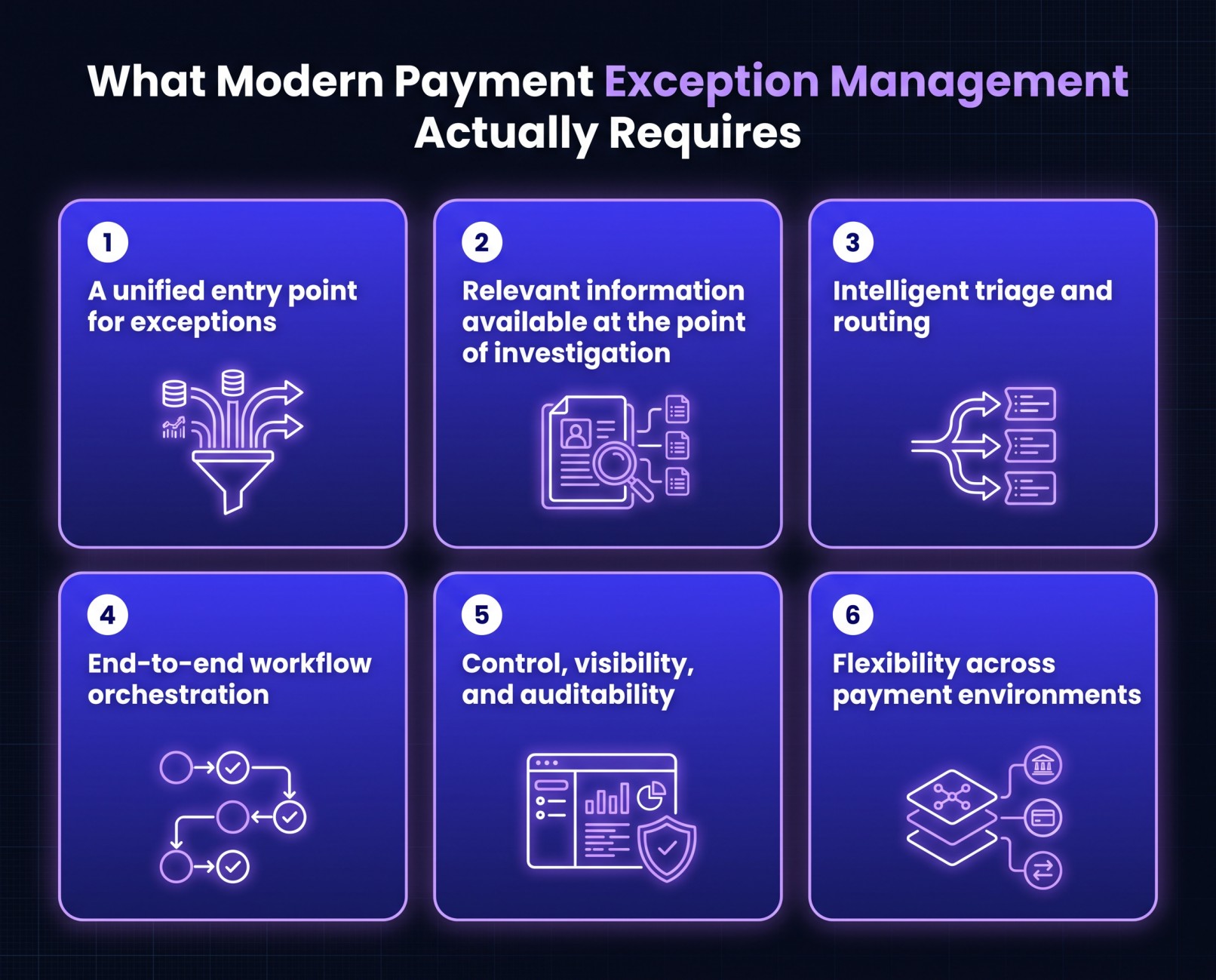
A modern approach should focus on how an exception moves from initial detection to resolution.
Rather than adding isolated functionality to individual systems, banks need capabilities that coordinate the investigation lifecycle across payment environments and operational teams.
A unified entry point for exceptions
Exceptions and inquiries can originate from multiple channels. Bringing them into structured workflows provides a consistent starting point and reduces the need for teams to manage each source independently.
Relevant information available at the point of investigation
Investigators should not have to build the case from scratch.
Payment details, identifiers, status information, messages, customer context, and previous actions should be available within the investigation workflow wherever possible.
This allows investigators to focus on determining the appropriate resolution rather than searching for basic information.
Intelligent triage and routing
Different exceptions require different levels of expertise and urgency.
Rules-based and intelligent classification can help identify the nature of an issue, prioritize it, and direct it to the appropriate queue or team.
This creates a more systematic way to manage workloads as volumes change.
End-to-end workflow orchestration
An investigation can involve validation, information gathering, follow-ups, approvals, escalations, and resolution.
These activities need to work as part of a coordinated process rather than separate tasks.
Automation can handle repeatable activities, while investigators retain control over decisions that require judgment.
Control, visibility, and auditability
Modern exception management also requires operational oversight.
Teams need visibility into case volumes, queues, SLA performance, bottlenecks, and outcomes. Individual investigations need a clear record of actions, decisions, communications, and approvals.
These capabilities help operations leaders understand both what is happening within the investigation function and where processes can be improved.
Flexibility across payment environments
Finally, the investigation model should not be tied to one payment rail or processing platform.
Banks need to accommodate different payment types and scenarios without redesigning the entire underlying environment each time requirements change.
This is where a dedicated investigation layer can provide an important separation between transaction processing and exception management.
Modernizing exception management does not necessarily mean replacing the systems that already process payments.
A dedicated payment investigations software layer can provide a way to introduce modern investigation capabilities while continuing to work with existing banking infrastructure.
TracEI by EvonSys is designed as a dedicated platform for payment exceptions and investigations, providing an operational layer for managing investigation workflows across payment environments.
Supporting diverse investigation scenarios
TracEI can support investigation scenarios across domestic and cross-border payments, including status inquiries, cancellation and return requests, stop and recall scenarios, beneficiary non-receipt, delayed or failed payments, and misdirected beneficiary details.
It can work across multiple sources and formats, including MT, MX, Fedwire, domestic schemes, email, APIs, RFIs, and alerts.
This provides a structured way to bring different investigation inputs into common workflows rather than creating separate processes around each payment environment.
Automating the investigation journey
TracEI supports workflows covering intake, validation, pre-checks, pre-population, routing, reminders, and case progression.
Intelligent capabilities can support intent classification and duplicate triage, helping teams direct cases efficiently while retaining human involvement where judgment is required.
Four-eye and six-eye controls, SLA-based queues, audit trails, and dashboards add operational governance and visibility.
Modernizing without disrupting the core
The broader value of a dedicated investigation layer is the separation it creates.
Banks can continue using their existing transaction-processing infrastructure while introducing a more flexible environment for managing what happens when payments require investigation.
As payment channels and exception scenarios evolve, changes can be managed within the investigation layer rather than repeatedly embedding new operational requirements into every underlying system.
This creates a more adaptable approach to banking operations modernization while preserving the role of existing platforms.
Legacy banking systems can continue processing payments. A modern investigation layer can manage what happens when those payments require human attention.
Incremental fixes can address immediate gaps, but as exception workflows grow more complex, they can add layers of processes and dependencies that make investigations harder to manage at scale.
The challenge is keeping pace with growing exception complexity while working across systems that were designed for different operational needs. Modern investigations need connected workflows, clear visibility, and consistent controls across the case lifecycle.
A more sustainable approach is to introduce a purpose-built layer for investigations and exceptions. Platforms such as TracEI can complement existing infrastructure while giving teams a structured foundation to automate routine work, connect information, and manage cases more efficiently.
For banks, modernization does not have to mean replacing everything. It means creating the right operational foundation around the systems already in place.
Bring Greater Control to Payment Exception Management with TracEI
Modernize E&I operations with a dedicated layer that connects workflows, intelligent triage, and operational visibility across your existing payment infrastructure.