Cross-border payment rails have accelerated significantly over the past few years, yet back-office exception workflows remain one of the most persistent cost centers in global transaction banking.
While standard payment processing now approaches real-time speed, unresolved inquiries continue to move slowly. Operations teams spend substantial working hours reading unstructured MT 199 messages, piecing together bilateral email exchanges, and chasing correspondent institutions across multiple time zones.
With the global ISO 20022 migration fundamentally redefining how financial institutions structure transaction data, Swift Case Manager marks a decisive industry transition toward structured, collaborative payment investigations.
By replacing unformatted text communications with standardized data models, the platform introduces a transparent, shared environment for managing payment friction.
Payment investigations are inherently complex because a single cross-border transaction can involve multiple financial institutions, systems, jurisdictions, and regulatory requirements.
When an exception occurs, the institution investigating the payment needs to determine what happened, identify where the payment is in the chain, establish what information is missing, communicate with the relevant counterparty, and document the resolution.
Historically, much of this work has depended on manual intervention.
The BIS Committee on Payments and Market Infrastructures (CPMI) estimates that approximately 1% to 3% of payments result in inquiries, with exceptions and investigations typically involving five to ten manual touchpoints. More than 72% of the data fields used for cross-border E&I messages have historically been free-format, making automation and consistent processing considerably more difficult.
Several factors contribute to this operational friction.
Unstructured Free-Text Messages
Traditional investigation processes have relied heavily on legacy MT messages, including MT 199. Because these messages allow open-ended narrative text, important information can be buried within paragraphs of free-form content.
An operations analyst may need to read the message, interpret the reason for the inquiry, identify the relevant transaction, search internal systems, determine the appropriate next action, and then manually construct a response.
The result is a workflow that depends heavily on human interpretation.
Sequential Handoffs Across the Payment Chain
Cross-border payments can pass through several correspondent institutions before reaching the beneficiary bank. When an investigation is raised, communication may similarly move between institutions as each participant searches for information and passes the inquiry along.
This creates delays that have little to do with the underlying payment itself.
The payment may already have reached its destination while the investigation remains trapped in a chain of emails, messages, internal tickets, and follow-ups.
Disconnected Systems and Records
Investigation teams rarely work from a single source of information.
Payment records may sit in a payment hub. Screening information may exist in a separate compliance system. Customer information may be stored elsewhere, while investigation communications and case notes reside in another application.
Without a connected investigation workflow, teams spend significant time switching between systems and reconstructing context.
Limited Automation
Unstructured data also limits the ability to automate investigation activities.
A system can identify that a message has arrived. But if the message contains a paragraph explaining an account mismatch or requesting additional beneficiary information, the system may not be able to reliably determine what action should happen next without human interpretation.
The operational difference between the legacy model and a structured investigation environment can be summarized as follows:
This difference becomes particularly important as payment volumes increase and investigation teams are expected to resolve exceptions without adding proportional operational overhead.
Swift Case Manager redesigns this process by providing a centralized, cloud-hosted case workspace accessible to every participant along a payment path. Rather than sending bilateral messages into an operational void, participants anchor investigation data to a single reference point tied to the transaction Unique End-to-End Transaction Reference (UETR).
What is a Swift Case Manager?
SWIFT Case Management (often referred to as SWIFT Case Manager) is Swift’s centralized cloud service designed to automate and orchestrate payment Exceptions & Investigations (E&I) and payment recalls across cross-border banking.
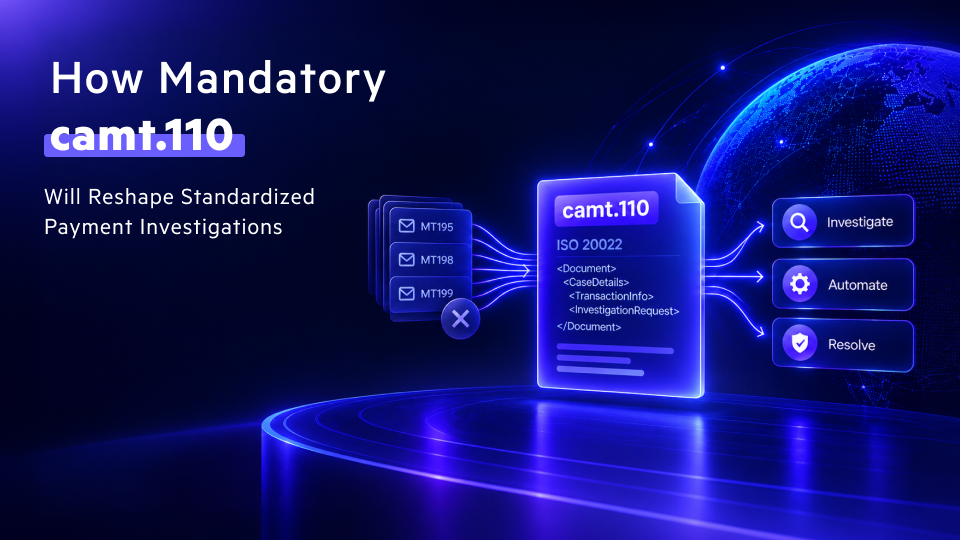
Traditionally, when a cross-border payment gets stuck, missing, or rejected, banks exchange unstructured, bilateral MT messages (such as MT 199 or MT 299) along the correspondent banking chain. This process is manual, slow, and expensive. Case Management replaces this with structured ISO 20022 messaging coordinated through a central orchestrator.
The architecture delivers structured capabilities across two essential operational pillars:
Stop and Recall Operations: Expedites critical payment recall workflows (camt.056 and camt.029), enabling institutions to broadcast cancellation requests across the payment chain instantly to prevent settlement exposure.
Case Orchestrator for Exceptions and Investigations (E&I): Centralizes multilateral communication for unable-to-apply scenarios, inquiries into missing remittance details, and regulatory screening verifications using structured XML schemas (camt.110 and camt.111).
Through Case Orchestrator, financial institutions eliminate the traditional multi-hop message trail. When an originating bank raises an inquiry, intermediary and beneficiary institutions interact with the exact same case file, access identical timestamped documentation, and monitor case ownership in real time.
The foundational shift behind modern Swift investigations lies in replacing conversational text with standardized, machine-readable data.
When an exception arrives as a structured camt.110 message, the data contains specific reason codes and field details indicating whether the inquiry concerns an invalid account number, a beneficiary name mismatch, or a compliance verification requirement.
Because the underlying intent is clearly coded, internal systems can immediately read the inquiry, run automated database queries, and retrieve relevant accounting records without requiring human triage. The investigative workflow transforms from an unstructured email chain into an automated, data-driven collaboration between banking systems.
While Swift Case Manager delivers the shared network for cross-bank collaboration, banks still face the internal challenge of integrating network-level messages into their existing core banking environments. Standardized incoming messages provide limited benefit if internal teams still manually copy structured fields into legacy core banking systems, case trackers, and clearing channels.
A successful strategy requires an orchestration layer that bridges external messaging networks with internal operational workflows.
This is precisely where TracEI completes the operational transition.
Engineered specifically to solve enterprise investigation challenges, TracEI functions as an intelligent payment exceptions and investigations orchestration platform. It integrates directly with Swift Case Manager, taking in incoming camt.110 inquiries and automatically linking them to internal transaction records through native UETR matching.
By automating case handling, TracEI empowers financial institutions to:
Drive Straight-Through Processing (STP): Evaluate incoming structured queries against pre-configured business rules, automatically querying internal ledgers and formulating standardized response messages without human intervention.
Remove Operational Silos: Consolidate separate payment hubs, compliance screening tools, and core ledgers into an audit-ready, single-screen workspace for operations teams handling complex cases.
Protect Client SLAs: Track case aging against correspondent network benchmarks in real time, preventing operational penalties and ensuring corporate clients receive immediate visibility into their transactions.
As global transaction banking moves toward faster settlement, handling exceptions through unstructured messaging and manual follow-ups is no longer sustainable. Swift Case Manager establishes the foundation for shared, transparent investigations across the correspondent network, transforming how institutions communicate during payment disputes.
However, the true operational gains are realized when banks modernize internally as well. By pairing the network collaboration of Swift Case Manager with internal workflow automation through TracEI, financial institutions can eliminate operational friction, resolve inquiries faster, and turn exception management into an efficient, scalable capability.
Turn ISO 20022 Data into Straight-Through Investigation Processing
Discover how TracEI pairs with Swift Case Manager to eliminate manual touchpoints, break down operational silos, and safeguard customer SLAs.