.png)

.png)
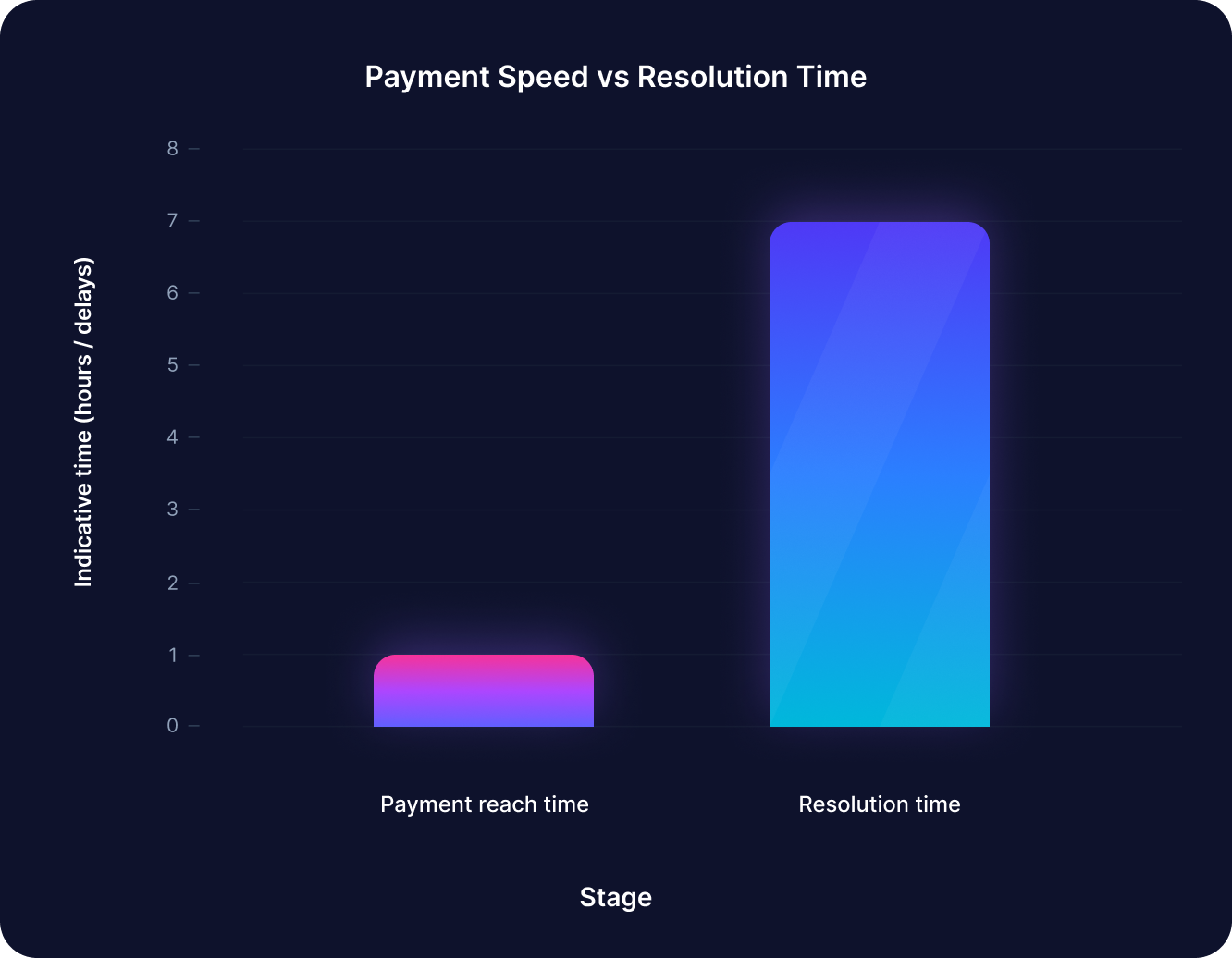
Cross‑border and domestic payments are moving faster than ever. Over 90 percent of cross‑border payments on SWIFT now reach the beneficiary bank within an hour. Yet when something goes wrong, resolution timelines still stretch into days or weeks. According to SWIFT, resolving a single delayed payment can take five to eight working days, and the average end‑to‑end effort per investigation can exceed 200 staff hours.
This growing gap between payment speed and investigation speed has turned payment investigation delays into a critical operational bottleneck.
When a payment is held, misrouted, rejected, duplicated, or missing, banks often fall back on manual processes. Teams search across payment engines, reconciliation systems, messaging platforms, and emails to reconstruct what happened. Each delay increases customer pressure and operational cost while tying up liquidity.
To address this, banks are reshaping their operating models. They are replacing fragmented workflows with intelligent, data‑driven investigation frameworks. Payment investigation platforms like TracEI are at the center of this shift, enabling faster resolution through automation, centralized data, and standardized case handling.
This blog explores how banks are redesigning operations to reduce delays, improve service reliability, and modernize bank payment investigation processes at scale.
Payment investigations were once treated as back‑office exceptions. Today, they directly affect revenue, liquidity, and customer retention.
Industry data shows that financial institutions collectively spend over USD 20 million annually on operational costs, penalties, and compensation related to investigation delays.
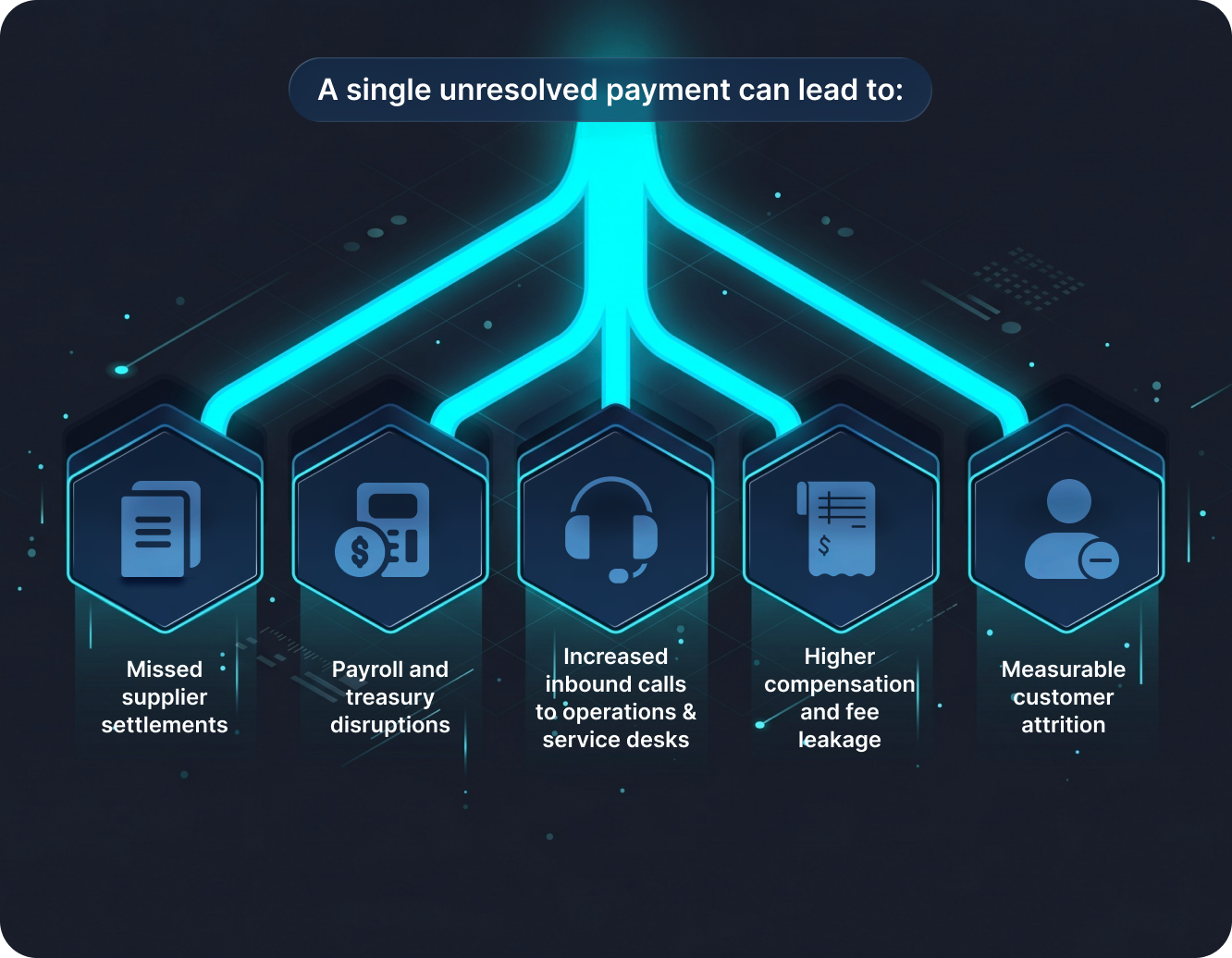
A single unresolved payment can lead to:
As transaction volumes rise and ISO 20022 introduces richer data structures, the complexity of bank payment investigation increases. Without modern tooling, this complexity translates directly into slower resolution times.
As banks transition from legacy systems to agile frameworks, the focus has moved from merely "fixing errors" to optimizing the entire payment investigation lifecycle. By implementing a structured bank payment investigation strategy, financial institutions can bridge the gap between back-office complexity and front-end speed. The following points detail the specific operational pillars banks are utilizing to achieve this modernization and drive significant gains in banking operations efficiency.
1. Intelligent Automation and AI‑Driven Investigations
Banks are embedding AI and rules‑based automation into investigation workflows to reduce manual triage. Modern systems automatically detect payment exceptions, categorize root causes, and trigger investigation cases in real time. This removes the need for operations staff to manually identify and classify issues.
AI‑assisted reconciliation can match transactions across inconsistent formats, improving payment failure analysis and reducing time spent searching for discrepancies. SWIFT estimates that automation can reduce investigation resolution time by up to 80 percent. Platforms like TracEI operationalize this capability by combining automation, orchestration, and guided workflows in a single investigation layer.
2. ISO 20022 as a Foundation for Exception Data Analysis
ISO 20022 has become a turning point for payment investigations exception data analysis.
Structured, machine‑readable data enables systems to automatically identify missing fields, validation errors, and routing issues. This improves prioritization and accuracy while reducing dependency on unstructured messages and emails.
According to SWIFT, around 2 to 5 percent of all payments trigger an investigation inquiry, and each inquiry costs up to 50 times more than a straight‑through transaction when handled manually. ISO 20022 reduces this multiplier by enabling automation and consistency. Banks using ISO‑native investigation platforms like TracEI can extract full value from rich data rather than treating compliance as a checkbox exercise.
3. Real‑Time Visibility Across the Payment Lifecycle
A core driver of payment investigation delays is fragmented visibility.
Banks are adopting API‑first architectures to connect core banking systems, payment hubs, messaging networks, and investigation platforms. This allows investigation teams to view transaction status, history, and communication in near real time.
Real‑time tracking supported by UETR standards reduces back‑and‑forth inquiries and accelerates payment failure analysis from days to hours. Unified visibility is a foundational enabler of operational scale and forms a critical pillar in the TracEI‑powered investigation framework.
4. Standardized Bank Payment Investigation with SWIFT Case Management
Email‑based investigations introduce delays, inconsistencies, and audit risk. To address this, banks are standardizing cross‑bank investigations using SWIFT Case Management.
This approach enables structured initiation, centralized tracking, and auditable communication across correspondent banks. Industry pilots have shown up to an 80 percent reduction in resolution time when standardized case workflows replace free‑text messaging.
When integrated with intelligent platforms like TracEI, SWIFT Case Management becomes part of a cohesive, end‑to‑end bank payment investigation framework.
5. Proactive Exception Management Using Advanced Analytics
Leading banks are no longer waiting for customers to report issues.
Advanced analytics and machine learning monitor payment flows continuously to detect anomalies, recurring delays, or data quality issues. Early identification allows teams to intervene before investigations escalate.
This approach improves first‑time resolution and reduces the frequency of repeated errors. McKinsey notes that banks applying analytics across operations can achieve efficiency improvements by 30 percent.
Proactive analytics is now a core contributor to sustained banking operations efficiency.
6. Purpose‑Built Payment Investigation Platforms
Fragmented tools increase handoffs and slow response times. As a result, banks are consolidating workflows into intelligent investigation platforms built specifically for payments.
Solutions like TracEI centralize automation, analytics, SWIFT integration, and workflow management into a single interface. This shortens resolution cycles and improves investigator productivity.
Key benefits include:
Replacing siloed tools with a unified payment investigation platform is one of the most direct ways banks are reducing payment investigation delays.
7. Centralized Investigation Hubs for Operational Scale
Banks are also restructuring their operating model by creating centralized investigation hubs.
These hubs bring together payments, compliance, and service teams with shared access to data and dashboards. Centralization eliminates duplication and improves handover efficiency.
Evidence from operational transformation programs shows that centralized models can materially improve throughput while reducing investigation backlog and cost.
When supported by platforms like TracEI, centralized hubs become data‑driven centers of excellence rather than reactive support functions.
Restructuring payment operations has become a practical necessity for banks that want to manage growing transaction volumes and rising service expectations. Persistent payment investigation delays increase operational cost, prolong liquidity exposure, and erode customer confidence. Addressing these issues requires a combination of clearer operating models, standardized workflows, and technology designed specifically for bank payment investigation.
By implementing TracEI, banks can move away from manual, case‑by‑case handling toward more consistent and transparent investigation processes. Automated workflows and centralized visibility support accurate payment failure analysis while reducing dependence on individual expertise. Over time, the ability to systematically analyze investigation exception data contributes to measurable banking operations efficiency gains. Banks that strengthen these capabilities are better positioned to resolve issues faster, reduce repeat failures, and provide the level of reliability expected in today’s payments environment.
Explore how banks are turning operational redesign into real-time investigation outcomes with TracEI


.png)


.png)