Live webinar | Seconds to Settle, Weeks to Resolve: The Payment Investigations Paradox
Register Now


The customer opens the mobile banking application and types, “I don’t recognize this transaction.” Conversational AI understands the situation and immediately retrieves the transaction information.
The context-aware AI agent asks, “Are you referring to the $8,500 transaction made today?” This keeps the customer engaged and eliminates the need to navigate multiple menus to reach a script-based solution, enhancing the customer experience when conversational AI is implemented.
This blog discusses conversational AI, its benefits, core features, and how it enhances the customer experience.
In our previous blog, we covered the major difficulties that customers face with fragmented systems and traditional self-service agents. This section explains the conversational AI solution and why it is essential to meet today's customer expectations.
At its core, conversational AI is an intelligence layer that understands, processes, and responds to customers by leveraging advanced Natural Language Processing (NLP) and Machine Learning (ML).
Traditional customer service experiences often break down because conversations, channels, and business systems operate in a fragmented way. These systems often have a limited context window, and self-service agents lose conversation history across sessions and channels. So, customers and agents need to move between apps, chatbots, and contact centers to start interactions from scratch.
Conversational AI changes this model by serving as the intelligence layer that connects every part of the customer journey. It remembers the context of previous interactions and carries it across channels. Most importantly, it integrates directly with enterprise systems and workflows, enabling organizations to move beyond answering questions and toward resolving customer issues. Here are some of the benefits:
When customers interact with a CSR or chatbot, they expect the issue to be understood and resolved quickly. Whether they are reporting a fraudulent transaction, checking the status of an application, or seeking support, several technologies work together behind the scenes to deliver a seamless experience.
Let's revisit the unfamiliar transaction scenario.
A customer opens their banking application and types:
"I don't recognize this transaction."
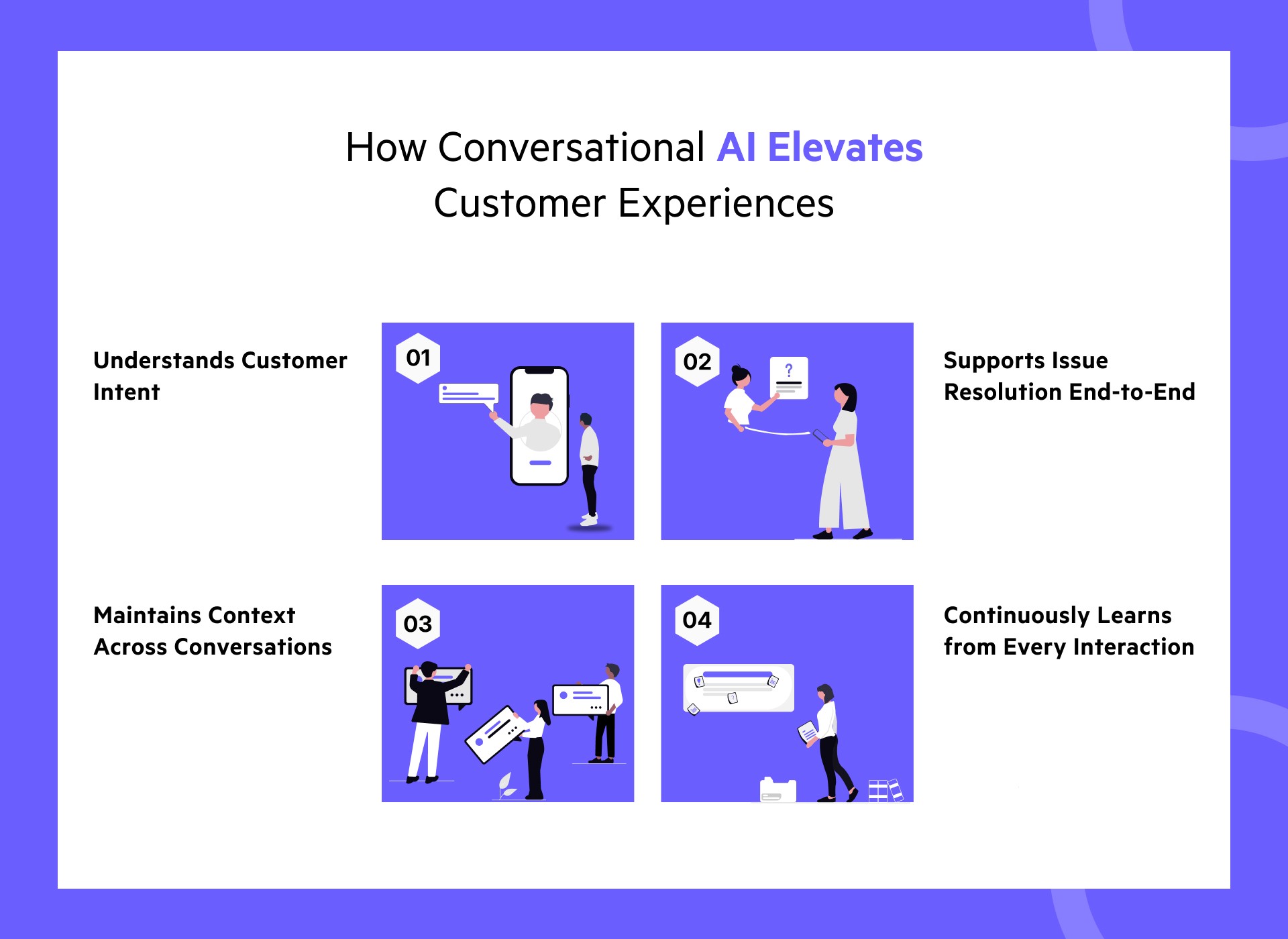
Within seconds, the conversational AI identifies the customer's intent, retrieves relevant information, and asks follow-up questions. This happens without requiring the customer to navigate multiple menus or speak with an agent.
Customers rarely use the same words to describe an issue. One customer may say the following:
"I don't recognize this payment."
Another may say:
"Did someone use my card?" or “There's an unusual transaction on my account."
Conversational AI uses Natural Language Processing (NLP) and Natural Language Understanding (NLU) to recognize that all three statements point to a potential fraud concern. Rather than relying on predefined keywords, it understands customer intent, extracts relevant information, and determines the context of the request.
This allows businesses to deliver personalized assistance instead of forcing customers through multiple menus or scripted conversations.
Customers become frustrated when they have to repeat information or start over after switching channels.
Conversational AI maintains the context of the interaction by remembering previous responses, understanding the current request, and determining the most appropriate next step. If the customer confirms that the transaction is fraudulent, the AI can immediately continue the conversation. By preserving context, conversational AI creates a more natural and effortless experience while reducing customer effort.
Through integrations with enterprise systems and workflows, conversational AI can retrieve transaction information, temporarily block a card, initiate a dispute case, update customer records, and provide real-time status updates.
Instead of directing customers to another channel or requiring them to speak with an agent, the AI helps complete the task within the same conversation.
Every customer interaction provides valuable information. Machine Learning (ML) continuously learns from conversations to improve intent recognition, personalize responses, and identify patterns in customer behavior. Over time, this enables conversational AI to become more accurate, adaptive, and effective at handling customer requests.
As a result, businesses can continuously improve customer experiences while delivering faster and more efficient service.
Bringing It All Together
When the customer replies:
"Block my card and raise a dispute."
The conversational AI understands the request, maintains the context of the conversation, retrieves the necessary information from enterprise systems, initiates the dispute process, and confirms:
"Your card has been temporarily blocked, and your dispute request has been submitted."
What feels like a simple conversation to the customer is actually multiple AI capabilities working together to understand intent, preserve context, take action, and resolve the issue faster.
Contextual awareness - The platform remembers previous turns in a conversation, allowing customers to continue without starting from scratch. Using advanced NLP, these systems analyze phrasing, sentiment, and context to determine whether an issue requires immediate attention.
Enterprise System Integrations – The conversational AI solution should seamlessly connect with:
This is important because answering customer queries requires access to data from multiple platforms. When a customer asks, "Why is my account opening application delayed?", without access to onboarding, application tracking, and verification systems, the AI can only offer generic responses. It forces the customer to switch channels or speak with an agent. However, when these systems are interconnected, the AI can retrieve personalized information in real time to provide accurate, context-aware responses.
Omnichannel Engagement – True omnichannel engagement means having one conversation across multiple touchpoints. Users should have effortless transitions between channels with real-time updates. The platform should maintain conversation history, customer preferences, and real-time updates across channels, enabling seamless transitions and delivering a consistent, personalized experience wherever the interaction occurs.
As customer journeys become increasingly complex, businesses need solutions that can deliver seamless, contextual, and proactive engagement at every touchpoint. Conversational AI provides the foundation for creating these experiences while improving operational efficiency and enabling more meaningful customer interactions.