.png)

.png)
A Pega managed services engagement shapes the long-term operational health of your enterprise platform. Getting to go-live is one milestone, while sustaining it through quarterly Infinity releases, integration changes, performance demands, and production incidents is an entirely different challenge. It falls on whoever manages your environment after launch.
The Pega services market includes a wide range of providers. Some have built their entire practice around Pega. Others have added it to a broader managed services portfolio. That distinction does not show up in a capability deck, but it does when a P1 incident hits production at 2 AM.
This guide covers five evaluation criteria that separate mature Pega support services from generic Pega application management.
Certification density is the most verifiable signal of practice depth a buyer has access to. The Pega certification ladder runs from CSA (Certified System Architect), which covers foundational platform tooling, through CSSA (Certified Senior System Architect), which validates advanced application design and integration architecture, up to CLSA (Certified Lead System Architect), the pinnacle credential for enterprise Pega support.
A mature support practice should include a balanced mix of CSSAs for day-to-day support, CLSAs for architectural escalation, and specialists such as CPBAs (Certified Pega Business Architect) or PCDSs (Pega Certified Data Scientist) where business architecture or decisioning capabilities are in scope.
Asking how many LSAs a provider has is necessary but incomplete. The follow-up question asking how many of those LSAs are available for support escalation versus fully allocated to active delivery projects matters more. If all of a provider's LSAs are project-allocated, senior architectural oversight on the support side is absent during incident escalation.
A credible Pega-focused MSP should carry a minimum of two to three active LSAs per ten to fifteen Pega-certified resources. For enterprise environments running Pega 8.x and Pega Infinity simultaneously, one LSA per product line is a stronger benchmark.
Elite status gives a provider closer proximity to Pega's product and support teams, faster escalation paths, and access to pre-release information. In a P1 incident requiring Pega product involvement, that standing translates to faster resolution. Tier alone is not sufficient.
The 2026 Pega Partners Program requires 75% of active certified resources to remain current on Pega Infinity 24.2. Ask which Infinity versions your shortlisted provider's support engineers are actively certified on today.
Enterprise Pega estates run across DEV, SIT, UAT, PREPROD, and PROD as a minimum. In regulated sectors, additional environments exist for compliance testing, DR rehearsal, and data residency separation. Managing a single environment is a different discipline from managing the full pipeline.
The support model shifts materially depending on where Pega runs.
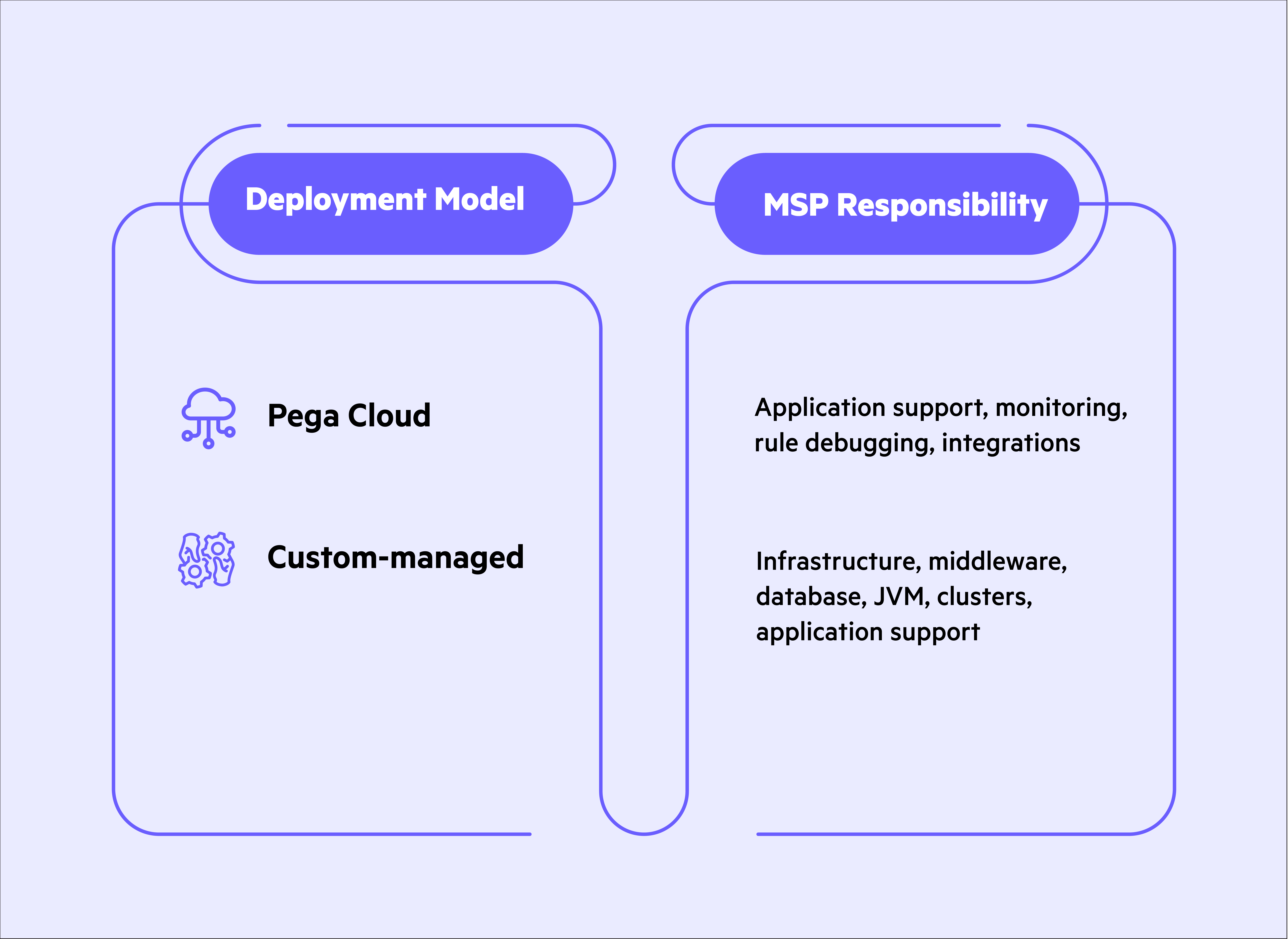
Incident isolation: When a PROD incident occurs, verifying whether the same configuration exists in lower environments. It requires environment parity knowledge that single-environment support teams don’t have.
Change management risk: Promoting changes across environments requires understanding ruleset versioning, data migration scripts, configuration differences, and environment-specific integration endpoints. Getting this wrong in a customer-managed model can cascade an incident from DEV all the way to PROD.
Tooling consistency: Monitoring, alerting, and log aggregation need to be configured consistently across environments. A provider experienced only in single-environment support will miss the discipline of maintaining consistent observability from bottom to top of the pipeline.
Pega Diagnostic Cloud is the baseline that provides platform-level health signals, not a monitoring strategy. A mature Pega managed services partner runs a layered observability stack that captures telemetry across the full application surface.
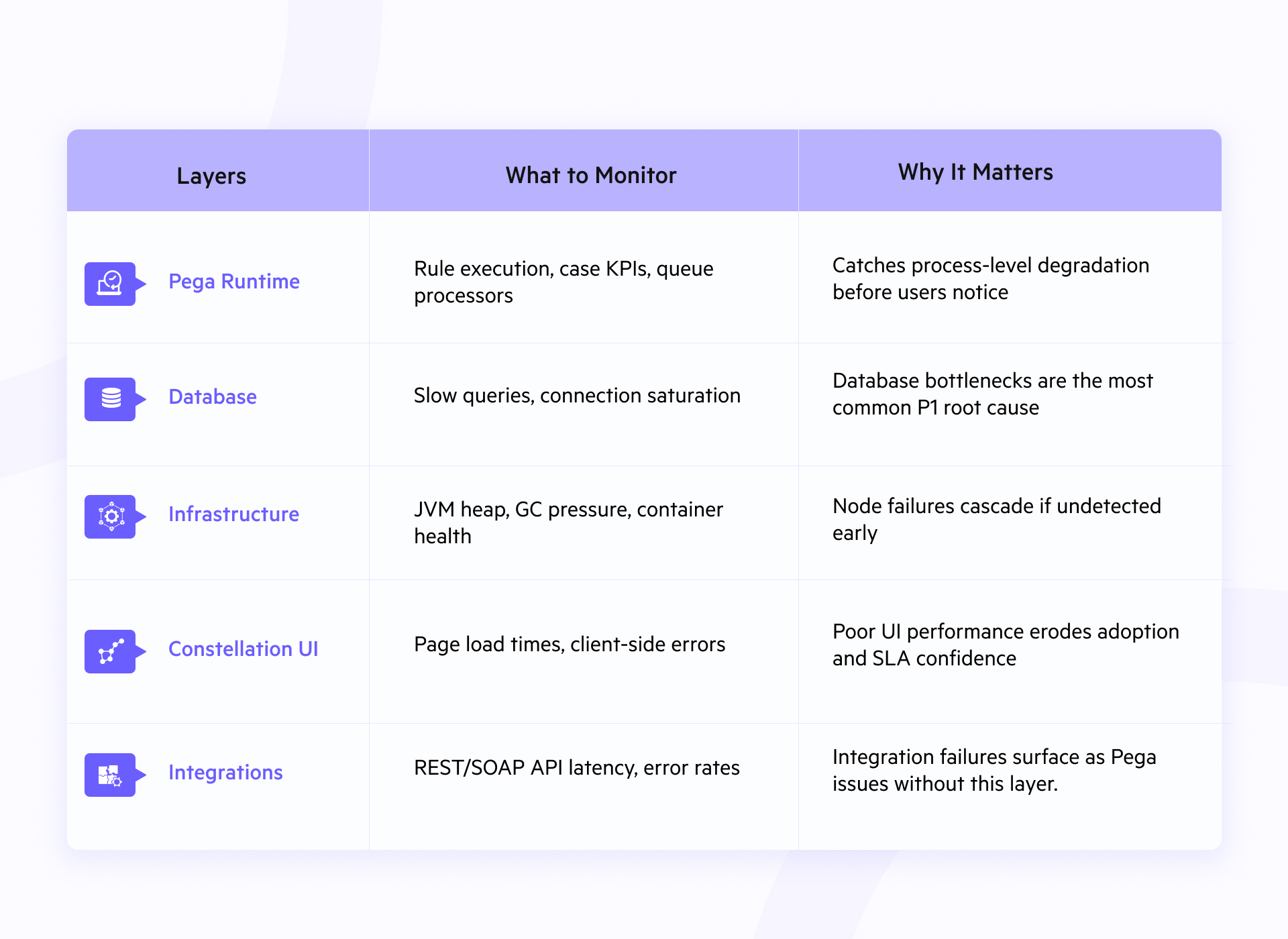
Mature MSPs should combine observability, alerting, ticketing, and escalation into a single operational workflow. Buyers should also verify whether they receive direct access to dashboards and operational reporting.
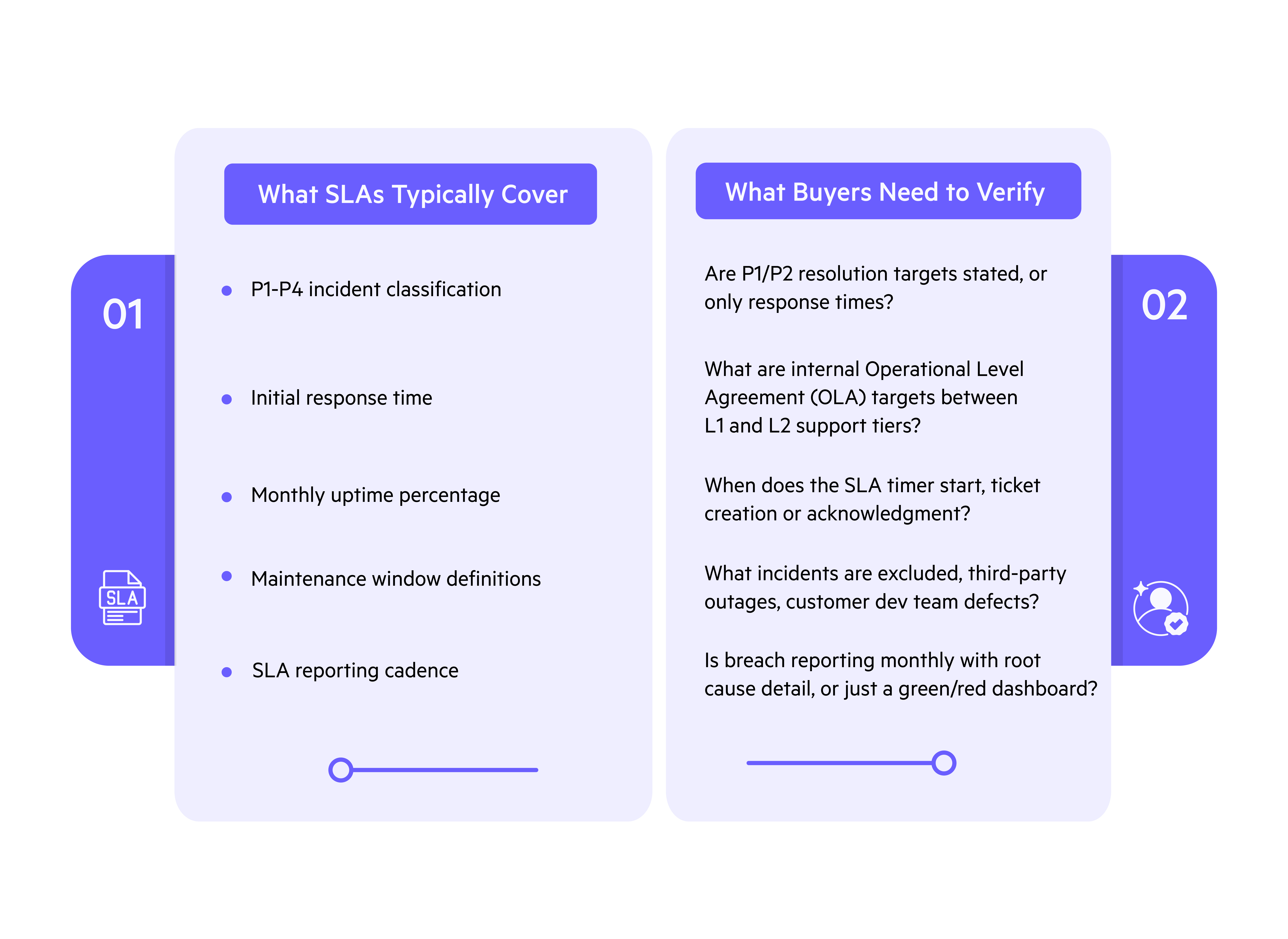
SLA documents should define not only response commitments but also operational accountability and reporting.
A mature Pega managed services provider operates structured change control. It involves CAB participation, release governance through Pega Deployment Manager, and documented rollback procedures. On-call arrangements where a single engineer is reachable by phone differ fundamentally from staffed shifts with defined rosters and per-engineer backup coverage.
Security requirements in regulated industries belong in the Statement of Work. Key areas to verify before signing:
ISO 27001 and SOC 2 Type II are the standard compliance baselines for Pega application management in enterprise environments.
Pega's quarterly Infinity release cadence is a direct test of DevOps maturity. An MSP without CI/CD pipeline capability accumulates deployment drag within 12 months. Missed releases compound into technical debt, security exposure, and forced upgrades under pressure.
Evaluate the provider’s DevOps maturity across four areas:
Institutional knowledge should live in documented runbooks and SOPs. If an engineer leaves, the support capability must remain intact.
Choosing a Pega managed services partner is less about comparing feature lists and more about validating operational maturity.
At EvonSys, that means a dedicated bench of certified Pega professionals, including support-focused LSAs. The active delivery is maintained across Pega Cloud and customer-managed environments, and full-stack observability powered by Datadog. The practice is supported by a 24x7 service desk, enterprise security controls, and internationally recognized compliance standards, including ISO 27001 and SOC 2 Type II. GitLab-based CI/CD with full runbook automation further strengthen delivery consistency and platform reliability.
Pega's autonomous enterprise vision, AI agents operating inside governed workflows with transparency and trust, depends on a stable, well-managed operational layer. Your Pega managed services partner is that layer. Evaluate it with the same rigor you applied to selecting the platform.
Ready to evaluate EvonSys as your Pega Managed Services Partner?
Our certified Pega architects and 24x7 support engineers will walk you through our bench composition, tooling stack, SLA structure, and client references.
.webp)

.png)


.png)