Evonsys is propelling industries into the future, transforming operations and customer experiences with low-code solutions that unlock unprecedented levels of efficiency and innovation.
Since 2015, Evonsys has harnessed the power of low code to refine global organizations. We've revolutionized sectors from banking to retail with our comprehensive solutions, focusing on risk mitigation, management optimization, and streamlined automation for unrivaled efficiency.
Extending App Signature Capabilities into Framework-Aware Modernization
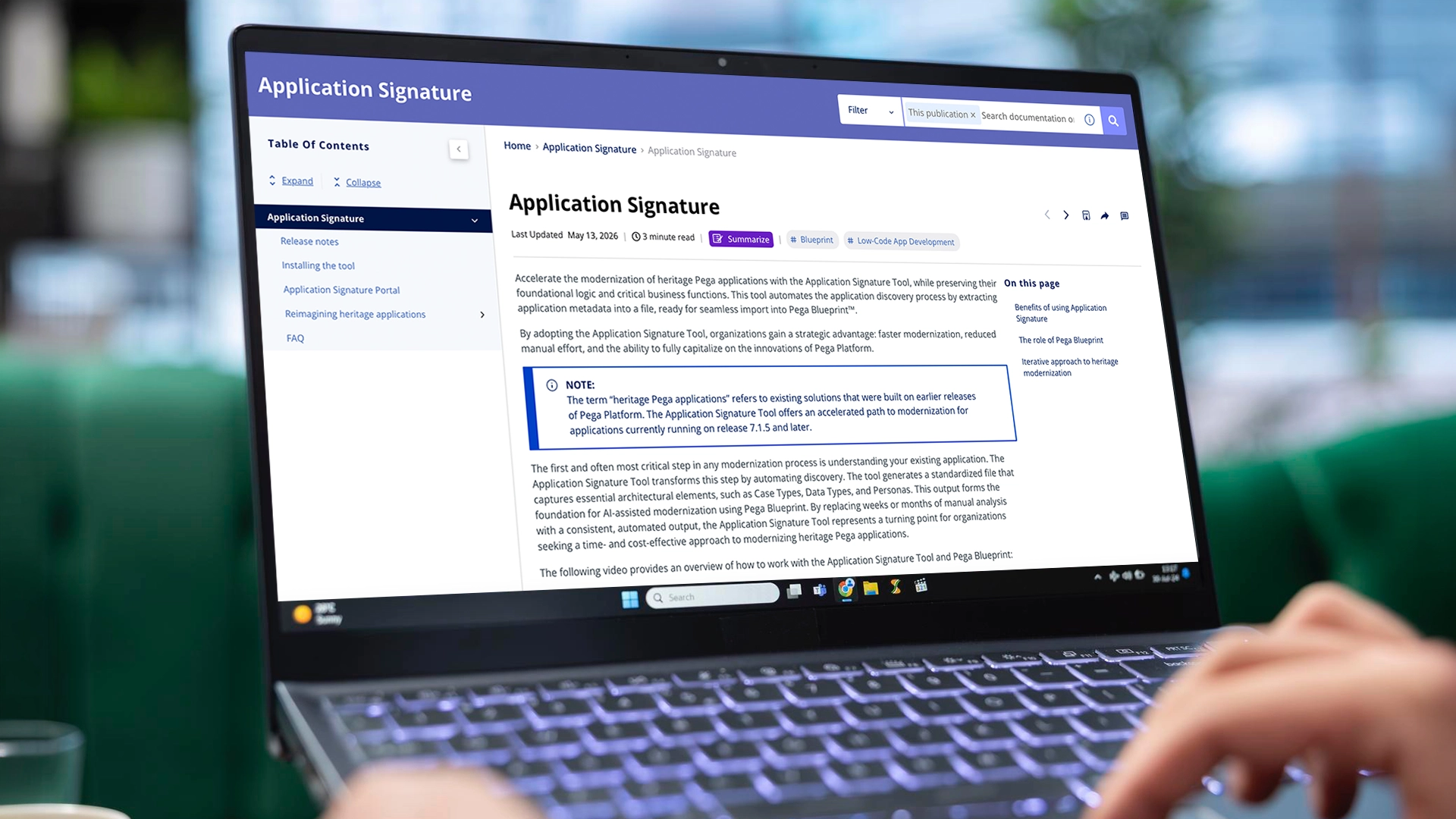
Part I established why application conversion alone is often only half the modernization answer. It introduced Pega App Signature as a Pega modernization tool that shifts the starting point from manual interpretation to a metadata-driven input layer, giving Blueprint a stronger foundation to generate a Constellation-supported model.
Part II picks up where that left off.
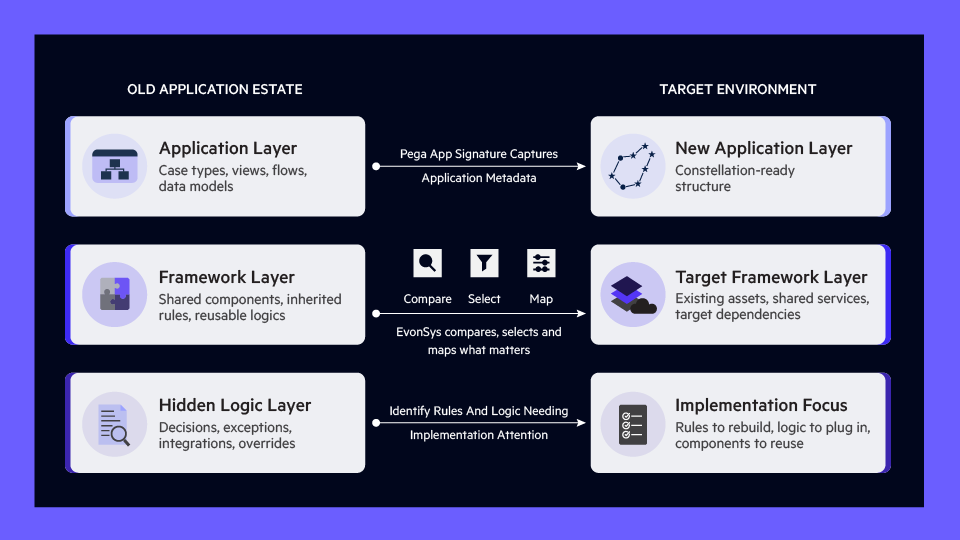
In many enterprise Pega environments, the application layer is built on top of frameworks that carry reusable assets, inherited rules, shared components, data structures, integrations, and business logic. These framework elements may support multiple applications and continue to play an important role in the target environment.
If modernization focuses only on the application layer, teams may miss the framework dependencies that determine how the application behaves.
Extending Pega App Signature capabilities into the framework layer changes that. Teams can assess not just the visible application structure, but the underlying framework components that influence what should move, what can be reused, and what needs to be redesigned, producing a modernization approach that reflects the real enterprise architecture, not just the surface-level application.
Old vs Target
Comparing the Old Environment with the Target Environment
A key part of framework-aware modernization is comparison. Traditional application conversion can easily become a one-way movement: read the old application, generate the new structure, and start building forward. But the target environment may already contain assets, rules, components, and framework structures that should influence what gets moved.
A deliberate comparison between old and target environments helps teams make informed decisions before modernization is underway, not after.
This comparison becomes especially important when the older application model and the target Constellation-supported model are structurally different. In that situation, treating legacy Pega modernization as a like-for-like movement creates false confidence. The target application may require a different build model, a different interaction pattern, and a different way of organizing components.
Modernization is not a one-way movement. It requires a clear understanding of both sides: the legacy structure and the future-state architecture.
Move What Matters
Supporting Selective Component Movement
Legacy applications often contain components that were useful at one point but may no longer belong in the modernized application. Some rules may reflect outdated business processes. Some flows may have been created for exceptions that no longer exist. Some components may already be available in the target framework. Others may need to be rebuilt in a cleaner way.
A wholesale migration approach carries this complexity into the future. EvonSys supports selective component movement.
Instead of assuming that everything in the old application should move forward, teams can choose the components that are actually required for the new environment. This gives modernization teams more control over what enters the modernized application structure.
Logic in Focus
Bringing Rules and Logic into Focus
Application modernization is often discussed in terms of visible structures: screens, case types, views, flows, and data models. But the deeper modernization challenge often sits in the rules and logic layer. The rules that define behavior, decisions that determine outcomes, exceptions that shape process reality, and integrations that connect the application to the enterprise.
If those elements are not understood, modernization can look complete on the surface while leaving significant delivery risk underneath. EvonSys extends the Pega App Signature approach into this layer helps teams identify the rules and logic that need implementation attention, not to automatically transform every rule, but to make focus areas visible before build begins.
What visibility changes in practice:
Teams understand which rules matter before build begins, not after
Dependencies are addressed proactively rather than discovered mid-delivery
Implementation effort is planned against a clearer picture of the logic landscape
In enterprise modernization, this is often where the difference is made. Not in the visible application shell, but in the logic that determines whether the new application actually works.
Control the Path
Creating a More Controlled Modernization Path
The combined value of framework-level analysis, old-vs-target comparison, selective component movement, and rules visibility is control. Modernization teams working with Pega App Signature as a modernization tool are not limited to application-level conversion or forced to move everything forward simply because it exists in the old system.
Instead, they can compare, select, and modernize with greater architectural clarity.
For enterprise teams, that clarity reduces rework, improves implementation planning, and creates a stronger bridge between the current application landscape and the target-state environment.
The goal is not just to generate a new application structure. The goal is to create a modernized application that reflects the right parts of the old environment, fits into the target framework, and gives implementation teams a clearer path to build with confidence.
Driving Outcomes Beyond a Facelift
A modernized application can look better long before it works better. A new interface, or Constellation-supported structure may create the appearance of progress. But if framework dependencies, rules, reusable components, and implementation focus areas are not understood, the organization simply moves old complexity into a new structure.
The value of framework-aware modernization is that it changes the measure of success. The question is no longer just whether a new application can be generated. It is whether the new application is shaped from the right inputs, compared against the right target environment, and built with enough visibility into the rules and logic that still require attention.
More accurate modernization inputs
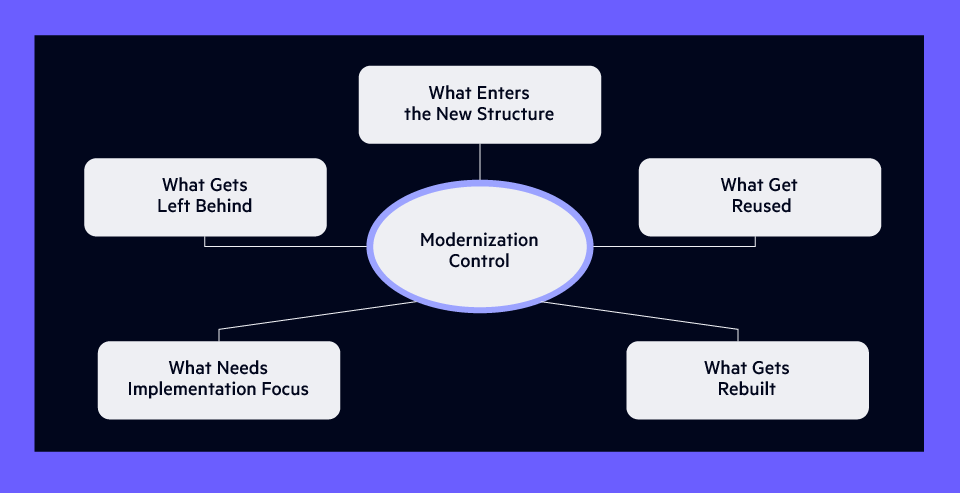
A metadata-driven starting point is grounded in what Pega App Signature extracts from the existing application reduces the risk of gaps traveling into the generated structure. It also reduces the pressure on architects to reconstruct the old application from scratch, freeing them to focus on higher-value decisions: what to reuse, what to rebuild, what to plug into the new framework, and what to leave behind.
Less dependence on manual prompt creation
Blueprint can help generate a modern application structure, but it still depends on the quality of the prompt. The person writing the prompt must understand the old application well enough to describe it accurately; otherwise, the output may inherit the limitations of incomplete analysis.
Framework-aware modernization reduces the pressure on manual interpretation.
It does not remove the need for architects, delivery leads, or implementation teams. But it gives them a stronger input layer to work from. Instead of starting with a blank prompt and a time-consuming manual study of the old application, teams can work from extracted metadata, framework comparison, and a clearer view of what matters.
Better framework-level comparison
EvonSys’ framework-aware approach helps compare old and target environments before modernization decisions are made. That comparison prevents teams from discovering structural mismatches late in delivery. Combined with visibility into the rules and logic layer, this gives implementation teams a clearer view of where effort is required, reducing surprises, reducing rework, and improving alignment between the generated structure and the work required to make it functional.
Clarity to Move Right
A Clear Understanding of What Needs to Move
A traditional conversion mindset can assume that the old application should be carried forward as completely as possible. But in real modernization programs, that is rarely the best answer.
EvonSys’ extension of Pega App Signature supports a “pick-and-choose” approach by helping teams identify what’s truly needed and select only the components worth moving into the modernized application.
Visibility into rules and logic that need attention
Structure is only part of the story. The harder work lives in the rules and logic layer: decisions, exceptions, integrations, and dependencies that don't always surface through the application layer alone.
This is where surface-level modernization creates false confidence. The application may look structurally complete, yet delivery teams still uncover critical rules during implementation, triggering rework, delays, and uncertainty.
The goal is not to auto-transform every rule. It's to flag the rules and logic that need attention before the project moves too far downstream. That means fewer surprises during delivery and tighter alignment between generated structure and actual build effort.
Better control over the target application structure
The larger outcome is often control. Control over modernization inputs, comparisons, what moves, what's rebuilt, what's reused, and what's left behind. For enterprise teams, that control matters more than speed alone.
Fast modernization is not useful if it carries the wrong components forward. A clean interface is not enough if the underlying logic is unresolved. A new structure is not enough if teams are still discovering critical dependencies late in the build.
Framework-aware modernization gives teams a governed path from legacy structure to modern application design, with better context and clearer implementation visibility from the start. That's what separates true modernization from a cosmetic rebuild.
Takeaway: From Generation to Guided Modernization
Pega App Signature gives modernization teams a stronger way to understand the existing application and create a more informed starting point for application generation. In many modernization journeys, that is a meaningful step forward.
But enterprise Pega environments are not always straightforward. Applications may sit inside broader framework structures, inherit shared rules, depend on reusable components, and carry logic that has been shaped over years of business change. Extending Pega App Signature into a framework-aware lens helps teams:
Compare old and target environments before decisions are made
Understand what is already available in the target framework
Identify what needs to move and what should be retired
Surface the rules and logic that require implementation attention
The result is a more controlled legacy Pega modernization path, one that builds on the strength of Pega App Signature while helping enterprises manage the additional complexity of framework-based applications.
The goal is not to move everything forward. The goal is to move the right things, with the right level of control.
Ready to modernize beyond the application layer? Let's talk.
























.png)










.png)

.png)




.png)


.png)


