Evonsys is propelling industries into the future, transforming operations and customer experiences with low-code solutions that unlock unprecedented levels of efficiency and innovation.
Since 2015, Evonsys has harnessed the power of low code to refine global organizations. We've revolutionized sectors from banking to retail with our comprehensive solutions, focusing on risk mitigation, management optimization, and streamlined automation for unrivaled efficiency.
Modernization is No Longer Just Application Conversion
Older Pega applications often carry years of accumulated implementation decisions. Case types may have evolved across business units. Rules may have been extended, overridden, or reused in ways that are not immediately visible. Data models may reflect historical process choices. Frameworks may contain inherited logic that still supports critical business operations. And behind every application layer, there may be dependencies, exceptions, integrations, and decision flows that have become part of how the enterprise runs.
That is why a straightforward application conversion alone is often only half the answer.
A modern application structure can be generated. A new interface can be designed. A Constellation-supported model can be created. But none of that automatically answers the harder modernization questions:
What from the old application should inform the new one? Which components are still relevant?
Which rules need to be rebuilt, and which logic should be preserved?
Which parts of the old environment should be left behind rather than carried forward into a new structure?
This is where modernization becomes less of a conversion exercise and more of an architectural decision-making process. Enterprise applications are not built in isolation. They are shaped over time by business change, regulatory needs, operational workarounds, integration constraints, and delivery decisions.
A better approach starts with a more precise question.
Not: How do we convert this application?
But: How do we determine what this application should contribute to the modernized environment?
That question sets the foundation for a more controlled modernization path, one that begins with better understanding, better inputs, and better architectural judgment.
Prompts Carry Risk
A Blueprint Is Only as Good as Its Inputs
Why prompt quality can make or break modernization outputs
Pega Blueprint gives modernization teams a powerful way to move from intent to application structure. With the right input, it can help generate the layout, structure, and starting model for a Constellation-supported application.
But Blueprint does not remove the need for architectural understanding. It depends on it.
The quality of the generated application is directly tied to the quality of the input provided:
If the prompt is clear, complete, and grounded in the realities of the existing application, the output reflects what the business actually needs.
If the prompt is vague, incomplete, based on a shallow reading of the legacy environment, the generated structure may carry gaps from the very beginning.
Prompting in this context is not simply a matter of describing screens or listing case types. A modernization prompt has to translate the intent of the old application into a structure that can support the new one.
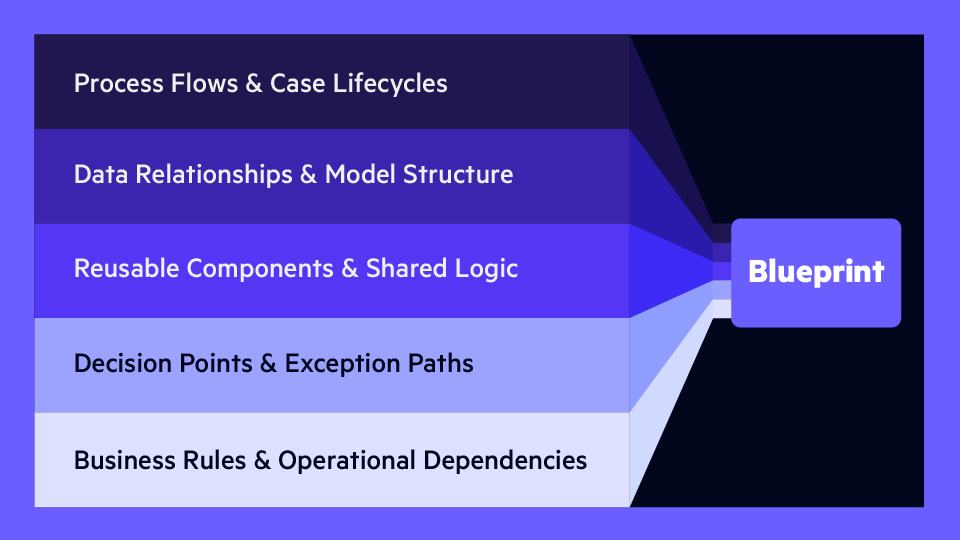
Modernization prompt must account for:
Process flows and case lifecycles
Data relationships and reusable components
Decision points and exception paths
Business rules and the operational logic users depend on every day
In a simple application, capturing this may be manageable. In a mature enterprise Pega environment, it becomes significantly harder.
Why enterprise environment add complexity:
A case type may have been extended several times to support new products, regions, or regulatory needs
Rules may have been reused across multiple processes
Data structures may reflect historical workarounds
Critical logic may sit in places that are not immediately visible to someone analyzing the application years later
The person writing the prompt needs more than a surface-level understanding. They need to know how the application behaves, why it was built that way, where the dependencies sit, and which parts of the old structure are still relevant.
A missed dependency can lead to an incomplete model. An overlooked rule can create rework during implementation. A misunderstood process variation can produce a structure that looks correct at a high level but fails to support real operational scenarios. A prompt that focuses only on visible flows and layouts may miss the underlying logic that makes the application work.
That is where manual interpretation starts to show its limits. Before a strong prompt can be written, someone has to study the old application, understand its architecture, map its components, identify what matters, and separate useful business logic from legacy complexity. That effort takes time. It also depends heavily on the knowledge of the people doing the analysis.
When that knowledge is fragmented, the prompt can be fragmented too.
And when the prompt is fragmented, the output may inherit those blind spots.
This is why the modernization conversation cannot stop at generation. Generating a new application structure is useful, but only if the input reflects the application accurately enough. Otherwise, teams may find themselves validating, correcting, and rebuilding parts of the generated output during delivery.
For enterprise modernization teams, this raises a practical question:
How do you reduce dependence on manual interpretation and create a more reliable input layer for modernization?
A Smarter Starting Point
A Stronger Starting Point with Pega App Signature
From manual interpretation to metadata-driven input
Manual interpretation has always been one of the risk points in application modernization. Before a team can generate a new application structure, it first must understand the old one. Identifying the case types, flows, data models, rules, dependencies, and logic that shaped the existing application.
In a small system, that may be manageable. In a mature enterprise Pega environment, it can quickly become time-consuming and uneven.
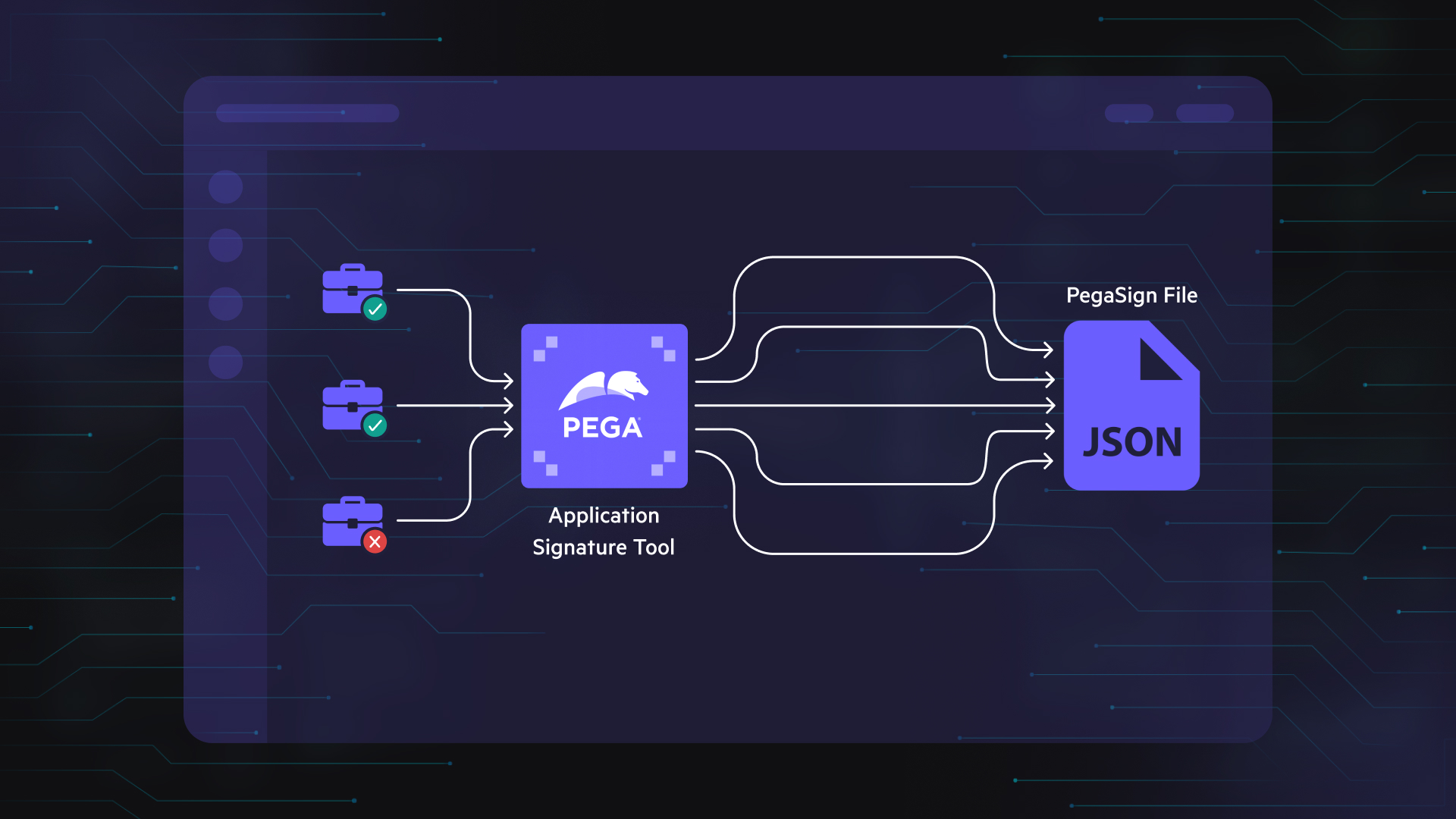
Pega App Signature helps strengthen this starting point.
Instead of relying only on manually analysis, Pega App Signature can run against the existing application and extract relevant metadata that can be used as input for Blueprint. That changes modernization from a process based largely on manual interpretation to one grounded in the actual structure of the application.
What changes with a metadata-driven input layer:
Important case structures are less likely to be missed
Rule dependencies are surfaced rather than understated
Process variations are captured with greater accuracy
The analysis cycle shortens, and blind spots reduce
Teams get a more structured view of the legacy application before shaping the modernized environment
The old application is no longer described only from memory, documentation, or manual analysis. It is being read for the metadata required to inform the new application structure. That creates a stronger foundation for Blueprint to generate a Constellation-supported model that is closer to the realities of the existing system.
This does not remove the need for architectural judgment.
The Framework Gap
Where Application-Level Conversion Reaches Its Limit
Why the framework layer changes the modernization problem
In simpler environments, an application can be assessed, interpreted, and used as the basis for generating a new structure. The scope is relatively contained. The old application represents the primary source of truth. The modernization effort is largely about understanding what exists, translating that into the target model, and building forward from there.
Enterprise Pega environments are rarely that simple.
Mature applications are built on frameworks. Over time, those frameworks become more than a technical foundation, they become:
Reusable assets, and inherited rules
Shared data structures and common process patterns
Integrations, decision logic, and components supporting multiple applications
Why framework-based applications don't modernize cleanly as isolated units:
A case type may depend on rules inherited from the framework layer
A process may use shared components also used by other applications
A data model may reflect enterprise-wide structures, not application-specific design
A decision flow may depend on reusable logic sitting outside the visible application boundary
If modernization only reads the application layer, it may miss the deeper structure that determines how the application actually behaves. That creates risk.
A modernized application may look structurally complete but still require significant rework once teams discover framework dependencies during delivery. Components may be recreated even though equivalent assets already exist in the target framework. Legacy rules may be carried forward without asking whether they are still required. Or worse, important logic may be left behind because it was not visible at the application level.
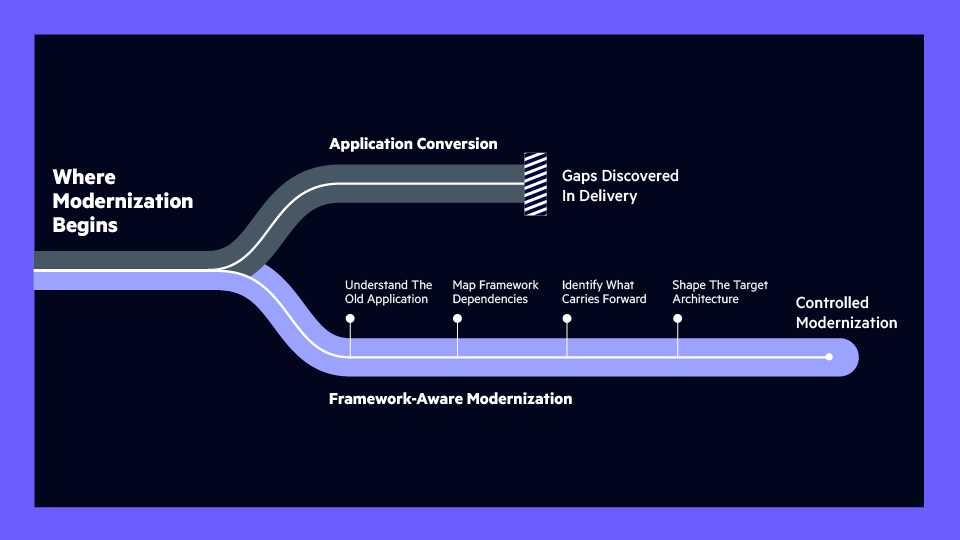
This is why framework-aware modernization is different from application conversion.
Framework-aware modernization asks more practical questions:
What is already available in the target framework?
What needs to be brought forward from the old application?
Which components are still relevant?
Which rules or logic require implementation attention?
Which parts of the old environment should be redesigned rather than reused?
Which inherited structures should not be carried forward at all?
These are not just technical questions. They are architectural decisions that determine whether modernization becomes a clean transition into a better operating model, or a cosmetic rebuild that quietly carries old complexity into a new application structure.
This is especially important when the older environment and the new Constellation-supported model are structurally different. In that situation, treating modernization as a simple like-for-like movement can create false confidence. The target application may require a different build model, a different interaction pattern, and a different way of organizing the components that support the user experience.
The pivot from App Signature as an application-level accelerator to a broader implementation need: a framework-aware approach requires knowing how the old application, the old framework, and the target framework should come together without carrying forward unnecessary complexity.
Related Articles
Pega Smart Dispute Agentic Automation: Modernizing Dispute Operations in Banks

























.png)










.png)

.png)




.png)


.png)


