.png)

.png)
When a corporate client asks why a payment hasn’t reached a new vendor, finding the answer isn’t easy.
The payment investigation doesn’t start in one place. The team needs to review payment systems, messaging platforms, and past correspondence to understand the situation. Because investigations are still manual, critical details are scattered across systems.
While investigators focus on one delayed payment, other requests continue to queue, and each one matters to the client. Without a clear way to prioritize or see the full picture, delays become inevitable.
It’s the result of payment investigation processes designed for lower volumes and simpler payment flows. As payments move faster and expectations rise, these gaps become more visible.
Payment investigations are becoming harder to manage due to the growing volume. In recent years, banks have expanded payment capabilities to support instant transfers and multiple digital touchpoints. While this may look like improving the customer experience, it significantly increases the number of real time transaction monitoring systems. When manual inputs contain errors, the transaction will be moved to payment investigation.
As payment rails increase, the time available to respond to exceptions shrinks. Looking ahead, the global payments industry is expected to continue growing. According to McKinsey, the industry is forecast to add roughly $700 billion in revenue, reaching about $3.1 trillion by 2028. Customers expect immediate clarity, especially for high-value or time-sensitive payments.
Since the investigation spans multiple systems and involves external parties, it is entirely manual. They must gather information from payment engines, core banking systems, messaging platforms, and customer records to reconstruct the scenario. Signals from real time transaction monitoring tools often lack investigation context.
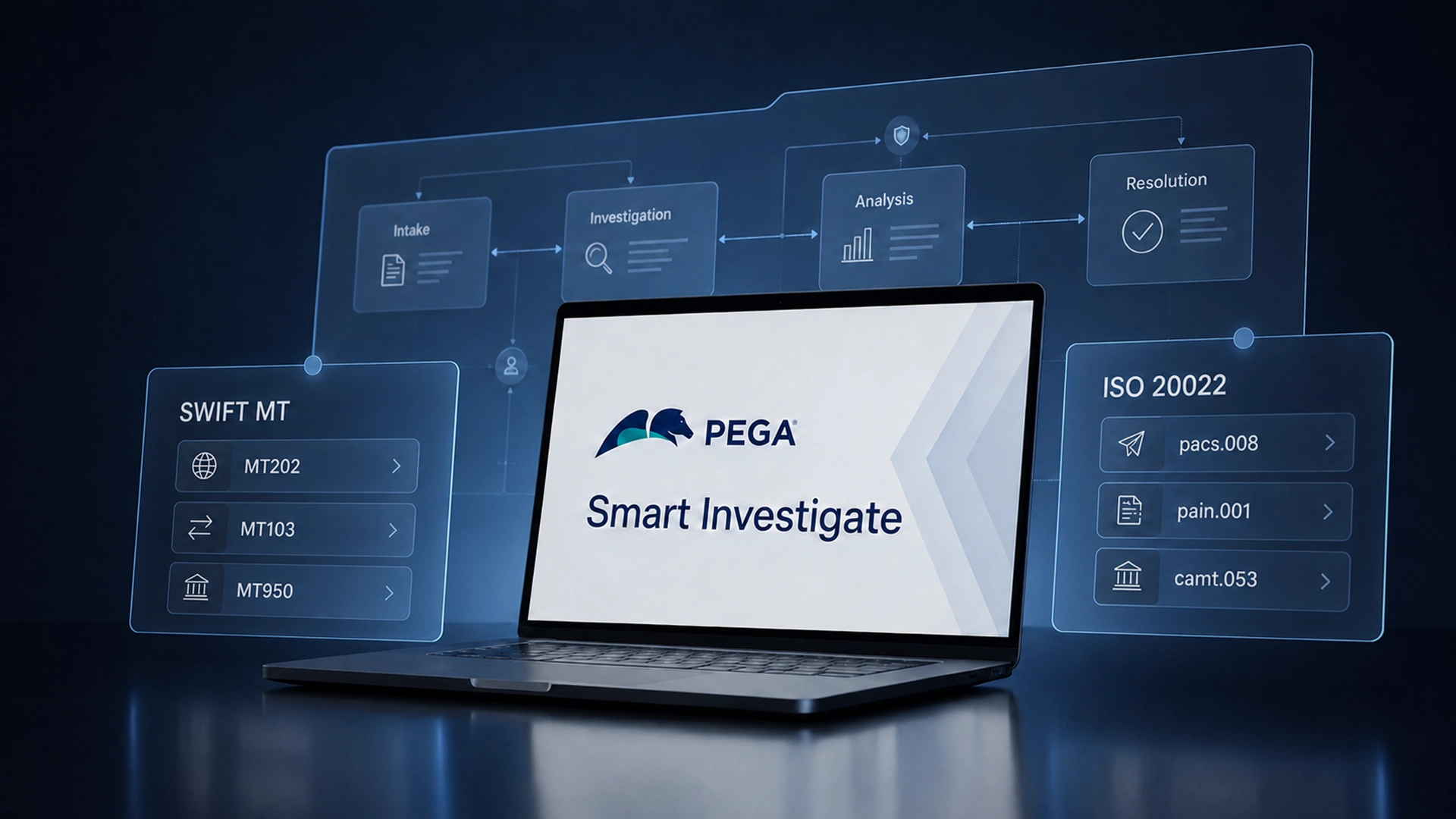
This gap explains why many banks are now rethinking how they manage investigations. Choose Pega Smart Investigate to move payment investigations from manual to a more unified model. It replaces the manual, disconnected process with an intelligent, automated case management system. The pre-built Swift messaging workflow helps to speed up the investigation. When enhanced by ISO 20022 standards, Swift case management enables faster case resolution.
Payment investigations are not triggered only by failures. They also occur when a customer raises an inquiry, leading to its own investigation logic, data formats, and settlement rules.
.webp)
So, how does the bank investigate unauthorized payments in most cases? They are handled manually, and even if only a small percentage of payments require investigation, the cases overwhelm the team. It manages the entire case through a single, structured, auditable workflow. The investigators get a unified view of data, apply rules and AI to guide decisions, and ensure regulatory timelines are met.
Payment investigations are closely tied to how payment messages move between banks. Transaction data sits in payment engines. Status updates live in messaging platforms. Customer instructions are stored in separate channels. Investigation notes are often tracked outside the core workflow altogether.
When customers ask how the bank investigates an unauthorized payment, investigators must navigate across these disconnected systems. Time is spent locating data instead of resolving the issue. Context is rebuilt repeatedly as cases move between teams.
As real time transaction monitoring volumes grow, these inefficiencies compound, slowing investigations further.
Banks and payment service providers have invested heavily in faster payment rails. But investigation models have remained largely unchanged.
The investigation team faces:
The result is a growing mismatch between how payments move and how exceptions are resolved.
Payment investigations are no longer a back-office function operating in the background. As banks try to answer questions like how they investigate unauthorized payments, the limitations of fragmented processes become more challenging. The banks should choose intelligent, case-driven investigations that scale with transaction growth.
When you’re overwhelmed with real time transaction monitoring, choose AI-powered Smart Investigate. At EvonSys, we bring deep Pega expertise and real-world payments experience to help banks implement Smart Investigate in a way that delivers measurable outcomes
See what a smarter payment investigation model looks like
As payment volumes continue to rise, the question is no longer if payment investigations need to change, but how quickly banks can make that shift.

.png)


.png)