A payment investigation may start with a single inquiry. But behind that inquiry can involve a chain of actions, from tracking the payment and gathering data to validating the request, contacting counterparties, tracking responses, triggering follow-ups, meeting SLAs, and documenting the final outcome.
When each step depends on separate systems and manual intervention, even a well-managed case can become a lengthy operational process.
This is where payment case orchestration is changing the approach.
Instead of simply managing cases, banks can orchestrate the activities, decisions, people, messages, and systems involved in moving an investigation from intake to resolution.
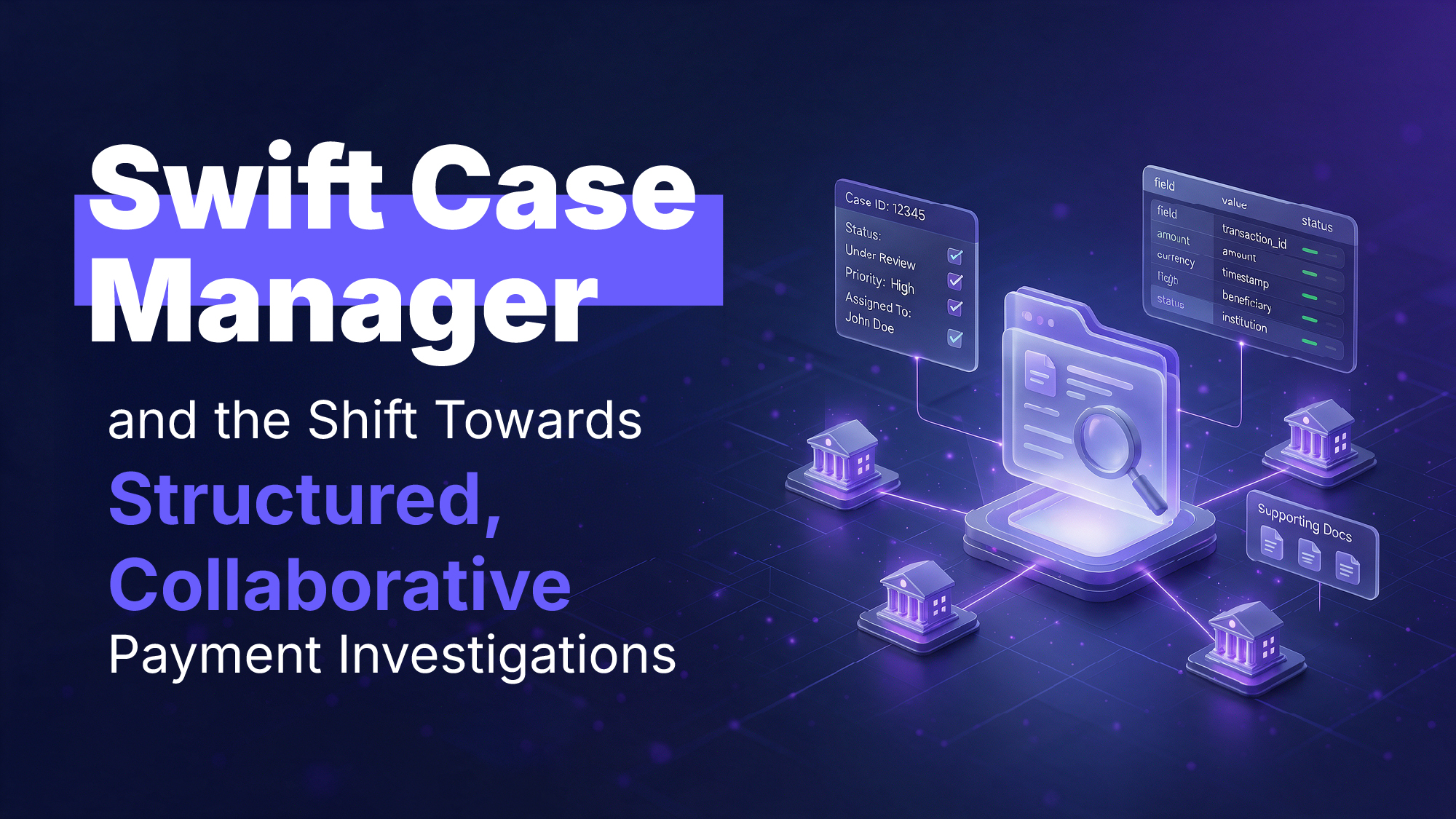
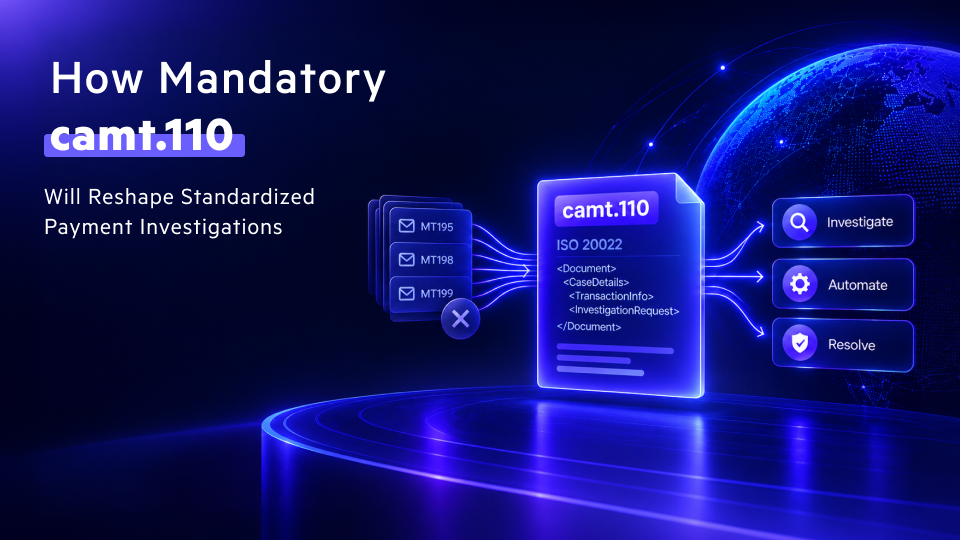
The shift is particularly relevant as ISO 20022 brings richer, more structured payment data into investigation workflows. Swift's Case Management model uses this foundation to centrally orchestrate Exceptions and Investigations through structured camt.110 investigation requests and camt.111 responses.
For banks investing in payment investigations software, this creates a broader opportunity. The goal is not simply to digitize the case. It is to orchestrate the investigation around it.
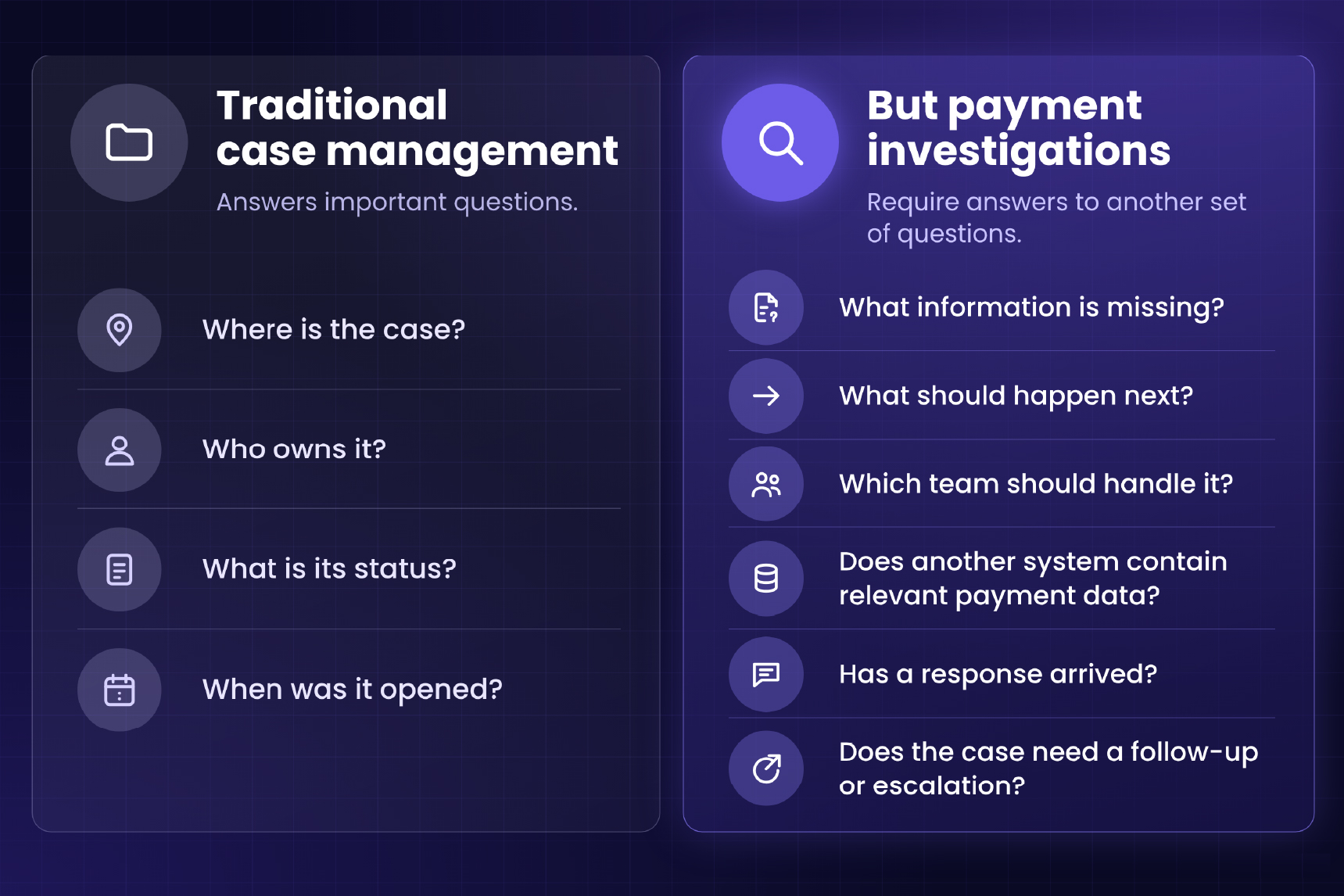
This is the difference between case management and case orchestration.
Case management provides a structured environment for recording and tracking an investigation. Case orchestration connects the activities required to progress that investigation.
For example, when an investigation request arrives, an orchestrated workflow can identify the request type, validate the available information, retrieve relevant payment data, determine the appropriate queue, create or update the case, and trigger the next action.
The analyst still makes decisions where human judgment is required. But the workflow can handle many of the repetitive steps surrounding those decisions.
That makes payment case orchestration an important part of the investigation workflow automation.
The value of ISO 20022 extends beyond replacing legacy message formats.
Its richer and more structured data gives investigation workflows greater context at the point of case intake, helping teams work with more complete information from the outset.
Swift describes Case Management as a network-agnostic solution built on ISO 20022 that uses structured data, UETR, and smart routing to streamline payment investigations. Its Case Orchestrator service centrally coordinates camt.110 and camt.111 investigation messages.
This creates a stronger foundation for more intelligent investigation workflows.
Instead of receiving an inquiry and relying on an analyst to manually interpret it, search for related payment information, and determine the next step, structured data can help workflows identify the investigation type, bring relevant transaction context into the case, and route it according to predefined rules.
But structured data alone does not automate an investigation.
The real value comes from connecting that data to the workflows that act on it. This is where banking workflow orchestration becomes important. It brings payment information together with business rules, operational queues, communication channels, SLAs, and human actions, allowing investigations to progress through a connected workflow rather than a series of manually coordinated steps.
For banks, this means ISO 20022 can become more than a messaging standard. It can provide the data foundation for investigation workflows that are more connected, contextual, and responsive.
Consider a beneficiary non-receipt investigation.
In a traditional process, an analyst may receive the inquiry, locate the payment, search for relevant information, determine which institution needs to be contacted, prepare a response or investigation request, record the action, and create a reminder for follow-up.
Every additional handoff introduces another opportunity for delay.
An orchestrated workflow can connect these activities.
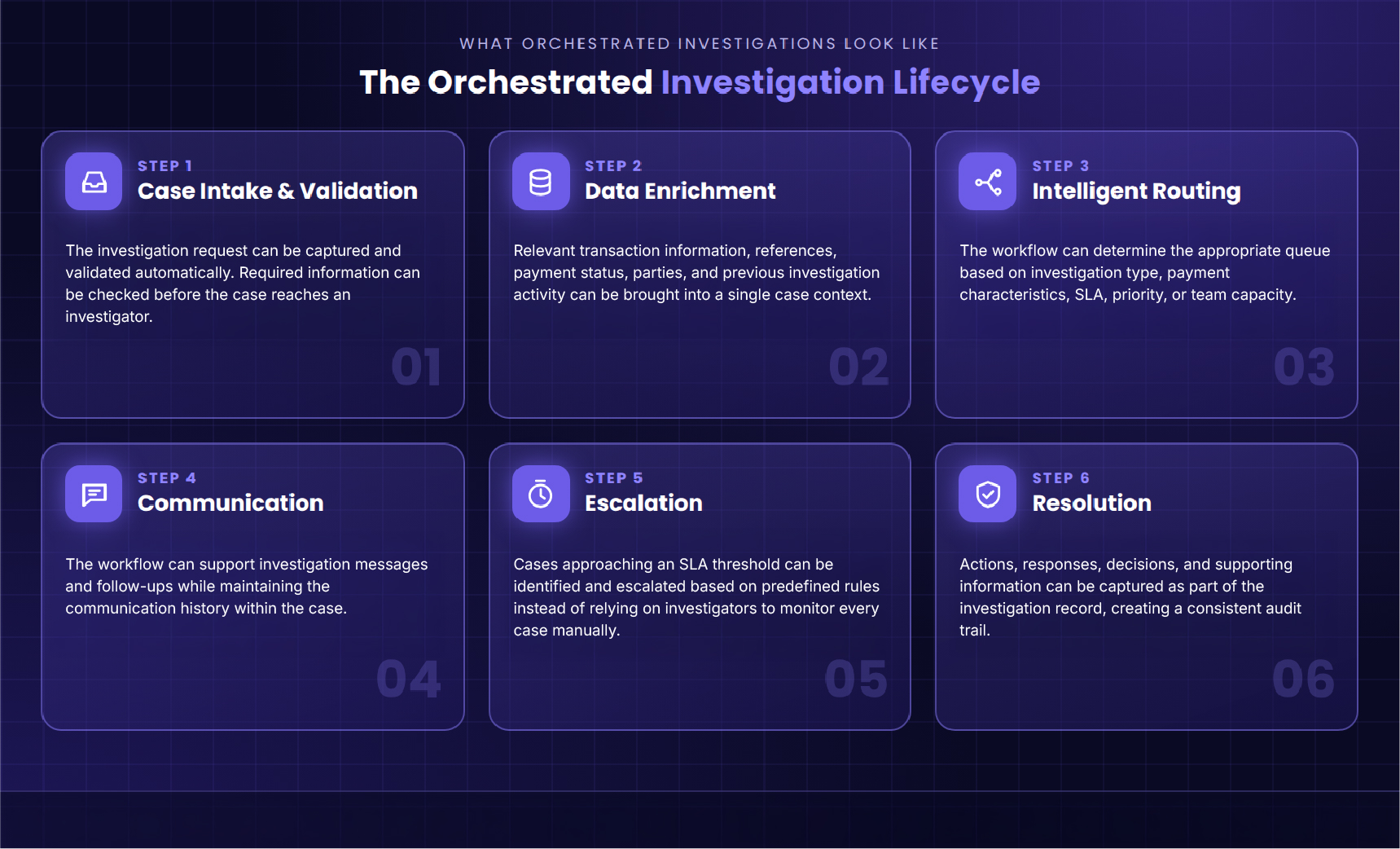
This is where a purpose-built payment investigations software like TracEI by EvonSys can connect the principles of payment case orchestration with day-to-day payment operations.
TracEI is designed to manage domestic and cross-border payment exceptions and investigations through structured workflows, centralized case management, and automated investigation processes.
Rather than treating case management as a destination for manually created records, TracEI connects the investigation lifecycle.
It can capture MT and MX messages, Fedwire ISO, RFIs, and other investigation inputs, create or update cases, enrich investigations with transaction information, and prioritize work queues. Its workflow also supports research, analysis, communication, execution, and continuous monitoring.
This creates a practical orchestration layer across the investigation process.
For example, structured information received via ISO 20022 can be used to populate investigation data, eliminating the need for investigators to manually re-enter it. Cases can then be routed according to scenario, reason code, or workflow requirements.
TracEI also brings investigation activities into a unified workspace, helping teams manage payment status inquiries, cancellation and return requests, beneficiary claims of non-receipt, and other exception scenarios.
The result is a shift from managing cases to managing the workflow around those cases.
That distinction becomes increasingly important as payment operations teams deal with multiple payment rails, messaging formats, counterparties, and investigation scenarios.
From Payment Operations Automation to Better Investigation Outcomes
Payment case orchestration is ultimately part of a broader move toward payment operations automation.
The objective is not to automate every decision. Investigators will continue to play an important role when cases require judgment, contextual analysis, customer communication, or exception handling.
The opportunity is to automate the coordination surrounding those decisions.
When workflows can capture information, enrich cases, route work, trigger follow-ups, monitor SLAs, and maintain an audit trail, investigators spend less time coordinating the process and more time resolving the issue.
This can also give operations leaders a clearer view of investigation performance.
Instead of looking only at open and closed cases, teams can examine where investigations spend time, which queues create bottlenecks, how long responses take, and where repetitive manual work persists.
That makes case orchestration relevant not only to investigation teams, but also to wider banking operations transformation initiatives.
Payment investigations are evolving from case-centric processes into orchestrated workflows.
Case management remains essential for controlling investigation records and providing visibility. But orchestration connects the wider lifecycle, from intake and validation to routing, communication, follow-up, escalation, and resolution.
ISO 20022 and Swift Case Management are helping establish a more structured foundation for this shift. Swift's Case Orchestrator is designed to centrally coordinate investigation requests and responses using camt.110 and camt.111.
For banks, the next opportunity is to connect that structured information to their internal operations.
Platforms like TracEI demonstrate how this can work in practice by bringing payment investigation intake, data enrichment, intelligent routing, workflow automation, communication, SLA management, and auditability into a connected process.
The future of payment investigations is therefore not simply about managing more cases.
It is about orchestrating the work required to resolve them.
Move From Case Management to Investigation Orchestration
Connect payment data, workflows, and actions with TracEI. Automate investigation tasks, route cases intelligently, and manage follow-ups across domestic and cross-border payments.