Live webinar | Seconds to Settle, Weeks to Resolve: The Payment Investigations Paradox
Register Now


Every day, millions of cross-border and domestic payments move through global banking networks. Most of these transactions progress through established processing infrastructure without disruption.
Yet a missing payment detail, an ambiguous message field, or an unexpected compliance flag can bring a high-value transaction to a halt. In many back-office environments, resolving a single exception can trigger a manual process spanning multiple legacy systems, operational interfaces, and disconnected spreadsheets. Also, investigators must gather information and coordinate actions across applications before resolving a case.
For decades, addressing these operational limitations meant replacing the underlying core infrastructure. But when the core systems continue to perform their primary transaction-processing functions, replacing them solely to improve investigation workflows introduces high cost, complexity, and operational risk.
A middle-layer architecture offers an alternative approach. It connects existing platforms with modern operational applications, orchestrates exception workflows, and brings relevant payment data into a connected process without requiring fundamental changes to underlying systems.
Core ledgers, mainframes, and payment processing engines deliver stability, security, and high transaction volumes. They execute ledger entries and update account balances with exceptional reliability. These platforms form the backbone of global banking operations.
However, core processing engines were not built for dynamic exception management. They operate on rigid batch schedules and closed database schemas. Relying solely on core platforms creates clear operational constraints when payment inquiries occur.
Exception resolution requires combining information from account databases, compliance screening platforms, and messaging networks. Traditional architectures isolate those records across disconnected systems.
A single payment inquiry often requires pulling data from three or four distinct legacy environments. This structural isolation turns routine data collection into a prolonged manual effort. Investigators spend valuable time gathering context rather than resolving issues.
Investigation teams routinely copy and paste transaction records between terminal interfaces and modern software applications. They manage case histories in offline spreadsheets and send manual status updates via email.
This practice increases operational expenditure significantly. It also increases the potential for human error, leads to inconsistent audit trails, and slows resolution times for high-value corporate clients.
Updating legacy mainframe code to support modern messaging standards such as ISO 20022 requires multi-year engineering projects. COBOL-based mainframes and legacy databases lack native support for rich XML syntax.
Modifying core code directly creates severe operational risk. These custom software initiatives draw heavily on institutional resources and stall broader digital transformation goals.
Attempting a complete core replacement to address back-office exception workflows introduces substantial operational friction. Core banking platforms handle critical ledger functions. Ripping out these systems to solve higher-level workflow issues creates an imbalance between risk and reward.
According to McKinsey, approximately 70% of legacy core transformation initiatives fail to achieve their initial business objectives or significantly exceed their projected timelines and budgets.
Replacing functional core ledgers to fix higher-level investigation workflows often creates unnecessary risk, potential downtime, and massive capital expenditures without delivering immediate business value.
A targeted orchestration approach solves these back-office limitations. By wrapping a flexible orchestration layer around existing ledgers, financial institutions modernize exception management. They achieve high operational efficiency without disturbing core processing engines.
A middle layer serves as an intelligent connector positioned directly between front-end operational applications and back-end mainframe platforms. Rather than replacing the core systems, this architecture wraps around existing infrastructure, extracting, enriching, and orchestrating data flows in real time.
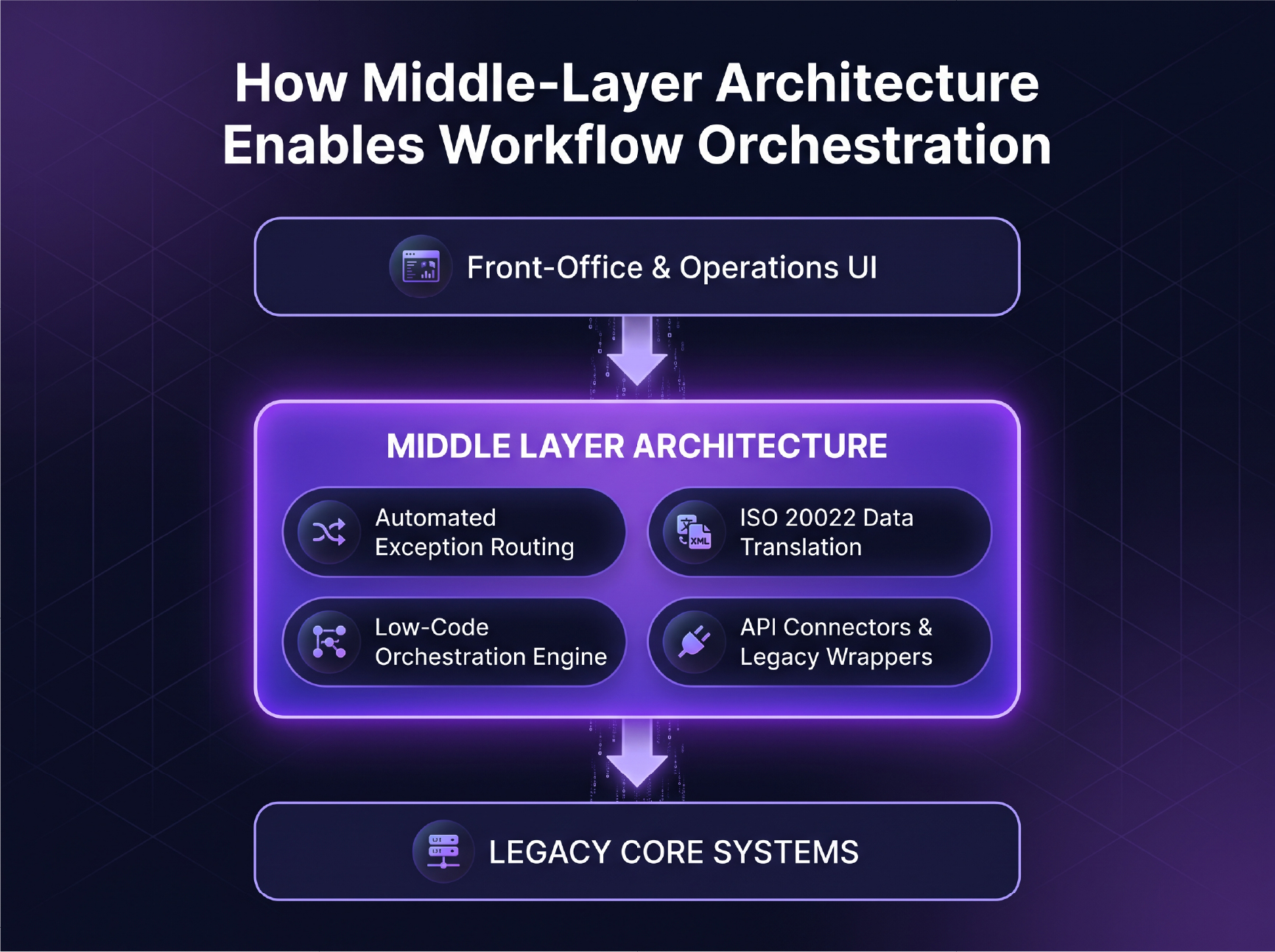
By decoupling operational workflows from static core ledgers, financial institutions gain rapid agility while protecting core operations.
Key Architectural Components
Modern API wrappers connect to legacy databases, pulling required transaction history automatically into investigation files without altering underlying records.
Dedicated payment investigation software automatically receives exception alerts and categorizes cases based on urgency, currency, and complexity.
The middle layer automatically converts legacy MT messages into rich, structured ISO 20022 MX formats, ensuring full compliance without forcing mainframes to process complex XML schemas directly.
While building a customized middle layer from the ground up remains an option, forward-thinking institutions leverage pre-built, specialized platforms to bypass extensive build cycles.
An example of this approach in action is TracEI, a SaaS-based payment investigations platform developed by EvonSys. Positioned explicitly as a middle-layer orchestration solution, TracEI integrates directly with legacy engines and messaging networks.
By using natural language processing to extract intent from incoming SWIFT messages and emails, TracEI automatically retrieves transaction context, populates case files, and applies deterministic routing logic. This allows banks to modernize exception handling without forcing changes on legacy back-office mainframes.
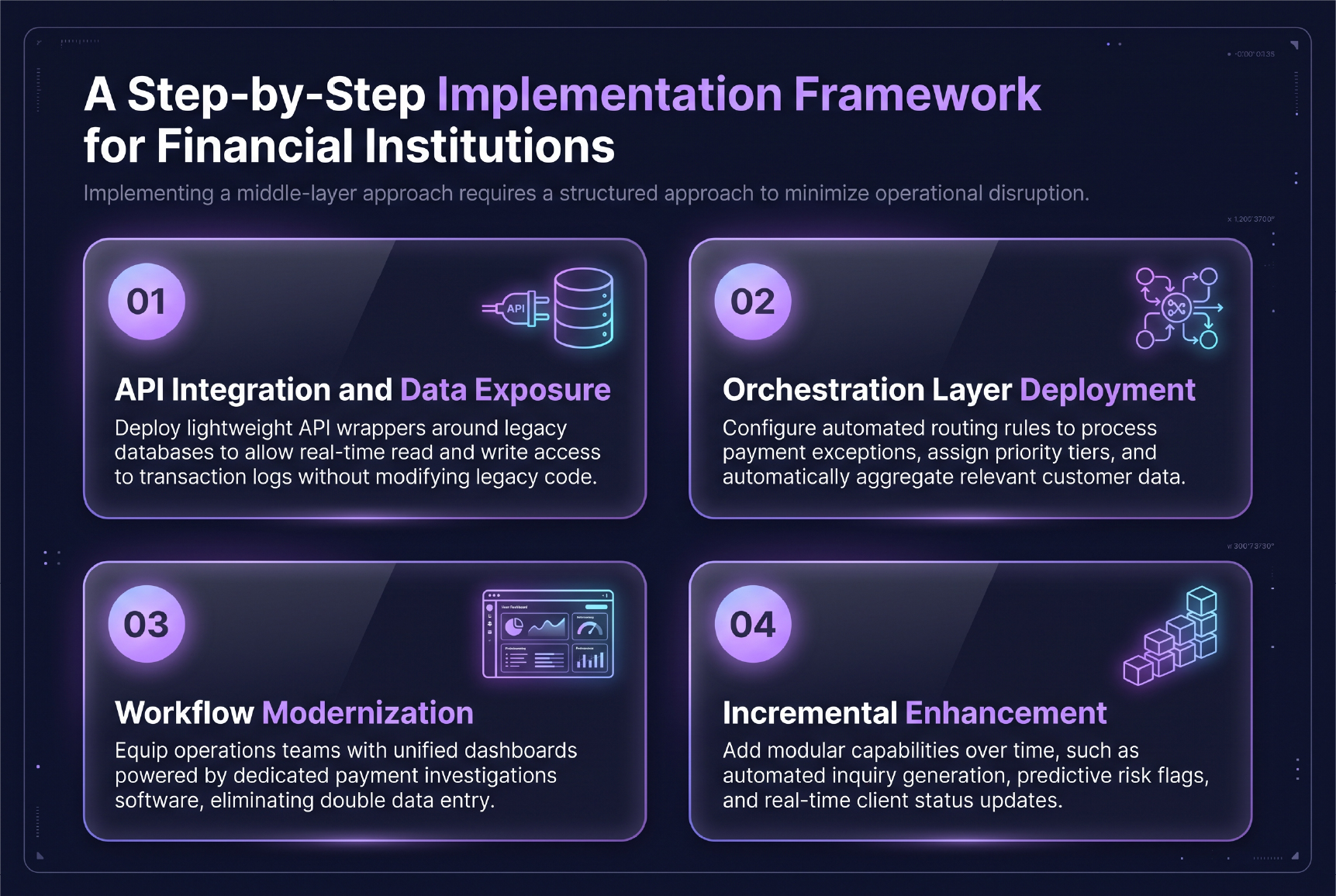
Implementing a middle-layer approach requires a structured approach to minimize operational disruption.
Deploy lightweight API wrappers around legacy databases to allow real-time read and write access to transaction logs without modifying legacy code.
Configure automated routing rules to process payment exceptions, assign priority tiers, and automatically aggregate relevant customer data.
Equip operations teams with unified dashboards powered by dedicated payment investigations software, eliminating double data entry.
Add modular capabilities over time, such as automated inquiry generation, predictive risk flags, and real-time client status updates.
Implementing a structured banking integration strategy through a dedicated middle layer provides clear operational and financial advantages. Rather than attempting risky core replacements, financial institutions can modernize back-office payment workflows directly. This approach preserves existing system stability while driving long-term efficiency across global operations.
Deploying a middle-layer solution takes months rather than years. Project teams configure pre-built API connectors and workflow engines instead of rewriting legacy mainframe code. This accelerated timeline delivers immediate operational relief to investigation teams. Institutions begin to see measurable improvements in case throughput and resolution times almost immediately.
Banks preserve their long-term capital investments in functional core engines while modernizing high-touch operational workflows. Avoiding full core replacement saves tens of millions of dollars in licensing, consulting, and system integration expenses. Financial leadership shifts capital allocation toward operational improvements that offer clear, measurable returns.
Automated data enrichment significantly reduces manual research time. The middle layer automatically aggregates transaction history, compliance records, and SWIFT messaging details into a single interface. Investigators spend less time searching across fragmented applications. This enables faster query resolutions for corporate and retail customers alike, improving overall satisfaction.
Institutions roll out modular enhancements incrementally over time without triggering platform-wide downtime. Operations teams can launch automated exception routing first, then introduce advanced ISO 20022 format translation or artificial intelligence capabilities later. This phased strategy minimizes operational disruption and allows teams to adapt to changes smoothly.
True operational agility does not require discarding functional foundational systems. By deploying specialized payment investigations software anchored by a robust middle-layer architecture, financial institutions can execute a successful banking operations transformation.
This strategy delivers comprehensive legacy system modernization, lowers operational risk, and empowers investigation teams to resolve complex cases faster without disturbing the stability of core banking platforms.
Eliminate Back-Office Bottlenecks Without Core Replacement Risks
See how a non-disruptive middle-layer architecture connects your legacy systems and scales payment operations effortlessly.