.png)

.png)
For many enterprises, the daily operations still rely on the systems built years ago. Over time, they have become deeply embedded in daily operations. This is especially true in industries like banking, where scalability and compliance are crucial. These legacy platforms that once powered growth now struggle to keep pace with today’s business demands. As the backbone of critical business operations, they introduce legacy system risks such as security vulnerabilities, limited scalability, and slow innovations.
To address these challenges, many enterprises launched digital transformation initiatives, often beginning with cloud adoption and support from implementation partners. Today, 94% of organizations use cloud computing, and over 60% of their data is stored in the cloud. However, simply hosting legacy applications on cloud infrastructure often fails to deliver complete results. The main concerns are the security risks and scalability constraints. The gap between cloud adoption and true modernization is where organizations begin to reassess not just where their systems run, but how they are built, managed, and secured.
This is where Pega Cloud migration becomes a strategic enabler rather than a technical project. By combining the Pega platform with a fully managed cloud environment, Pega Cloud migration helps organizations modernize legacy processes while strengthening Pega Cloud security.
Many enterprises initiate cloud implementation with a straightforward goal: move existing systems to the cloud sooner, often referred to as "lift and shift". This approach promises faster deployment and reduced reliance on infrastructure. However, because of complex workloads, the results are frequently underwhelming.
The core issue is that traditional cloud migrations focus primarily on infrastructure rather than the platform itself. Legacy systems are moved into virtual machines or containers in the cloud, but their underlying design remains unchanged. Business logic stays hard-coded, deployment processes remain manual, and security controls continue to vary across applications.
Outdated protocols, weak encryption, and a lack of vendor support expose the core operating system to cybersecurity risks. As a result, security controls were often:
Patches are delayed due to concerns about the legacy system's risks. Access controls become fragmented as teams and roles evolve. Each of these factors increases the likelihood that vulnerabilities will go unnoticed.
These legacy system risks do not disappear when the system is moved to the cloud. In many cases, they become harder to manage because the environment itself becomes more distributed.
Cloud providers offer robust security for their underlying infrastructure. But for the legacy systems, the configuration, identity management, and patching often remain with the customer.
For legacy applications, this creates several challenges:
So, simply hosting applications in the cloud does not automatically create a secure environment. Fragmented security increases both risk and cost by leading to inconsistent control application across systems, resulting in gaps in access enforcement, slower responses to new vulnerabilities, and greater effort during audits.
This is where Pega Cloud security and platform-led modernization make a difference. Simply hosting applications in the cloud does not, by itself, create a secure environment. For highly regulated sectors, Pega Cloud for banking provides a more unified, secure, and scalable approach that addresses these challenges at the platform level rather than treating them as isolated infrastructure issues.
During cloud adoption, scalability is a key goal, yet it remains challenging to achieve. While cloud infrastructure can scale on demand, legacy applications are not built to take advantage of it. Their architecture assumes fixed capacity, tightly coupled components, and manual control. As a result, scaling still requires advanced capacity planning, manual configuration changes, and, in many cases, planned downtime. This directly undermines the promise of agility that organizations expect from cloud adoption.
From an operational standpoint, this creates a serious risk. Teams must handle peak loads, increasing costs, or accept performance degradation during high demand. These limitations are not infrastructure failures; they are legacy system risks rooted in outdated application and platform design.
In financial services, the impact is far more severe. Banks operate in environments where transaction spikes are predictable but unavoidable, such as end-of-month processing, regulatory reporting, peak customer activity, or market volatility. Systems that cannot scale automatically introduce operational instability.
That is why institutions evaluating Pega Cloud for banking increasingly recognize that Pega Cloud migration is not about relocating workloads. Still, it is about replacing fragile, manually managed platforms with a managed environment designed by default for scale, resilience, and security.
Addressing legacy system risks requires more than stronger infrastructure or additional security tools. It requires changing how applications are built, governed, and operated. This is where Pega Cloud migration fundamentally differs from traditional cloud approaches.
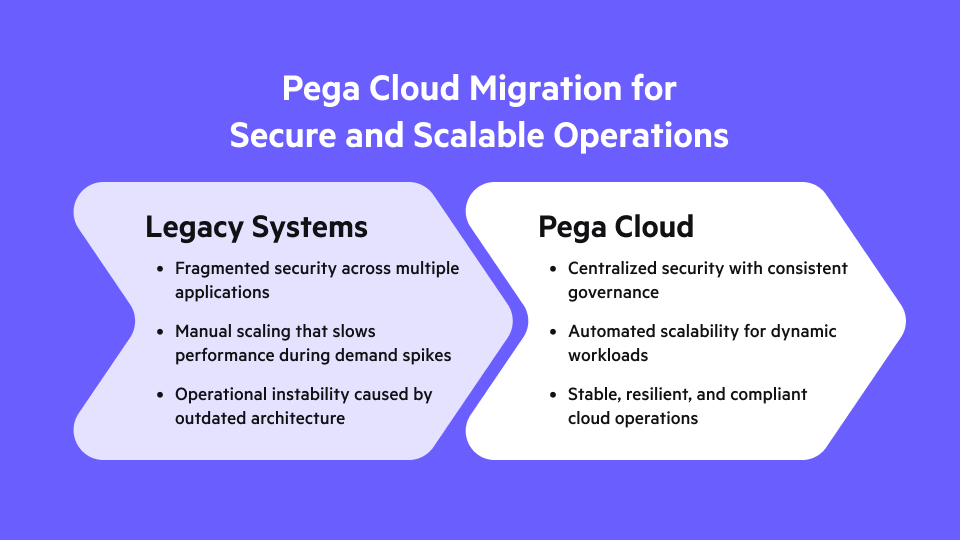
Pega Cloud combines the Pega Platform with a fully managed cloud environment, shifting responsibility for security, scalability, and operational stability away from fragmented application teams and into a standardized platform layer. Instead of each system implementing its own controls and scaling logic, these capabilities are enforced centrally and consistently.
From a security standpoint, the Pega Cloud security eliminates one of the most common failure points in legacy environments: inconsistency. Pega Cloud security is applied at the platform level, ensuring uniform access controls, standardized authentication, and continuous patching across all Pega applications. Security no longer depends on individual deployment decisions or manual intervention, reducing configuration drift and exposure over time.
Scalability follows the same principle. Rather than scaling individual applications manually, Pega Cloud manages capacity at the platform level. This allows workloads to adjust automatically based on demand, without requiring downtime or advance provisioning. For organizations that previously relied on overprovisioning to maintain performance, this directly reduces cost while improving reliability.
For banking institutions, this model addresses operational and regulatory pressures simultaneously. Pega Cloud for banking supports high availability, predictable performance, and auditable controls, critical requirements for customer-facing and back-office systems alike. By standardizing how applications are secured and scaled, banks gain stronger governance without slowing delivery or increasing operational overhead.
Most importantly, Pega Cloud migration reduces the need for specialized infrastructure knowledge. Teams focus on business logic, decisioning, and customer experience, while the platform handles the underlying operational complexity. This shift is what enables true modernization—moving away from fragile, manually managed systems toward a resilient, security-first operating model.
Legacy systems are no longer just inconvenient; they pose operational risks, security exposures, and scalability constraints. For banks, the legacy system risks carry regulatory, financial, and reputational consequences that cannot be ignored.
Pega Cloud migration addresses these challenges by combining the Pega Platform with a fully managed, secure, and scalable cloud environment. By migrating processes incrementally, banks maintain operational continuity, strengthen Pega cloud security, and systematically reduce legacy system risks. Over time, this approach transforms high-risk, rigid systems into agile, governed, and resilient operations, enabling faster decision-making, better customer experiences, and compliance-ready processes.
Evonsys, as a Pega implementation partner, helps banking organizations plan and execute this transition with minimal disruption. With deep expertise in Pega Cloud for banking, Evonsys guides clients through assessment, migration strategy, integration with legacy systems, and platform optimization. The result is a predictable, low-risk modernization path that delivers measurable business outcomes and positions banks to confidently meet future demands.
Planning a cloud migration requires the right strategy and expertise.
Build a Secure and Scalable Future with Pega Cloud.

.png)


.png)